| Global Awards for Excellence | ||
| Austria | Belgium | Cyprus |
| France | Germany | Greece |
| Ireland | Italy | Netherlands |
| Portugal | Spain | Switzerland |
| UK | ||
|
WESTERN EUROPE |
|
Best Bank: Santander |
|
Best Investment Bank: JPMorgan |
|
Best M&A Adviser: JPMorgan |
|
Best Equity House: Bank of America Merrill Lynch |
|
Best Debt House: BNP Paribas |
|
Best Risk Adviser: Deutsche Bank |
|
Best at FX: Deutsche Bank |
|
Best at Cash Management: Deutsche Bank |
|
Best at Project Finance: BNP Paribas |
In Europe, Santander stands out as one of the strong banks to which more has been given. From the crisis that convulsed the banking system in the past 12 months, it has emerged with positions in two of the continent’s largest economies, the UK and Germany, substantially bolstered by acquisitions from failing or retreating competitors.
Before the UK banking system almost collapsed last year, the Spanish bank had already made impressive strides in overhauling Abbey, replacing the bank’s systems so as to reduce the cost-income ratio, thus enabling it to compete for deposits at market-beating rates.
With stable retail funding and strong capital, the bank was able to increase new lending in the UK just as terms and conditions improved for lenders and as other banks were forced to pull back. Abbey’s Spanish owners had held it back from the wildest excesses of UK mortgage lending during 2006. As the market turned, it was able to grab a high market share of good-quality assets secured at conservative loan-to-value ratios.
While many of its large European rivals announced big losses and cutbacks and had to be propped up with state injections of capital, guarantees or other forms of insurance, Santander stood on its own feet. It posted record recurrent earnings, maintained its dividend and strengthened its capital ratios with a €7.5 billion rights issue in the autumn of 2008, the first open-market capital-raising by a large bank following the failure of Lehman.
Santander had launched into a volatile equity capital market that had chewed up and spat out offerings from other banks, pitching them towards disaster. It is a testament to the bank that its own branch network drummed up a core of demand for the offering, including from retail customers that the bank had been switching out of falling markets-based investments back into traditional safe but low-yielding deposits.
 |
|
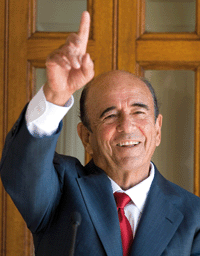
Emilio Botín, Santander: conservatism has stood the bank in good stead |
This is a bank that increased its revenues in 2008 by 10%, at a rate five times faster than its costs. Its market-leading cost-income ratio of 41.9%, based on its back-office Partenon system, now stands revealed as a benefit not just to shareholders but also to customers, enabling the bank to absorb rising credit costs and still pay customers for deposits, and enabling it to continue with the basics of banking that are now beyond many of its competitors. So when the UK authorities were looking around for strong arms into which to fold teetering Bradford & Bingley and Alliance & Leicester last year, Santander appeared as a saviour.
But the Spanish are tough and wily negotiators, as others have found. This was never a bank likely to poison itself – as Lloyds did with HBOS – by hastily ingesting a cheap and tasty-looking offering only to be struck down by a hidden core of rotten loans. Santander knew exactly what it wanted with these deals. It was buying cheap deposit funding and liquidity.
While other banks have cut back in the UK, Santander – soon to be operating under a single brand – has grown a substantial share of customer deposits and mortgage and SME lending. Watch it motor from here.
In Germany, Santander picked up the consumer finance operations of RBS and GE as their own problems forced them to retrench. Although it doesn’t have the same kind of branch network it boasts in the UK and Spain, it doesn’t want one in the low-margin German retail market. It still reaches well over 6 million customers in Germany. Its earnings are comparable to those of Commerzbank.
At home, the Spanish economy looks vulnerable but the bank has not been badly hurt so far, partly thanks to a conservative risk management culture, partly thanks to the lessons absorbed by Banco de España during the Spanish banking crises of the 1980s and 1990s that instilled a disciplined monitoring of credit and liquidity exposure. Santander has been required to build generic provisions through the good times.
It remains to be seen how well it will manage to maintain good rates of recovery on problem loans. It has one advantage over many of its competitors: it at least knows the borrowers to which it lent. It is not scrabbling through thousands of lines inside structured credit exposures to underlying borrowers with which it has no contact.
Put together the number-one-ranked M&A adviser, the second-ranked equity capital markets bookrunner and a top-six firm in debt capital markets and you have a very powerful investment bank. House all that inside one of the few large banks in the world with such a strong balance sheet that it did not to have to run to the taxpayer for support and it all looks even more impressive.
It is a testament to JPMorgan’s financial strength, long-standing client relationships, geographic reach and industry sector expertise that it out-muscles the largest European investment banks on their own turf.
The firm’s rivals will complain that it wins business on the back of its balance-sheet strength, as if this is some kind of underhand practice not to be countenanced in polite company. JPMorgan’s European executives laugh at the accusation. Of course, they say. They all signed up for the integrated investment bank model: they believe in it and use it.
Europe’s premier home-grown investment banks, such as Deutsche Bank, Barclays Capital and even Credit Suisse, have built large markets businesses trading rates, FX and other instruments, rather than leading with corporate finance advice. JPMorgan has a much longer tradition in that area, reminiscent of firms such as Lazard and Rothschild but much stronger financially.
 |
|
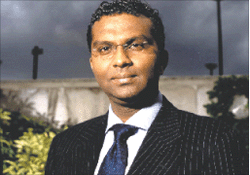
Viswas Raghavan, JPMorgan: muscling out the Europeans at home |
Even after all its years doing corporate finance work in Europe and nurturing relationships, JPMorgan is still happy to use any means to win new business. Lazard is the long-standing adviser to InBev and had worked with its client for months on the protracted and ultimately unfriendly bid for Anheuser-Bush in the US. JPMorgan was called in as an additional adviser by the Belgian company last year. Its tactical M&A advice, insights into the credit markets and willingness to underwrite finance helped deliver the prize of the iconic US company in the largest ever all-cash M&A deal.
JPMorgan has advised on most large deals over the past 12 months in the UK, Germany, France, Benelux, Spain, Italy and the Nordic region. It represented British Energy on its agreed $23 billion acquisition by Electricité de France and then represented EDF in turn on the French company’s $6.5 billion acquisition of Constellation Energy’s nuclear generation business. It advised Continental of Germany on its $34 billion acquisition by Schaeffler. In Spain, it advised Citi Infrastructure on the $13 billion acquisition of Itinere Infraestructuras from Sacyr. In Italy, it advised Enel on the acquisition of a 25% stake in Endesa from Acciona for $14 billion.
It has done its fair share of financial institutions business, advising Alliance & Leicester on its $2.5 billion sale to Santander. It also advised the Spanish bank itself, Europe’s best bank and smartest principal player in financial institutions M&A, on its own $1.9 billion acquisition of Sovereign Bancorp in the US.
And its help has been sought in equity capital markets by other strong banks. It worked closely with HSBC in the run-up to and execution of its £12.9 billion rights issue, a deal which, had it faltered, might have choked off the recovery in the banking industry in the second quarter of this year before it had properly begun. JPMorgan also executed a crucial $2.6 billion rights issue for Nordea this year, the largest ever in Sweden and second-largest ever from the Nordic region. Nordea cemented its position as the region’s most strongly capitalized bank even as markets were beginning to fret about the problems brewing in the neighbouring Baltic states.
In the energy sector, JPMorgan advised RWE on the acquisition of Essent for $12.6 billion, demonstrating to a nervous market at the start of this year that large acquisition financings could still be done.
It has advised governments such as the Kingdom of Sweden on its divestiture of Vaskronan for $6.8 billion and it has advised those seeking investment from governments, such as Lloyds Group on its $22 billion capital increase by the UK Treasury.
The strength of the old Merrill Lynch equity franchise is evident from its position at the top of the ECM league tables in Europe, over a tumultuous 12-month period in which Merrill came close to collapse following the failure of Lehman Brothers, was quickly bought by Bank of America, had its chief executive sacked when the firm disclosed further huge losses to its new owner and faced staff outflows as many of its surviving senior executives left in disgust.
In European ECM, the takeover by Bank of America was less of a distraction. The US bank did not have an ECM presence in Europe and, undistracted by fears of job-cutting, members of the old Merrill team went about their business. It’s as well for many of Europe’s banks that they did. The firm has been prominent in the arranging and placing of many large deals that have kept the heads of the continent’s leading banks above water.
In November 2008, even Santander must have been concerned when three global bulge-bracket firms turned down the invitation to work on its $9.3 billion rights issue owing to severe cutbacks in their own risk-taking capacity. Bank of America Merrill Lynch stood firm and underwrote two-thirds of the deal. That is testament to its secondary market franchise. Amid all the woes that have beset Merrill, it is sometimes forgotten that it boasts one of the leading equity distribution and trading platforms in European stocks.
Earlier this year it underwrote, jointly with JPMorgan, two-thirds of the $3.7 billion rights issue for Nordea, reopening the European equity capital market for bank issuers. Bank of America Merrill Lynch helped develop pricing of the deal at a 43% discount to the theoretical ex-rights price, ensuring overwhelming take-up. Nordea stock traded up 45% from announcement to closing as investors bought into the rationale for the deal, realizing that it would give the Swedish-Finnish bank one of the highest core tier 1 equity ratios of any bank and that this would be sufficient to insulate it against growing problems in the Baltic states, which account for just 3% or so of its loan book. It was a deal that helped position the issuer as a likely winner in a crisis-hit industry.
Bank of America Merrill Lynch also reopened the equity capital markets for non-financial companies in January, readjusting the capital structure of Scottish and Southern Energy with a $703 million accelerated deal executed in just a few hours and placed with high-quality long-only and sector specialist investors. The deal bolstered the balance sheet of an already strong company, allowing it to consider small-scale, opportunistic M&A openings.
And Bank of America Merrill Lynch has been prominent in the rights issues with which other UK industrial and property companies such as Cookson ($366 million) and Segro ($812 million) rushed to restore their balance sheets at the start of the year.
BNP Paribas has used the strength of its balance sheet to power ahead of most competitors in the European debt capital markets. Following the collapse of several banks, borrowers and counterparties are understandably asking the question: is this institution going to be around, in a similar form, in five years’ time? The narrowing of the playing field has certainly benefited strong double-A-rated banks in the debt sector such as BNP Paribas. For Western Europe in euro, sterling and Swiss francs, BNP Paribas is marginally ahead of last year’s winner, HSBC. It has more than its fair share of landmark corporate deals such as Roche and ABinBev. It helped drive key trends such as government-guaranteed bonds and it was a leading underwriter for the public sector via its participation in the SFEF funding programme, where it was involved in every deal for the French entity.
Deutsche Bank distinguished itself in the past year in risk management by continuing to make markets in derivatives products and by not following other firms into sudden rises of 400% or more in margin requirements for customers. It remained the leading market provider of credit risk protection through the most troubled months for the credit markets and the banking industry, executing several client trades of €1 billion and even one of €2 billion, even as other market makers withdrew. It provided a similarly consistent and dependable presence in rates derivatives.
 |
|
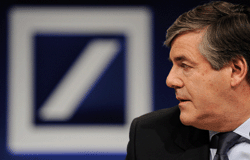
Josef Ackermann, Deutsche Bank: top in risk, FX and cash management |
When many other banks were scaling back their FX market making, particularly in September and October 2008, Deutsche Bank maintained its presence. In fact it was able to raise its liquidity profile during these difficult months as it fitted in with a new business model based on flow products. This shift means the FX business has further evolved from simply market making to a solutions-driven approach for corporate clients that need to address the rise in currency volatility. Deutsche also provided good calls on the market’s overall direction, with its research team advising clients to sell euro versus the dollar in June ahead of the move later that summer. It raised the bar by pioneering new FX indices that gave fresh opportunities to market players and end investors. In a similar vein, Deutsche offered many new FX-linked investment products, confirming the trend of FX being viewed as an asset class. The increase in currency volatility also made hedging more expensive than in previous years, with premiums on plain vanilla options elevated well beyond 2007 levels. Not only did the bank employ more strategies that enabled clients to pay lower up-front premiums, it also used the credit support annex (CSA) concept-widely used in the credit and rate sectors – in support of FX. CSAs allow clients to use collateral other than cash as margin for transactions.
In cash management, Deutsche Bank benefited from the flight-to-quality effect of the financial crisis. On the corporate side of its business, transaction volumes increased by 128% in the first quarter of 2009, while the value of mandates rose by just over 100% compared with the first quarter of 2008. Deutsche Bank is by far the largest euro clearer, with double the volumes of the next competitor on the Eurosystem settlement platform Target2. The bank has invested in its cash management business, launching a new integrated FX and payments processing platform called FX4Cash that allows both corporates and financials access to payments in 120 currencies while using a single funding account, combining FX trade and settlements aspects of processing into a single flow.
BNP Paribas had a strong year in project finance in Western Europe, being instrumental in some of the key transactions in the region. Its business ranged from traditional infrastructure assets – such as financial adviser to the Liefkenshoek Tunnel deal in Belgium and the A150 motorway in France (which is now out to tender) – to waste energy and renewables. The French bank was MLA and sole underwriter and bookrunner on the Trattamento Rifituti Metropolitani (TRM) waste-to-energy project in Turin, which was the largest ever project finance deal in Italy sponsored by the public sector and the first time the European Investment Bank has taken construction risk on a project in Italy. It was also mandated lead arranger on the IP Maestrale €1.29 billion windfarm deal in Italy and the £330 million Fred Olsen wind holdings deal in the UK.


