|
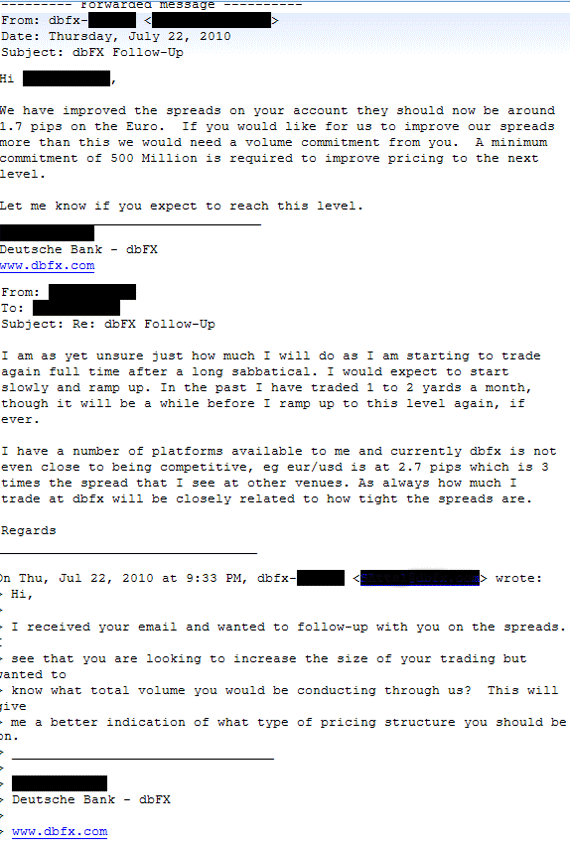
We received an email from a disgruntled dbFX customer this week, claiming that Deutsche’s spreads weren’t nearly as tight as claimed on their website. Judging by a sample of emails that we were passed (we have blanked out the names in the spirit of fairness), our correspondent was rather shocked to discover that he was being quoted 2.7 pips on EUR/USD. After pointing out that the spread was three times as wide as many other platforms, dbFX brought it down to 1.7, then helpfully noted that in order to receive anything tighter, he would have to commit to trading $500 million a month! How much volume our correspondent was trading at the time is unclear – he talks about slowly building up to some fairly big sums. Whatever, it is safe to assume that it was more than the £65 in my spread betting account where I can trade EUR/USD at 2 pips. A look at the dbFX site reveals EUR/USD spreads “as low as” 1.7 pips. There is also a footnote that reads: “Prices are derived directly from the FX market and will fluctuate according to natural changes in volatility and liquidity. All dbFX clients receive the same pricing, unless they are active traders using a custom solution.” We put in a call to Deutsche Bank to find our what was going on. They told us that, as with their institutional offering, it depends on liquidity, the client, volume, hedging ability – and that greater volumes could lead to tighter spreads. I thought Deutsche Bank was one of the biggest banks in the world with deep pools of liquidity. Surely that’s one of the reasons why it has come first in the Euromoney FX survey five years in a row. Why should it depend on the client? Orwell’s Animal Farm springs to mind: “All clients are equal, but some are more equal than others”. These days offering a client a 2.7 spread in EUR/USD is extremely wide; even 1.7 pips, while not wide enough to drive a bus through, doesn’t look competitive when the true market price hovers between 0.3 and 0.8 on a normal day. Perhaps Deutsche Bank would like to take a look at this handy tool – plenty of retail players are. Among other popular retail platforms, Forex.com’s website quotes EUR/USD as low as 0.9 but is typically 2.1 – still pretty wide. When asked about receiving something a bit tighter, Forex.com said: “We offer slightly tighter spreads to our clients who have an account balance of at least $50,000. Everyone else sees the same spreads. Approximately 50% of our quoted prices are at the typical spread or better.” Over at Oanda, EUR/USD is quoted at 0.9 pips, fixed during “normal market conditions,” they say. “Our FXTrade offers tight spreads to all traders with no discrimination. Our posted spreads are our standard spreads, except when market liquidity just isn’t available to us (for example, during market events or weekends).” FXCM quote 2 pips on EUR/USD – again fairly wide considering it has NDD, which should allow it to offer lower prices. So, the moral of the story is that all that technology doesn’t necessarily make for tight spreads. Or, as Deutsche Bank summed up so well for us: “Shop around”.
|
Related

Redefining treasury: modernising payments to unlock strategic growth
Sponsored by HSBC
Redefining treasury: modernising payments to unlock strategic growth
Sponsored by HSBC