
Awards for Excellence 2018
|
|
|
Also shortlisted |
BAWAG |
Commercial International Bank |
| View full 2018 results |

It can be hard to believe today that barely three years ago analysts were predicting the demise of Raiffeisen Bank International’s central and eastern European empire.
As the Austrian group posted its first ever full-year loss for 2014 and faced increasingly insistent questions from regulators about its meagre capital base and hefty exposure to Russia, many felt that the only way back would be through a drastic reduction of its sprawling regional network.
Instead, RBI has emerged in better shape than at almost any point since the financial crisis. Profitability, while not back to the glory days before 2008, is healthy. Return on equity last year came in at 12.2%. More importantly, this is now based on solid foundations in the form of a comfortable capital cushion.
What is more, contrary to expectations, this recovery has been achieved without any big changes to RBI’s business model or drastic reductions in geographical coverage.
The group still boasts subsidiaries in 14 CEE markets, including a sizeable operation in Russia. All are profitable and most are growing at a healthy rate. Six were named as best bank in their respective countries in this year’s Awards for Excellence, including Raiffeisen Bank Aval in Ukraine.
The key to RBI’s turnaround was a restructuring plan formulated in February 2015 by former chief executive Karl Sevelda. This involved a streamlining of the group’s operations, with exits from peripheral businesses in Asia and the US, and the sale of subscale operations in Slovenia and Poland, along with a reduction in risk-weighted assets in markets including Ukraine and Russia.
Johann Strobl, RBI’s chief risk officer during the restructuring and Sevelda’s successor as chief executive, says the most challenging part of the transformation was making the case for it internally.
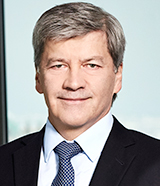 |
| Johann Strobl |
“Our business is focused on multinational customers and our ambition was always to serve them in all markets, so to convince the organization that we needed to pull back from things like trade finance in Asia was tough,” he says.
With that hurdle cleared, however, RBI’s management was able to act quickly. Within a year buyers had been found for the Slovenian operation and 30% of Ukrainian subsidiary Raiffeisen Bank Aval, while the rundown of non-core assets was well underway.
By mid 2016, the group was firmly back in profit and the target common equity tier-1 ratio of 12% had been surpassed 18 months ahead of schedule. By the end of last year it had reached 13.6%.
“There was a lot of scepticism about the restructuring programme at the beginning, particularly from the markets, but we are strong in execution,” says Strobl. “We managed to divest non-core assets and reduce exposure to other markets with little if any impact on our revenues and P&L, and we did it faster than anyone thought possible.”
Intensive work on asset quality also produced impressive results, with non-performing loans falling to just 5.7% of total lending by the end of December versus 11.9% two years earlier.
The only big stumbling block to full implementation of the restructuring plan came in Poland, where regulatory requirements repeatedly stymied attempts to sell or list Raiffeisen Polbank. This issue was finally resolved in early April, however, when BNP Paribas agreed to buy the lender for €775 million.
Meanwhile, back in Austria, the merger of RBI with its unlisted holding company, Raiffeisen Zentralbank (RZB), in March 2017 had lifted restrictions on the group’s ability to raise capital via the public markets.
As well as strengthening RBI’s financial position, the successful completion of the transformation strategy has allowed the group to refocus on growth and innovation. Last year saw impressive results from target markets where RBI is looking to strengthen its position, including the Czech Republic, Bulgaria and Serbia, boosted by substantial investment in digitalization.
The group has long boasted a regional technology leader in Slovakia’s Tatra Banka and is now working to build similar competencies across the rest of its CEE network. In keeping with RBI’s traditional bottom-up approach to innovation – what the group calls a ‘think big, start small’ model – much of this work is taking place at local level.
Strobl has also championed a more coordinated approach to development, however. One of his first actions after taking over as chief executive in March 2017 was to launch RBI’s first accelerator programme, Elevator Lab, in Vienna. The initiative, which is just entering its second season, is designed to harness the potential of later-stage fintech startups.
Further challenges for RBI’s CEE network may lie ahead, whether in the form of political turbulence, internal market upheavals or the knock-on effect from monetary tightening in the developed world. If they do, however, the group will be in a much better position to meet them than it was three years ago.
“I’m fully confident that our business model is now crisis-proof, in so far as that is possible,” says Strobl. “It maybe took us a little bit longer than others to build up our capital base, but it meant that we were able to do it without destroying value. We now have both the elements necessary for success: strong capital but also earning capacity.”



