|
|
|
View the Euromoney 25 |

HSBC has been transformed in the last seven years under the leadership of chief executive Stuart Gulliver and former chairman Douglas Flint. Those two veterans of the group took on its leadership in 2011 and overhauled a sprawling collection of separate banking franchises that previous management had rapidly accumulated in the years before the financial crisis.
HSBC had become too complex to manage, as became painfully clear in 2012 with the US Senate Permanent Subcommittee on Investigations’ report into its banking of Mexican drug cartels. But it was also too inefficient to reward shareholders and risked losing relevance to customers.
And 2017 was the pivotal year in which the benefits of this overhaul became clear to shareholders.
Under Gulliver, HSBC has exited 97 businesses, folded its tents in 20 countries, cut $309 billion of risk-weighted assets, brought the swollen balance sheet of $2.7 trillion down to $1.9 trillion, shed 65,000 full-time employees and attacked the bank’s costs.
Much of that work has been going on behind the scenes, such as centralizing IT. “The biggest transformation has been moving HSBC from a loose federation of stand-alone businesses in which the country heads were ‘kings’, operating their own franchises, their own IT systems, their own processes for account and credit-card handling, their own internet and digital channels,” Gulliver told Euromoney last July, “to a group of four truly global businesses, each consistently overseen and properly controlled from the centre, with far fewer systems, much greater economies of scale and each implementing global standards for financial crime risk management.”
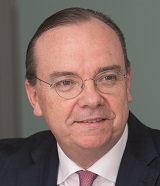 |
| Stuart Gulliver |
In the third-quarter results last year, HSBC delivered a return on tangible common equity of 9.3%, up from just 5.3% for the same period a year earlier and tantalizingly within sight of the 10% target Gulliver set out for investors back in 2015.
Back then HSBC promised investors it would cut annual running costs by between $4.5 billion and $5 billion. It has already passed this mark and is on track to achieve $6 billion of annual cost cuts, with the end of spending to achieve this in sight. The cost/efficiency ratio was down to 63.8% in the third quarter of 2017 from 70.2% a year earlier. Group return on risk weighted assets hit 2.3%, up from 1.3% 12 months earlier.
Always excessively conservatively funded and strongly capitalized, HSBC is beginning to tilt benefits towards shareholders. It has already supplemented regular dividends with one big share buy-back.
The ratio of loan advances to customer deposits is finally picking up – to 70.7% up from 67.9% a year earlier – as the commercial banking unit in particular enjoys strong loan growth in Asia. Loan impairment charges are miniscule. The pivot to Asia seems to be working.
The global banking and markets division has found a path to profit that distinguishes it from many universal banks still struggling to wring acceptable returns from volatile equities earnings and reduced FICC revenues. Its transaction banking products continued to benefit from higher balances and higher spreads on deposits in the first nine months of 2017, particularly the Global Liquidity & Cash Management business, which grew revenues by 19% over the year before.
According to Rohith Chandra-Rajan and Aman Rakkar, analysts at Barclays: “This reinforces our view that HSBC can finally return to revenue growth in 2017, for the first time since 2007, and that this is a base on which it can build.”
Time will tell. HSBC releases its full-year 2017 results on February 20.
By then, investors, customers and employees will be increasingly curious to know what the new leaders of HSBC intend to build on the base that Gulliver has buttressed for them.
Mark Tucker, for years the driving force behind AIA’s rise to leadership in Asian insurance, took over as chairman on October 1 and was soon into his stride, appointing HSBC lifer John Flint, former group treasurer, head of strategy and head of retail banking and wealth management, as the next chief executive when Gulliver leaves in February.
There is plenty still to do.
HSBC has devoted $2.1 billion to digital without yet achieving much of great note. In November, it appointed Mike Warriner, formerly engineering director at Google, as chief information officer of Retail Banking and Wealth Management to set its digital platform strategy.
At the third-quarter results, finance director Iain Mackay was defending this investment to investors as the place where the bank might expect returns to be highest.
More troubling would be any sign that Tucker hopes to make his mark by any renewed dash for profit growth based on ambitious, ill-judged and potentially capital destructive acquisitions. Given its past history, shareholders will have shifted nervously in their seats at unconfirmed rumours that the new chairman may have been looking at acquisitions of US credit card companies.