 |
| Illustration: Paul Daviz |
|
IN ADDITION |
|
Many costly man-hours have been expended determining exactly how asset managers in Europe should manage the research payment accounts (RPAs) that they will soon be required to set up under the Markets in Financial Instruments Directive (Mifid) II, the EU regulation that will unbundle research costs from execution and trading.
RPAs must be funded by specific research charges billed to asset managers’ end-client investors. The equity markets, which have traditionally paid for research as part of commission-sharing agreements (CSAs), will now have to fund the RPA using revised and stricter CSAs or set up a separate research charge to clients instead.
In fixed income, where the costs of research and execution have always been a blended part of the price of the security, the fiendish challenge of how to manage an RPA has become a billion-dollar question.
As the January 3 deadline to comply with the new rules looms, many asset managers appear to have found a straightforward answer to how to charge investors for the third-party research used in managing their money – don’t do it at all. Many fund managers have decided that dealing with an RPA is just too difficult and they will now pay for research themselves from their own P&L.
The balance may have been tipped by the announcement in early August that US asset manager Vanguard, with $4.4 trillion of assets under management, plans to absorb its own costs of research. The news prompted wild speculation about how much this would cost the investment house, but once the dust settled, Vanguard itself reckoned it would be around $5 million – peanuts for such a large firm.
Once firms of this size have so publicly laid out their course, it becomes very hard for other asset managers to swim against the tide.
|
|
|
Jon Foster, |

“Competitive dynamics will dictate what happens here,” says Jon Foster, co-founder and chairman at Smartkarma, the research aggregator. “It is fairly obvious why large asset managers have opted to go the P&L route. The cost of administration of an RPA would be very onerous and expensive, and the relative cost of buying research onto the P&L is small.
“This will roll through everyone and become part of the competitive landscape,” he tells Euromoney. “I think that this is ultimately, in the long run, the best outcome. Everyone is much more responsible and commercial when they are spending their own money. This is probably where the regulators wanted it to get to.”
The unexpected
This is not what everyone expected to happen, however.
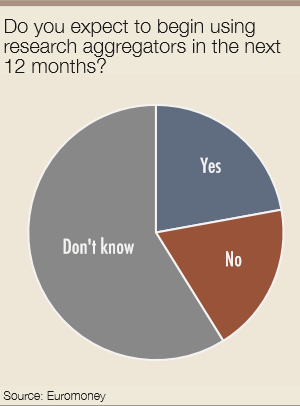
When Euromoney asked asset managers if they would pass on the costs of research to clients as part of our 2017 fixed income research survey in May, 32% of the 2,259 respondents believed that this would be the case. Around 26% disagreed, while fully 42% still had no opinion on such an important matter.
 |
It is very much easier for large firms to absorb the cost of research than it is for smaller ones to do so.
Firstly, the complexity involved for a firm such as Vanguard to charge each client for research that has been relevant to their own portfolio’s performance is mind boggling – it is not surprising that they have decided not to bother.
Secondly, research is relatively far more affordable for larger firms: an asset manager with $1 trillion AuM does not have to pay 1,000 times more for research than an asset manager with $1 billion AuM in order to manage that money.
“At the beginning of the year, there was a 50/50 split between asset managers adopting a P&L or RPA approach,” reckons Mahesh Natayan, head of portfolio management and research for Thomson Reuters. “Now it is more like 75/25. In just the last two weeks, big firms have moved from the 25 to 75 camp.”
That momentum may now be unstoppable.
On September 1, when the Financial Times published a review of how asset managers planned to pay for research, the newspaper reckoned that eight firms were planning to pass costs on to clients, 24 were to absorb costs, 19 were undecided and 5 declined to comment.
When it updated its findings on September 19, however, the number of asset managers firmly planning to pass costs on to clients had shrunk to just three, with two firms previously committed to this route now declaring themselves undecided. The number of firms planning to absorb costs had jumped to 47, while undecideds had fallen to 11. The same five firms refused to answer: the asset management divisions of Credit Suisse, Goldman Sachs, Investec, Morgan Stanley and State Street.
Goldman has subsequently confirmed that it will absorb research costs in its $1.4 trillion asset management arm.
Many more investors will likely run with the herd.
 |
|
Vicky Sanders, RSRCHXchange |
“It feels like the undecided people have leaned towards P&L recently,” says Vicky Sanders, co-CEO at research aggregator RSRCHXchange. “Asset management is a highly competitive industry, so if there is going to be a disadvantage to attracting new assets by passing on research costs then they need to consider this. When very large firms announced that they were taking the P&L route it affected the whole industry.”
Euromoney contacted Amundi, Europe’s largest asset manager, for this article. It is one of the firms which on September 1 was down as passing costs on, but, along with BNP Paribas, by September 19 had reverted to being undecided.
Other firms to have changed tack include Janus Henderson and Invesco, who have now opted to absorb costs – although the latter had previously stated that passing costs on was its preferred approach.
Amundi’s PR agency told Euromoney that the asset manager had reviewed its position “in light of the Pioneer acquisition”. This seems curious as Amundi had announced its merger with Pioneer in December last year and the deal was complete by July 3 – two months before the initial Financial Times survey was published.
Similarly, when Euromoney conducted its fixed income research survey this time last year, Legal & General Investment Management had decided to pass research costs on to clients and had implemented a new fee structure from April 1, increasing fees by up to 15 basis points, depending on the mandate, to reflect the cost of research.
When contacted by Euromoney, an LGIM spokesman confirmed that the asset manager had “moved on” from this position and will now pay for research from its own P&L.
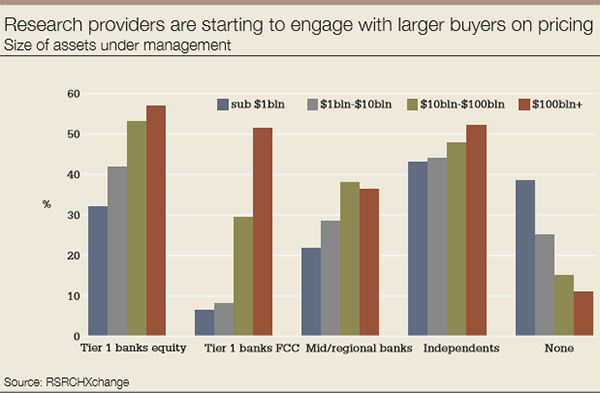 |
It appears inevitable that the larger asset managers will bow to competitive pressure and absorb their research costs, but this will not necessarily be the case at the smaller and more specialized end of the market – partly because an RPA will be far more straightforward for these firms to manage.
“It is quite hard to draw a line between which type of fund should do what,” muses Sanders. “If you are an organization that doesn’t have so much complexity, then running an RPA isn’t so difficult. You can still charge clients if you can show that it increases performance. The hedge funds that we speak to are still looking to charge clients.”
Foster at Smartkarma agrees, but still sees a risk for fund managers even at this level: “If you can get away with arguing that you are very specialized and you are adding alpha, then maybe you can get away with charging for research. The cost of research may be basis points, but it could be the difference between you getting an investor’s money or not getting it and it going to someone else.”
Nigel Jenkins, managing principal at asset manager Payden & Rygel, believes there is another, more important, aspect to this argument that is often ignored.
“For us, anything other than us absorbing the cost of research was never considered as we are fixed income-focused: it would be very difficult to establish who used what across 50 different portfolios. But also paying for research out of our own resources seems to us to be the right thing to do,” he says. “We charge a fee to clients. It is transparent and covers all of the costs that we incur. Research is just another cost of doing business. Even if there was an easy way to charge we would not do it because it is not the right thing to do.”
Payden & Rygel has $110 billion under management.
Mystery
While the fog may now be clearing as to how asset managers will pay for research, exactly what they will end up paying is still something of a mystery.
Sell-side firms must charge for research that is substantive – defined by the FCA as being capable of adding value to investment or trading decisions by providing new insights that inform decisions. It must include original thought, new and existing facts and must not repeat previous work. It must have intellectual rigour and present meaningful conclusions. If research meets these criteria it must be paid for.
The question is: how much?
Banks provide research as an inducement to asset managers to trade with them and pay commission or spread. For investment banks, the cost of providing research is clear, but the value it brings is harder to specify and the instinct to cross-subsidize will be strong. Research that is not substantive and is deemed to be of minor non-monetary benefit can be provided free of charge.
Some banks will charge asset managers just enough for their research to be credible, others may seek to charge enough to actually run a viable research business.
Several banks are considering the Danish model, where written research is available for free on a portal but access to analysts will be chargeable.
Credit Suisse is taking this approach and will make access to most of its research free to institutional investors. It will charge for analyst time, however.
The amount of time and energy that we put into producing research means that it would not make sense if it was not deemed to be valuable – Jeff Meli, Barclays
Banks opting for this model are relying on the premise that fixed income research will be deemed of minor non-monetary benefit if it is available to all investment firms or the general public. Others such as Danske Bank, RBC, BNP Paribas and RBS are also believed to be taking this approach.
The alternative route is to charge clients for what they use. There has been a range of prices mooted for both basic and premium research packages, but it is almost impossible to compare like with like and get any kind of idea yet what different investors will be paying.
“The approach that the investment banks have taken to this issue is very diverse,” Jenkins points out. “There are a myriad of pricing models and levels of pricing.”
He says that the highest price his firm has been quoted for annual access is $100,000, but “the level of sell-side pricing has been coming down consistently since January or February. Prices started coming down when it became clear some banks would provide research for free and clients were not prepared to pay the prices they were initially quoting.”
One bank that will take the latter approach is Barclays.
 |
| Jeff Meli, Barclays |
“We are planning to charge for research,” Jeff Meli, co-head of research at the bank, tells Euromoney. “We run an institutional research model globally, which means that our research can only go to institutional investors not onto a free portal under the Finra [Financial Industry Regulatory Authority] rules. Well-written, impactful fixed income research is valuable. And it is more valuable when it is not distributed widely. The amount of time and energy that we put into producing research means that it would not make sense if it was not deemed to be valuable.”
If most asset managers choose to absorb the cost of third-party research as a hit to their own margins, they will be much more discerning in what and how much they buy. The one thing that does not seem to be up for debate when it comes to fixed income research after Mifid II is that there will be much less of it.
In June, McKinsey & Co estimated that Mifid could cut equity research revenue by 30% over the next three years. The impact on fixed income will be far more extreme. Unsurprisingly, 68% of respondents to the Euromoney survey will cut the amount of research they consume post-Mifid II, while just 8% said that they would not.
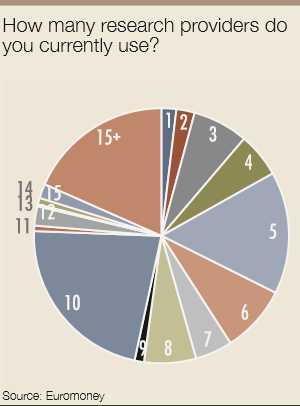 |
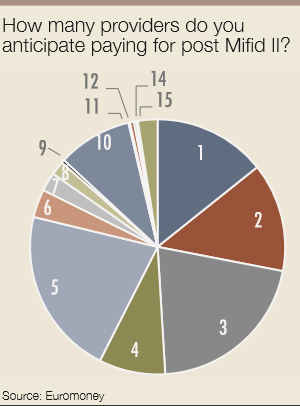
Around 15% of respondents currently use five research providers, 22% use 10 and 18% use 15 or more. After the January introduction, this is expected to change to 21% using five providers, 9% using 10 providers and just 2.5% using 15 providers or more.
John Dwyer at Celent argues that Mifid II will drive the market in three directions: boutiques offering specialist research at premium pricing; momentum players that will offer broad sector coverage; and research aggregators that will connect the long tail of both the buy and sell side. The latter will offer research either as a product – where the price is determined by the analyst on a per report basis – or as a service, where subscription-based pricing will give end users access to all research on a platform.
Few mourn
For now, few on the investor side mourn the fact that they will receive less research.
“We will not get research from about 50% of the providers that we do now going forward,” says Jenkins. “If we felt that this would have an impact on alpha generation then we would pay for it – in relative terms the cost is not that great. Our market ideas, positions and trades are our own. We are not looking to research for trade ideas. We want it to give us a diversity of views and to benchmark our propositions.
“Historically there has been so much research that you might miss out on taking notice of the best. As long as we have access to a diversity of views, the impact on our business of the research aspect of Mifid II will be minimal,” he declares. “The changes will have absolutely no impact on alpha generation.”
That is not, of course, what research providers want to hear.
Foster at Smartkarma believes that not everyone will decide to use less research post-Mifid II; rather they will consume research in a different way.
“It has been assumed that if investors have to pay, then everyone will buy less research and make worse decisions,” he says. “But I am pretty confident that not everyone will decide to be worse at their jobs. There is enough margin in this business to keep it efficient.”
And his belief is that platforms such as Smartkarma are where that money will be spent.
 |
Jenkins agrees that his firm is likely to use more independent providers: “We have been a sporadic user of independent research in the past, but Mifid II has pushed us towards looking more intensely at independent providers.”
Unsurprisingly, bank research providers believe that predictions of their product’s early demise are very wide of the mark.
“Sell-side research providers have a lot of consumers of their research,” points out Meli. “They have internal sales and trading, corporates and global clients that are not subject to Mifid II. The total amount of cost that we therefore need to defray as a result of the regulation is a fraction of our overall cost of production.”
US banks and brokerages are now lobbying the SEC to waive the requirement that they would have to register as investment advisers in order to provide research to European asset manager clients. Several large US pension funds have made public their desire to see such a waiver across the board so that they can receive research on a standalone basis as well, levelling the playing field.
They believe that they are at a disadvantage if European end investors know what they are paying for research and they do not (although if most asset managers absorb these costs they still won’t). They also probably believe that bringing standalone research costs under the spotlight means that they will fall a lot in the US as well.
“I am not surprised that the banks were trying to protect their existing pricing,” says Foster. “Now they have given up and said we can’t have closed door pricing. I am not surprised it is chaotic.
“The end game of unbundling is that research becomes a separate function altogether. We are talking about separate, independent research providers. This removes all complexity around inducement. When research is provided as part of a broker/bank it is a minefield. If you take this through to its logical conclusion then banks will not provide research,” he claims.
However, the onus for setting the upfront price for research rests with the research provider and it is clear that this process is not well advanced. In the RSRCHXchange survey in June, 23% of respondents had received no pricing information at all.
Rumours of pricing metrics have been buzzing around the market all summer.
Crédit Agricole is understood to have offered a basic and premium package for fixed income research of €60,000 for reports and €120,000 for direct access to analysts. Nomura has been quoted as charging around $140,000 for its premium service. JPMorgan is believed to have quoted as little as $50,000 for its basic fixed income package.
Investors are still surprised to learn that it is their responsibility to identify substantive research. They need to know that it is up to them – Vicky Sanders, RSRCHXchange
All of these figures should be taken with a large pinch of salt as the situation is still so fluid. Euromoney contacted the banks involved, but they declined to comment on their pricing strategies.
“Pricing is still opaque but we are seeing some data points emerge. We will start to see some coalescing,” says Natayan at Thomson Reuters. “People are not as prepared as they should be, but they are much better prepared than they were three to six months ago. There will be a race to the fourth quarter,” he predicts.
How much is an hour of an analyst’s time worth?
On professional networking site The Expert Network, an hour of an expert’s time can cost between $750 and $1,000: are banks really going to seek multiples of that for an hour of an analyst’s time?
Sanders likens the emerging research business model to the music industry.
“In the music industry, tickets to see a show are priced at a huge premium to just listening to the existing recording,” she says. “We are seeing this mirrored in financial services, where investors will pay up for access to the analyst.”
The ability of even the most insightful report to generate alpha will fall over time – accurately valuing it is therefore very challenging.
The worth
While investment banking providers need to set a price for research, investors themselves are responsible for identifying the worth of the research they use. The same piece of research with a single cost of production may have different value to different consumers. This presents another, less flattering musical parallel: sell-side research providers as buskers, their clients determining how many coins to toss into the hat.
“Investors are still surprised to learn that it is their responsibility to identify substantive research. They need to know that it is up to them,” says Sanders. In such an unclear environment, how can they accurately predict what they will spend on research? Vanguard reckoned it would spend $5 million, while some independent analysis determined that it would cost them closer to $100 million. That is a hell of a lot of somewhere inbetween.
When RSRCHXchange asked investors what was the biggest challenge to compliance with Mifid II, nearly 40% of respondents said that it would be setting and regularly assessing a research budget. Indeed, when investors were asked if they had set a research budget, 32.7% still had not, while 39.7% were in the process of doing so. Just 22% had already set a budget for consumption.
“Clients are in two camps: those that differentiate by quality and those that don’t,” explains Meli. “The process has been smoother with those in the first camp, whereas the progress with the second is more difficult given the diversity of research models on the sell side. We believe there will be enough clients differentiating by quality to support more robust offerings.”
In July, Bloomberg reported that Barclays would be offering three packages for its equity research – bronze, silver and gold – at a price that could range from £30,000 ($40,250) to £350,000 a year. However, these figures apply to small to medium-sized European clients only.
“The full price ranges vary widely and resources for larger European clients are valued materially higher, reflecting the higher level of service they will receive,” a Barclays spokesperson tells Euromoney.
“It is hard to say what percentage of our revenue stream is impacted by this,” Meli says. “Research unbundling is only part of Mifid II. We don’t know how client trading might be affected by unbundling research. To what extent will investors change their behaviour in ways that make them more price sensitive? Research may eventually need to stand on its own, which is the goal of the regulation. If this happens, it will take some time.”
With less than four months to go, there is still little certainty about what the market will look like. Dwyer at Celent describes the deconstruction and reconstitution of the research value chain as a paradigm shift for the industry.
“It will take years for the market to stabilize and properly evolve,” Sanders agrees. “I am not surprised that we are where we are. The entire industry has to change and there is still a lot of work to be done.”
There will likely be a mad rush on both the buy and sell side to get compliant at the end of this year, which will spill into the first couple of months of 2018.
Meli believes that the regulation will succeed, describing it as a positive development: “Ideally, one outcome of the regulation is that the quality of research will improve and it will be more relevant.” But the fate of those on the sell side producing that research is still far from certain.
“The bear case is that published fixed income research withers and what remains is the minimal desk product necessary for market-making,” Meli continues. “The bull case is that clients differentiate by quality and a handful of sell side producers survive to produce thoughtful content and they get paid commensurately. In the latter case, the number of providers is likely to shrink meaningfully.”
Natayan suggests that the challenges facing fixed income research are such that Mifid II might actually never fully achieve what it has set out to do in this market.
“Fixed income is hard,” he says. “It is quite possible that in fixed income you will see pricing but it will not be fully unbundled. For example, a modified CSA agreement, which would be a hybrid model of partial unbundling.”
That could well be on the table if the challenges around establishing price cannot be overcome. Only time will tell – and that is something that fixed income research providers and consumers don’t have very much of.
“I am still expecting a lot of people on the buy side to be shocked on January 3 when their inbox is empty,” Sanders predicts.
Idiosyncratic equity research faces up to new world order
In a 2016 joint study on the future of equity research, Bloomberg Intelligence and Frost Consulting described the equity research business model as among the most unique and idiosyncratic in the world.
“Around $20 billion per annum of valuable research produced by investment banks is floated into the ether: there is no actual quoted price for this research and associated sales and analytical services. No contracts are signed and nobody agreed to buy anything. Yet this research costs the banks billions of dollars to produce,” they wrote.
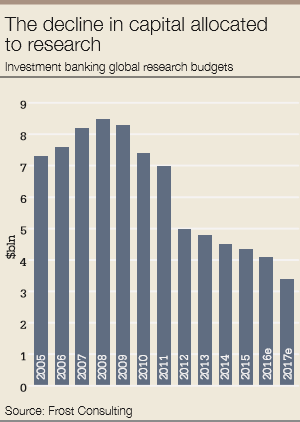 |
According to the report, the decline in equity research provision was already well underway long before Mifid II.
There had been a 40% reduction in budgets allocated by the 600 firms producing equity research from $8.2 billion at the peak just before the financial crisis to $4.8 billion in 2013. The average number of analysts following all global equities had fallen by around 50% between 2007 and 2012, from roughly four analysts per stock to about two.
The forthcoming regulations certainly spell the end of the kind of comprehensive equity research offerings that investors have become used to.
“On the equity side firms are establishing bundles such as equity strategy, corporate and regional research – breaking it down into sectors. The old waterfront model is seeing segmentation,” says Mahesh Natayan, head of portfolio management and research for Thomson Reuters. Research providers are having to radically change the nature of the research that they provide as well.
“Long-only active managers and hedge funds focused on equities are demanding less in the way of traditional products (single stock reports) and more in services such as access to analysts and corporate management,” observed analysts at McKinsey in June. “Investors are seeking new forms of information and analytics through big data and artificial intelligence which can complement conventional fundamental research in decision making.”
McKinsey sees a variety of business models for equity research emerging.
There will be a small number of global banks offering both execution services and broad-based research; and a small cadre of non-bank market makers that will offer global execution but limited or no research.
Sustainability
 |
Other universal banks will attempt to maintain broad research efforts with smaller scale global execution, but this model is unlikely to be sustainable.
The majority of banks will cut research and execution to focus on expertise in local sectors and regional markets. Independent research firms offering little or no execution should see growth.
Euromoney’s conversations with research providers reveal that the market expects the number of firms producing equity research to fall by 40%, from around 150 to 90. This is a reflection not only of the new rules but also of the rise of passive investment strategies that require less research input.
The impact of the decision by many asset management firms to take research costs onto their own P&L is hard to predict – principally because research providers themselves are still so unclear on what they will charge for equity research.
In June, McKinsey reckoned that profits at European asset management firms could be hit by as much as 15% to 20% because of the research cost increases from Mifid II.