Markets are crippled with fear. European stocks have plummeted. Volatility gauges have spiked. Amid a political vacuum in Greece, the future of the eurozone hangs in the balance – and investors are firmly risk-off. So how can fear-soaked investors navigate the storm – other than cash-under-the-mattress strategies? A Credit Suisse strategy report today proffers some advice:
|
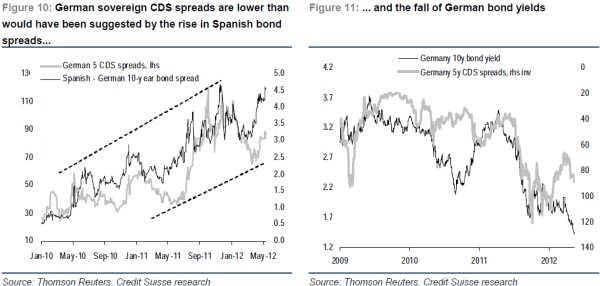
“German CDS spreads: German CDS spreads are lower than they should be given the rise in Spanish bond spreads or the fall in German 10-year bond yields (Germany sees its bond yields and CDS spreads move in opposite directions during crisis episodes, as bond yields are pushed down by ‘safe haven’ flows, while CDS spreads move up, as markets expect that Germany will either have to commit further resources to bail out the periphery or will have to deal with the fall-out on its commercial banks’ balance sheets). We would agree with our European credit strategists who recommend buying protection on Germany and selling protection on Spain.” |
 |
|
“The euro should fall: Euro-area risk indicators suggest the euro has downside from current levels, with the spreads of the average Euro-area bond yields over German bond yields, for instance, pointing to a weaker euro. Similarly, the relation between the Euro TWI and the ECB balance sheet as well as that between the €/$ and Euro-area lead indicators relative to those in the US all suggest the euro should be considerably weaker.” |
|
“Credit looks more vulnerable than equities: While we see that the performance of credit as an asset class has been supported by the low yields on government instruments (pushing investors looking for yield up the risk curve) and by the ECB’s provision of liquidity (which reduces default risks), we still think credit is likely to underperform, for the following reasons: The Euro-area is already close to a recession (with manufacturing PMI new orders consistent with minus 1% GDP growth) – but implied speculative default rates, at 4%, are considerably lower than the realised default rates during the past two recessions (10%+); The main driver of the outperformance of credit versus equities has been the fall in German bond yields – and, as we have argued above, we think bond yields have upside risk from here; Inflows into corporate credit funds, which had been strong, have now slowed, according to data provided by EPFR Global.” |
Interestingly, CS reckons that Bund yields could actually rise – even in a risk-off environment. Here”s the rationale:
|
It continued: “We halve our underweight of Continental European equities: sentiment indicators suggest high stress (but not quite at May 2010 levels); there are signs that policy makers are willing to allow higher inflation in the core, to stimulate growth and to postpone fiscal tightening. We think there is only a 15% probability of a Greek exit by year-end. Yet, valuations remain mixed. ■ We stay underweight banks in spite of attractive valuations, not least as they tend to underperform into a weaker euro. There is potentially interesting risk/reward in non-EMU banks (domestic UK and Swedish banks). ■ Dividend swaps look attractive.”
|