
|
|
| América Móvil | |
| Date | November 28 |
| Size | Ps15 billion ($1.1 billion-equivalent) |
| Structure | Global Peso, 10-year bonds |
| Bookrunners | Deutsche Bank, HSBC and Morgan Stanley were active bookrunners, with BBVA, Citi and Credit Suisse as passive bookrunners |
| return to the Latin America Deals of the Year index | |
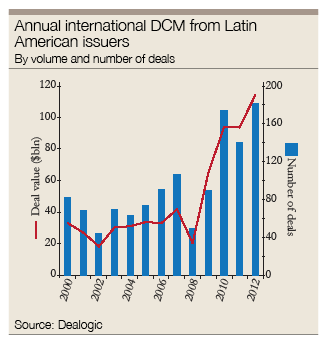
Latin American issuers in the international debt capital markets enjoyed near-perfect conditions in 2012; total volumes hit another new record and many other records were set. The region’s credits continued to improve relatively and absolutely on those from developed markets, while issuers could access lower rates in the international market than were available domestically. There was heavy demand as international investors searched for yield outside their home and other developed markets. The result was that records tumbled. In total, $114.2 billion was raised by Latin American issuers in the international DCM markets. In February 2012, Petrobras broke the record for a single deal by an emerging markets issuer when it printed a total of $7 billion in four tranches. Total orders hit $25 billion. Pricing records were also set: a $1.35 billion issue by the Republic of Brazil paid the lowest-ever yield for the sovereign; in October Cielo issued the lowest-ever-yielding deal for a Brazilian corporate. In July, Codelco printed a deal with the lowest coupon and yield ever achieved by a LatAm issuer, including the Chilean sovereign, in the 10-year and 30-year sectors respectively. All these deals were of course highly successful and were skilfully led and executed, but with such favourable underlying market conditions it is hard to evaluate which were the standout transactions.
Euromoney’s fixed-income deal of the year for Latin America goes to América Móvil’s December Global MXN bond. This deal wins because by innovating a new structure that links international and domestic investors into a completely homogenous structure, the company is looking forward to and positioning itself for a time beyond 2012’s near-perfect DCM conditions. The deal is the first transaction of a series, combining to create a funding programme that will enable the company to tap liquid markets and achieve low cost of funding for years to come. By launching in 2012 when market conditions facilitated heavy demand, América Móvil further enhanced its reputation for being the region’s most innovative issuer of bonds.
The transaction’s innovation met a real corporate need and has had direct funding benefits for the company. After a series of acquisitions the company had accrued substantial international debt, with the level of the domestic, peso-denominated bonds outstanding falling to just 15%. “We wanted to retain our exposure to our local currency; doing this in the international market meant going through swaps and derivatives, which results in counterparty credit risk and sometimes credit charges,” says América Móvil’s chief financial officer, Carlos García Moreno. To make the funding more efficient the company created the SEC-registered security labelled as crédito extranjeros and lobbied the Mexican banking commission to recognize the product and ensure seamless clearing between Mexico and the international markets. América Móvil’s security created pooled liquidity between the domestic and international investors, which increased total investors and enabled the cost of local funding to fall. The structure enabled América Móvil to capitalize on growing demand from international investors for local-currency paper from emerging markets, with Mexico at the forefront of this trend. “The fundamentals in Mexico have been in very good shape [for some years now] and many institutional investors concluded that they were underinvested in EM and were looking to buy local currency in a way that wasn’t typical five years ago,” says García Moreno. “Mexico is a market where it is relatively easy to enter and exit [for international investors] and has a free-floating exchange rate and the government has been able to develop a very good domestic public sector debt market – the best by far in the emerging markets – with a very established yield curve.”
 |
América Móvil wanted to create an alternative to the government mbonos; by committing to come to the market every quarter for the next five years in a programme that will be worth about $3 billion-equivalent, it has achieved its objective of establishing a corporate alternative to Mexico’s public-sector peso-denominated debt. The transaction in December was worth Ps15 billion ($1.1 billion) and was issued at mbonos plus 93 basis points, which had tightened to around 50bp over the benchmark in early January 2013. The fact that the company is committed to returning to the market every quarter made this a good mandate to win. For the first deal, América Móvil chose Deutsche Bank, HSBC and Morgan Stanley as active bookrunners, with BBVA, Citi and Credit Suisse as passive bookrunners. García Moreno says the aim was simple: having the largest two Mexican banks and the four other banks together meant that the experience and scale was there to make markets for the paper 24 hours a day. All deals will be issued through the bookbuilding process. “It gives us much better control about how we allocate,” says Garcia. “It is important to develop liquidity, and for that you need a combination of players: some pension funds but also retail, hedge funds and banks.”



