Scotiabank is North America’s best bank for ESG in recognition of the breadth and verifiability of what it did in 2025. It put CAD40 billion ($28.3 billion) of climate-related finance to work, had that figure independently assured for the first time, disclosed its inaugural energy supply ratio, and built a franchise financing the data centres and building retrofits that will determine North America’s energy demand for the next decade.
The CAD40 billion delivered in the 2025 financial year takes the running total to CAD212 billion since 2019, against a CAD350 billion target for 2030, and KPMG’s limited assurance engagement now covers climate-related finance for the first time. Alongside it, Scotiabank became the first Canadian bank to publish an energy supply ratio, a dollar-for-dollar comparison of low-carbon and conventional energy financing.
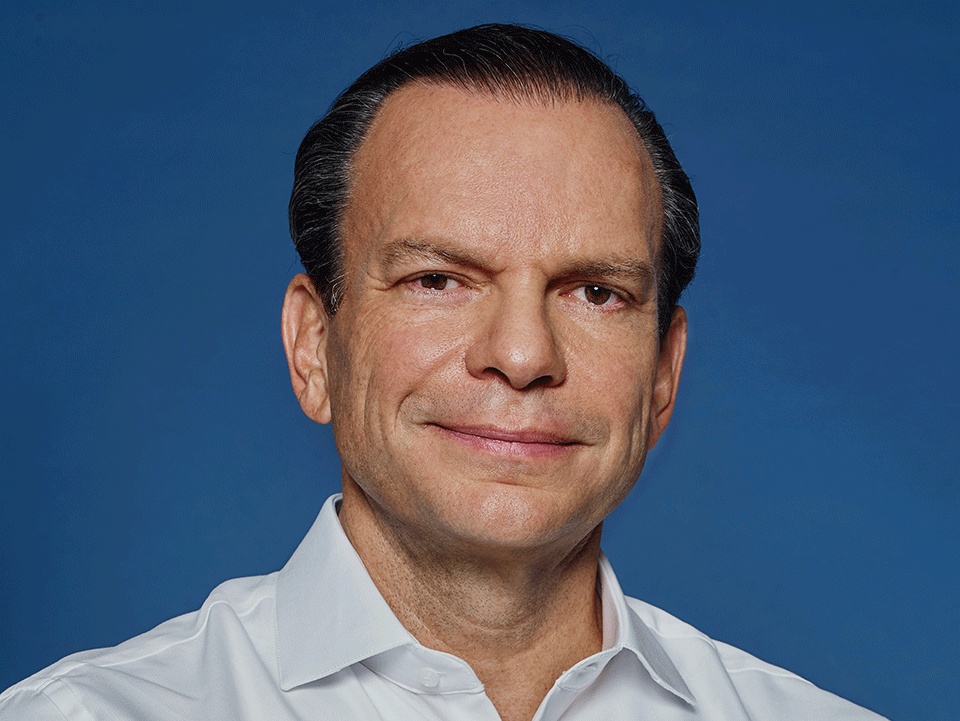
“The energy supply ratio shows how we’re supporting today’s energy system while financing the transition to a lower-carbon economy,” says Meigan Terry, executive vice-president and chief global corporate and public affairs officer at Scotiabank. “Combined with our CAD350 billion climate-related finance commitment, it demonstrates how we’re helping meet clients’ evolving energy needs while supporting long-term climate objectives. That’s the role we play as a bank.”
Scotiabank dismantled its central ESG committee in favour of making business line leaders answerable for delivery. Sustainability metrics, combined with client metrics, now carry a 20% weighting in the all-bank business performance factor, the basis of variable pay for most employees.
Financing the build-out
The clearest test of that model is where the region’s energy demand is actually growing. Scotiabank was joint bookrunner on 12 green data centre debt financings during the year – one loan and 11 asset-backed securitisations – among them eStruxture’s inaugural CAD750 million green ABS, the first rated Canadian asset-only securitisation in the sector, where the bank acted as joint structuring adviser, joint active bookrunner and sole sustainability structuring agent. It is a sector whose power consumption makes the sustainability question unavoidable and few banks in the region have built a comparable book.
At the other end of the market is the partnership with Canada Infrastructure Bank. Clients of Scotiabank who own commercial, industrial, institutional, office, and multi-residential buildings can access low-cost, flexible financing from CIB to make upgrades that reduce Scope 1 and 2 emissions by at least 30%. Scotiabank contributes to the success of the initiative by identifying motivated property owners and managing the origination, underwriting and administration of the retrofit loans provided by CIB.
Scotiabank is giving homeowners access to a Home Energy and Advice Tool, by Climative, that lets homeowners evaluate the energy efficiency and resiliency of their home and understand personalized ways to improve it – a resource many Canadian homeowners have never had. “Energy literacy is financial literacy,” says Terry.

We’re continuing to create a path to credible plans that deliver measurable and impactful outcomes – social, climate, inclusion – but in a way that’s tied very closely to the growth agenda of the bank
Meigan Terry
In Mexico, the bank was joint bookrunner on a MXN4.5 billion (CAD312 million) blue bond for agricultural trust fund FEFA, the country’s first financing sustainable fishing and aquaculture. Scotiabank then extended the same expertise beyond the region, acting as ESG structuring agent and joint bookrunner on Chile’s first local corporate blue bond, a CLF4 million (CAD218 million) transaction for water utility Esval – evidence of a sustainable finance capability deep enough to travel.
The social programmes are held to the same standard. ScotiaRISE, a 10-year, $500 million commitment, has backed 300 partners and disbursed $212 million, with LBG Canada verifying the figures under the London Benchmarking Group model; its reach grew to 1.1 million “critical moments in time” in 2025, from 389,439 the year before.
The Bank’s more recent commitment to Indigenous reconciliation is reflected in the 2024 launch of its Truth & Reconciliation Action Plan, of which 11 of its 37 commitments have already been operationalised, and in the supported the establishment of Cedar Leaf Capital, an Indigenous-led brokerage with its own board and profit-and-loss account that Scotiabank intends eventually to move into full Indigenous ownership.
“We’re creating economic reconciliation at a time when it’s so needed. Because it’s in the area of what we do best, it’s been a very impactful piece of work,” says Terry.
In its own operations, the bank has cut Scope 1 and 2 emissions by 36.3% since 2016 and now sources all its Canadian electricity from emissions-free sources. “We’re continuing to create a path to credible plans that deliver measurable and impactful outcomes – social, climate, inclusion – but in a way that’s tied very closely to the growth agenda of the bank,” says Terry.