
Large banks each spend billions of dollars a year on technology innovation. For their global markets businesses, much of that spending goes on tools for disseminating prices and automated dealing with buy-side clients.
Yet most work that portfolio managers do before handing a trade to their dealing desks, is devoted to forming a view of the world and of markets that leads them to a transaction.
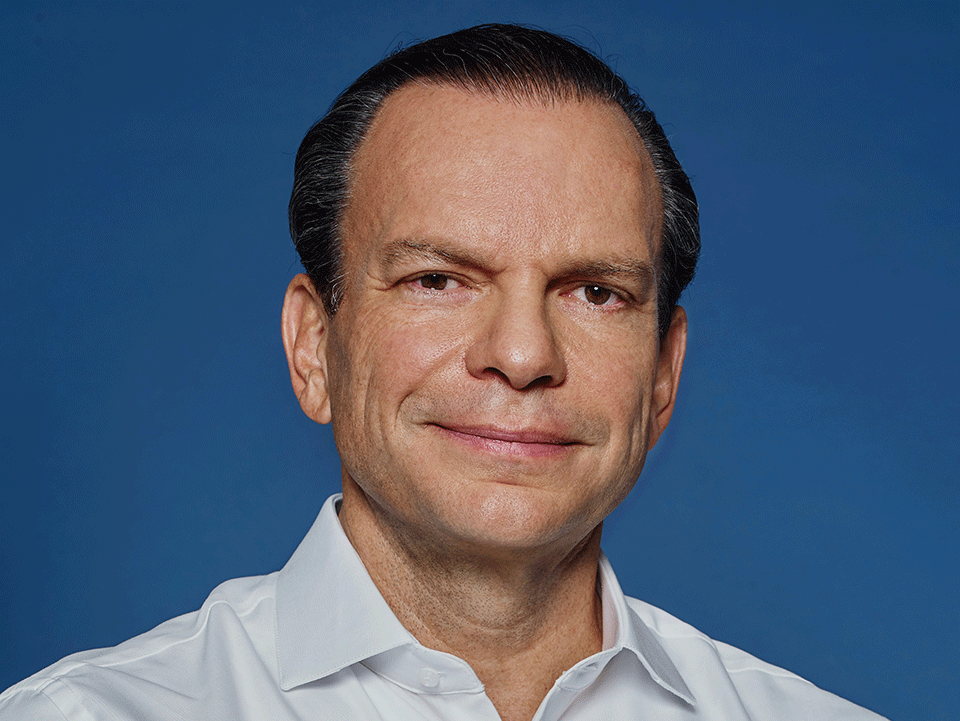
“Far more important than getting the best price is doing the right trade,” says Chris Churchman, head of Goldman Sachs Marquee.
Marquee began as the firm’s digital platform for research. Its earliest versions allowed buy-side clients to select research reports from Goldman’s analysts and view cross-asset strategy pieces and other insights.
That is still how most sell-side research platforms look, with PDFs that investors can dip into, links beside them to associated research and now also to endless podcasts and videos where strategists and analyst interview each other.
Goldman Sachs has been more ambitious with Marquee.
“Our north star is to become an integral part of our clients’ investment processes,” Churchman says. “The premise is that if we can help them all along the journey from forming a view to next reviewing ways to put on that view and finally structuring a trade, we are much more likely to get a chance to execute the transaction and maybe a last-look chance to match better pricing away from us.”

He takes Euromoney on a tour of Marquee, showcasing its latest updates: Marquee MarketView, launched in November 2023; and Marquee Visual Structuring, a trade testing and structuring tool first released in September 2022 for FX options and then expanded last year to cover equities, precious metals, credit, crypto and rates.
The demo is like a scene from the film Minority Report. Gone are the days when clients must go back into research report PDFs to check the charts that were current when it was written. Marquee lets clients pull the data that is most relevant to them into their own dashboards where they are constantly updated.
Maybe an asset manager is interested in where the euro/dollar rate is headed for the rest of this year. They can pull the most relevant data, for example on the spot rate, on interest-rate differentials, data on fund flows and positioning. If the client sees a research report on inflation with a key chart, they can pull that out as well.
The client can pin all these on their own dashboard where they constantly update. They can also add their own information to form a view of whether euro/dollar is cheap to fair value.
This is different. While trading has gone digital and real-time, the world of sophisticated financial analytics still suffers from fragmented data and scattered insights. Constant switching – between different platforms and applications, spreadsheets, Python notebooks, web-based dashboards, research PDFs and screenshots in emails – is time-consuming and inefficient.
With Marquee MarketView, Goldman aims to solve these problems.
“MarketView is Pinterest for finance,” says Churchman.
It links naturally to Visual Structuring.
If a client forms a view that the euro/dollar rate is headed lower in the next few months, the next step is deciding how to express that view. Visual Structuring allows the client to look at various options trades they might put on at different strike prices and expiration dates.
Marquee MarketView is Pinterest for finance
Chris Churchman
“Visual Structuring empowers clients to efficiently and effectively make decisions about which options structure to trade – i.e. make these decisions both quickly and with high confidence,” Churchman says. “The aim is to answer all the questions a client might have such as: What is the probability of various scenarios? How will my risks evolve over time? What events might impact it? Is the option structure good value right now? Has it paid out in the past?
“It’s all priced instantaneously, and while not click-and-trade live, it’s close enough for our clients to make an informed decision about which variation they want to firm up with a tradable price – which they can easily get by opening into our single-dealer platform.”
Like many such ideas, these developments first began to help Goldman’s own analysts and traders share information – perhaps within their own teams, or even firmwide – before being opened up to clients. When clients construct dashboards, they too can keep them proprietary or allow other people inside their own shops to see them.
Where it goes next might be surprising.
“We’re at the start of this journey,” says Churchman. “We initially planned this as a workflow tool. Now some clients are even saying they want to publish their own ideas over the platform to the broader market.”
Why would they share their own painstakingly constructed alpha?
“Ultimately our clients want to make informed decisions, and part of the way they stress test their views is by bouncing them off peers. We’re not there yet, but this idea of creating a kind of social network for capital markets presents a unique opportunity and a potentially interesting future path to explore.”