|
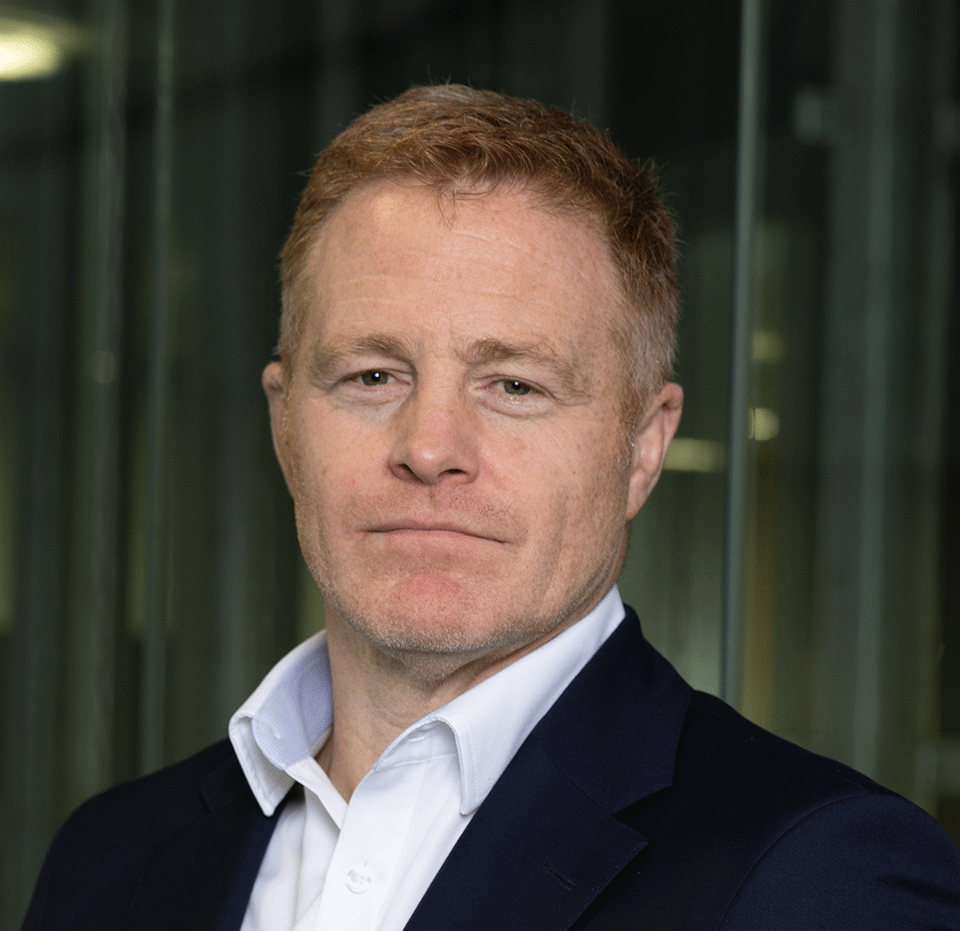
Few would envy the task of Soedradjat Djiwandono, governor of Indonesia’s central bank. A US-educated technocrat and formerly minister of trade, Soedradjat is charged with the management of the rupiah, the supervision of the banking system, the reorganization and merger of failed banks, the control of inflation and the monitoring of public and private sector foreign debt. Soedradjat recently gained some new duties: reassuring foreign investors during a period of political instability and co-ordinating policy with other central banks in the region to avoid a Mexico-style crisis in Southeast Asia. The governor has risen admirably to the challenge. Despite elections in prospect, rioting in Indonesian streets and concerns over the health of ageing president Suharto, he has calmed fears, controlled overheating, reduced inflation from nearly 10% to below 7%, and displayed a deft hand in currency management in the face of large inflows of hot money. Soedradjat has his eye on Indonesia’s neighbours. Many of them face similar problems: high current -account deficits, inflation and pressure on the currency. The current shakeout in Thailand has particularly riveted the attention of policy-makers. “We see growth declining here a little this year to 7.5% and that’s a good thing,” says the governor. “When this figure is exceeded, overheating starts.” Indonesia contained inflation at 6.5% last year, still higher than its neighbours, but a considerable improvement on the 9%-plus common in recent years. The current-account deficit is forecast at $8.8 billion for fiscal 1996/97 and $9.8 billion for fiscal 1997/98, both a high but manageable 4% of GDP. Indonesia’s foreign debt of around $100 billion, of which 55% is government borrowings, mandates a maximum current-account deficit of 4%, policy-makers believe. Indonesia has maintained export growth at 11%, below the target of 16% but still better than some countries in the region. The trade surplus in 1996 was $6.95 billion, up from $4.75 billion in 1995, helped by higher oil prices. Financing the deficit has not been a problem with $10.8 billion of capital inflows, mostly direct foreign investment, last year. The balance of payments remains in surplus and foreign reserves have been boosted to $19 billion or five months of imports. But the capital inflows do present a challenge. Speculators have poured in funds to take advantage of the 15% interest rates available on the rupiah. Jakarta has long had a policy of depreciating the currency by up to 5% a year against the US dollar, to promote exports. Speculators believe the risk of a larger devaluation is small because of the effect it would have on investor confidence. Not only is the hot money capable of causing potential instability if it is rapidly withdrawn, but the burgeoning liquidity adds to overheating pressures and also causes the currency to appreciate. But a reduction in interest rates is not possible due to the need to curb excessive lending and to enable weak banks to rebuild balance sheets. Spreads in Indonesia are between 5% and 7%. Soedradjat has tried to transfer more risk to the speculators by widening the intervention band from 3% a year ago to 8% now, but with only marginal success. “We’re trying to strike a balanced policy on the rupiah,” the governor says. “On the one hand, our economy is export-led, so we try to support this with a creeping annual devaluation of 3%-5%. This policy has been stable for years. On the other hand, the rupiah is now an exotic currency and trading levels are rising rapidly, with the capital inflows causing rupiah appreciation. We have to be realistic about the foreign exchange markets.” This realism is leading to discussions on other technical ways to help exporters with management of currency and other risks, so that reliance on the exchange rate will be minimized. The Bank Indonesia governor’s main focus lies firmly on the control of overheating. Next month, banks’ reserve requirements will go up from 3% to 5% and a stiff letter has been despatched to big lenders instructing them to observe their targets for this year. The governor wants to maintain lending growth at 18% compared with 27% last year. “We’re not on target for bank lending,” he says, “but I think the growth rate has started to moderate since the end of last year. If you add in commercial paper transactions for last year, lending growth comes down to 19%.” The central bank is also trying to impose some order on the banking sector, which has grown to 239 banks since deregulation in 1988 galvanized the private sector. A temporary freeze has been imposed on bank licences and banks are being required to boost their capital adequacy ratio to 9% by September this year, 10% by 1999 and 12% by 2001.The national average ratio is now 11.8%. In the longer term the government wants to see the emergence of four or five large banks that can compete globally, plus a number of smaller niche banks. In the shorter term it faces two problems: persuading smaller banks to merge, or liquidating them if they fail, and resolving the intractable problem of bad loans at Indonesia’s large state-owned banks. The urge to merge has not been an obvious characteristic in Indonesian banking and only one bank has ever been liquidated. Before 1988 the sector was dominated by the state banks, which include four behemoths. Deregulation unleashed massive competition from the private sector, which has now overtaken the big state banks in both deposits and lending. Excessive lending in competition for market share in the early 1990s resulted in an asset bubble, which was burst by a tight money policy introduced in 1991. Bank Summa, exposed mainly to property lending and liquidated in 1992, was the sole major casualty. Recovery is well under way and the shakeout barely affected most of the big privately owned banks. But several state banks are receiving treatment, in the nursing home or the hospice, depending on the seriousness of the disease. Bad loans in the banking sector are estimated at Rupiah 10.4 trillion ($4.3 billion), of which Rupiah 7.1 trillion is at the state banks. Soedradjat faces several difficulties in reorganizing the state banks, where politically connected individuals are thought to be responsible for much of the debt. “We wanted to take the problem loans off the balance sheet,” he says. “This doesn’t mean that the debtor is absolved, but people misunderstood.” The plan has gone ahead, despite heated objections. The bank is also in talks with Bapepam, the capital markets regulatory body, to set up a procedure for mergers of banks through the Jakarta Stock Exchange and with the tax office over tax treatment of interest payments on problem loans. Five of the state-owned banks are being supervised by a joint ministry of finance/Bank Indonesia committee, which is restructuring their balance sheets, chasing debtors and taking court action to recover and then auction collateral. Four are meeting their targets, including Bank Negara Indonesia (BNI) which launched a successful public offering of stock last year. The flotation of BNI in November raised Rupiah 922 billion. The stock was offered at Rupiah 850 and jumped to Rupiah 1,250 on listing. The bank has assets of Rupiah 32 trillion and reported net earnings of Rupiah 379 billion in 1995. Bad loans of Rupiah 1.2 trillion, 5% of total loans, did not deter investors in Indonesia’s only privatization last year. A particular black spot is Bank Bapindo, the government development bank, which lent $420 million to Eddy Tansil, a small-time ethnic Chinese businessman whose Golden Key group planned to construct several petrochemical plants. Tansil defaulted on his loans and was subsequently jailed along with several indigenous senior Bapindo officials for corruption. He bought his way out of prison and absconded last year, creating a major public outcry. His whereabouts are still unknown. Attempts to resolve the affairs of Bapindo and other failed banks reveal some of the more intractable obstacles facing the central bank when it tries to promote mergers or clean up bad debt problems. Political sensitivities dictate that assets owned by indigenous entrepreneurs cannot be handed over to ethnic Chinese businessmen. The latter still dominate the private sector, although Indonesia’s large and increasingly efficient state sector controls the bigger part of the country’s assets. Less than a dozen indigenous private sector business groups are large enough to take part in rescue efforts and three of them are controlled by president Suharto’s children, who sometimes bring their own political difficulties. When finance minister Mar’ie Muhammed placed ailing textile group Kanindo under the care of the national association of batik cooperatives (GKBI) three years ago, the new management returned the company to operating profitability within a few months and was in negotiation with a state bank to restructure Kanindo’s debt. The company’s potential had come to the notice however of Bambang Trihatmodjo, second son of Suharto, who moved in on the deal and took over the company. The central bank is struggling with another failed indigenous-owned bank, which went into default two years ago. Bank Pacific, the 12th largest private bank with assets of Rupiah 2.3 trillion, was owned by the family of Ibnu Sutowo, the former head of state oil company Pertamina. Sutowo was tasked by Suharto in the 1970s with pushing Indonesia’s industrial development forward quickly, using the massive windfall profits it was earning from the hike in oil prices. In only a few years Pertamina ran up overseas debts of $10 billion, much of it unknown to the financial authorities. Sutowo was dismissed from Pertamina but never charged with any crime. Along with Bank Pacific his family owns a very large prime property in central Jakarta which houses the Hilton Hotel, apartments and the Jakarta Convention Centre. His son Pontjo is treasurer of Golkar, the Indonesian ruling party. But it was daughter Endang Utari Mokodompit who caused the current problem. In the early 1990s she embarked on a property-buying splurge, acquiring a 1,800-hectare resort site 80 kilometres south of Jakarta and a 39% stake in the giant Bugis Junction shopping complex in Singapore, being developed at a cost of $900 million. Along the way she picked up a 38% stake in Singapore-based food processing group Auric Pacific for $192 million and a further interest in an engineering group. Endang, who was chief executive officer of Bank Pacific at the time, appears to have financed the purchases through commercial paper transactions via a finance company called Pacific International Finance, a subsidiary of her investment company Aditarina. Pacific International Finance had borrowings of $600 million by late 1994. Some of the loans were guaranteed by Bank Pacific, to which creditors turned when payments from the finance company stopped arriving on time in mid-1995. Bank Pacific’s then minor shareholder was the central bank with a 38% stake. Its equity involvement dates from 1983 when the bank had to inject capital into Bank Pacific following an earlier failure. Soedradjat quickly placed Bank Pacific under the control of BNI, which injected Rupiah 500 billion. Bank Indonesia’s stake was raised to 51% and the Sutowos were removed from the board. “In the Bank Pacific case we are looking for someone who can take over the whole bank, including the BI stake,” says Soedradjat. “But it’s not easy resolving the liabilities and other legal problems.” The Bakrie group seems the likeliest candidate at present. A large indigenous conglomerate with interests in telecommunications, infrastructure, property, plantations and finance, it is restructuring its own sprawling interests. Bakrie is leading a consortium which also includes the Pentasensa financial services group, owned by “Titiek” Suharto, the president’s second daughter and the Alatief retail and property group, run by minister of manpower Abdul Latief, which is negotiating the takeover. Earlier, BI had talks with large privately owned Bank Danamon, which had previously successfully taken over two smaller banks Bank Delta and Bank Continental. But Danamon is owned by the ethnic Chinese Atmadja family a no-no when it comes to “local” assets. The central bank is keen to dispose of its stakes in financial institutions, which have mostly arisen due to past bail-outs, or are the remnants of a time when the central bank was trying to encourage foreign banks to help develop specialized banks. Officials believe they expose the bank to potential accusations of lax supervision and conflict of interest. But getting rid of the shares is not easy, given the shortage of qualified buyers, the ethnic sensitivities and the tight relationships between the small network of key business players. These sensitivities have slowed the process of consolidation in the banking sector considerably. Only six mergers have been achieved, bringing the total number of banks down to 233 since Bank Indonesia started to put pressure on the smaller banks by raising capital adequacy requirements. The bank governor could also have done without a couple of other domestic incidents in the past year, especially the discovery that his head of treasury was involved in a scam designed to steal Rupiah 7 billion from the central bank. Three bank officials are now in jail over the incident, which was quickly discovered. No cash was lost. A more difficult political problem emerged when BJ Habibie, the influential minister of science and technology, came up with a theory on lowering interest rates. They were a problem for business, Habibie said, and the government should follow a “zigzag” approach to getting them down, first lowering them to promote growth, then raising them to combat inflation, then lowering them again and so on until they reached 4%. Fortunately Soedradjat and the other technocrats who manage the Indonesian economy were able to rely on the support of Soemitro Djodjohadikusumo, a former finance minister who remains a close and outspoken adviser to Suharto. “What is this zigzag theory all about?” Soemitro rhetorically asked journalists. “You want to make this country bankrupt?” Eliminating monopolies and corruption was the way to reduce inflation and thus interest rates, he said firmly. But the bank governor can report success in his new role as chief PR man for the Indonesian economy. In roadshows to the US, Europe and Asia, Soedradjat has been trying to reduce the headline effect of bad news such as rioting and other unfavourable publicity. With two elections due in the next year, investor concern has been rising. “Before, Indonesia was little known,” he says, “people had heard of Bali and perhaps the Borobodur temple. Now we’re notorious for human rights problems and political trouble. But we had a very successful issue of our $400 million Yankee bond last year with a very good price of 100 basis points. This got worse after the June riots last year but now the spread has tightened again. I’m fairly optimistic we’ll achieve a reasonably smooth ride.” Nothing can hold back LippoDespite international controversy over its involvement in president Clinton’s campaign funding, the hyperactive Lippo group has continued to expand and diversify, positioning itself for major involvement in Hong Kong and ChinaThe timing couldn’t have been worse. Just as the Lippo group was launching a major restructuring of its listed Indonesian companies, the story broke in the international media that the group’s founding family had been involved in questionable contributions to the re-election campaign of US president Bill Clinton. The story has run and run. But not even international notoriety has been able to put a spoke in the plans of Indonesia’s most hyperactive conglomerate. In an orgy of fund-raising and share swapping inside the group, which continued throughout 1996 and into this year, the Riady family has: * restructured its Indonesian financial companies so as to withdraw $384 million of its own funds in the Lippo group. * purchased a controlling stake in a major Indonesian department store chain, overnight turning the group into a dominant force in the retail sector. * purchased a controlling stake in a Singapore company which owns a large formerly Australian-owned food processing and cold storage company. * announced a further restructuring of the Indonesian property division, in which China Resources, Lippo’s mainland Chinese state-owned business partner, will increase its stake in Lippo Land by 20%. What seems to be emerging is a partnership between two giant companies, one with its origins in Indonesia, the other in China. Their joint interests include banking, financial services, insurance and property development in Indonesia, Hong Kong and China, along with food distribution, trading, warehousing, supermarkets and department stores in Indonesia, China and southeast Asia. Ownership and control is primarily based offshore in safe havens. Local stock markets have been used to the full to raise capital. The synergy is undeniable, as is the quality of Lippo’s partner in the run-up to the handover of Hong Kong to China in July. “Despite all their problems, you have to say the Riadys have proved themselves consummate businessmen this year,” says William Keeling of Kleinwort Benson’s Jakarta office. For the past 18 months Lippo and the Riady family have been under a cloud. Apart from the Clinton allegations, Lippo suffered a financial crisis in November 1995 and last year received a political buffeting when it was accused of trying to take assets out of Indonesia. Virtually all ethnic Chinese business groups in Indonesia that have investments abroad are routinely accused of capital flight. Many of the largest ones, including Lippo, Indonesia’s fourth-biggest conglomerate, have been investing in other Asian countries, and in mainland China, over the past decade. Ethnic Chinese businessmen in Asia learned long ago not to put all their eggs in one basket. But they are also aiming to increase competitiveness and to take advantage of rapidly growing markets, not only to diversify risk. But Indonesia restored diplomatic links with China only in 1990, after a 25-year break. Much resentment is still felt in Indonesia about the dominant role played by ethnic Chinese companies in the private sector. Thus, much of the overseas investment has been kept quiet. Companies like Lippo normally run their overseas subsidiaries through listed companies in Singapore, Hong Kong or the US, and finance expansion through sophisticated deals in the international capital markets arranged by companies set up in offshore safe havens such as the Cayman Islands or Netherlands Antilles. While companies have made full use of regional stock markets to raise capital, key shareholdings are often held through unlisted private companies, making exact control and linkages difficult to trace. In advance of the handover of Hong Kong to China Indonesian conglomerates, along with other foreign firms, have aimed to find a strategic Chinese partner to assist with their China mainland investments. In the early 1990s Lippo secured as its partner one of the best companies on offer: China Resource Holdings, owned by China’s ministry of foreign trade and economic co-operation. A trading giant with annual turnover of around $8 billion and assets of $6 billion, it is about the same size as British hong (trading company) Jardine Matheson. It has interests ranging from property development in China and Hong Kong to brewing, food and livestock distribution. It is the second-largest cold storage and warehousing operation in Hong Kong. China Resources has been active in Hong Kong for 45 years and is headed not by a princeling but by a ministry bureaucrat. Its listed subsidiary in Hong Kong, China Resources Enterprise, holds stakes in three Chinese breweries and a large China property developer. Lippo was already active in property development in Fujian province, the original homeland of the Riady family. It had also established banking and brokerage arms in Hong Kong, with a view to expanding into China as China’s financial industry developed. In 1993 Lippo upgraded the partnership with China Resources by increasing its mainland partner’s stake in Lippo’s Hong Kong holding company, the HKCB Bank Holding Company, to 50%. But, before long, Lippo’s expansive plans for regional growth were to receive a setback. Since the late 1980s, founder Mochtar Riady, regarded as Indonesia’s most professional banker, had been turning over control of the group to his two sons, Stephen and James. Stephen was put in charge of Hong Kong and China operations, while James, the eldest, got Indonesia. James Riady is a man in a hurry with a sense of mission. He is also a friend of Bill Clinton, and spent most of his years in business in Los Angeles and Arkansas, where his father purchased a stake in the Worthen Bank in the 1980s to give James some hands-on banking experience.
When James returned to Indonesia after his long stint abroad, it soon became James set about building his Indonesian operation with vigour. His father had already established a thriving financial services group. Flagship Bank Lippo with assets of Rupiah 9 trillion and hundreds of branches was already widely known and profitable. Lippo Life was busily introducing the Indonesian middle class to insurance policies and Lippo Securities had developed into the largest retail broker on the rapidly growing Jakarta Stock Exchange. James focused immediately on the potential of the middle class, now 21% of the urban Indonesian population, but numbering perhaps 5% in 1990. Property was what they would want, he decided. Large tracts of land were acquired adjacent to motorways outside Jakarta and two new cities were built: Lippo Cikarang an industrial estate with housing, hotel and leisure facilities and the showpiece Lippo Karawaci. Equipped with villas, condominium apartments, office blocks, hotels, an expensive private school, a high-tech hospital, golf courses, horse riding and swimming pools, and the largest shopping mall in Indonesia, Lippo Karawaci was designed to show what living in Jakarta was all about. Then there was what to do at the weekend. On the West Java coast near the Krakatao volcano, Lippo put up a condominium, villa and hotel development complete with marina and water sports facilities. In a hill station resort near Jakarta, a similar development went up amid the tea plantations, this time packed with funfair amusements for the children. Lippo also joined other partners in the Lido Lake hotel and leisure resort south of Jakarta and the Royal Sentul Highlands resort near Jakarta, which features a motor racing circuit. All were equipped with best quality infrastructure roads, water supply and sanitation, electricity, telephones and satellite TV, all paid for by Lippo. Pretty soon debt was mounting, and despite some of the most sophisticated marketing and promotion efforts seen in Indonesia, apartments and villas failed to sell as interest rates of over 20% priced the property beyond the reach of the still small middle class. In mid-1995, a number of senior foreign managers left Lippo’s property division. One senior manager committed suicide, throwing himself from an office tower at Lippo Karawaci, reportedly due to depression. Lippo Land, the listed property arm, published annual results showing short-term debt of $550 million with interest payments of $100 million due. With cash flow from sales at a trickle, rumours circulated that Bank Lippo had breached the central bank’s rules on lending to affiliates and was dangerously exposed to the property division. By November a run had started on Bank Lippo and the bank reportedly defaulted on its interbank obligations. The central bank moved swiftly to shore up confidence, organizing other large banks to place funds at Lippo’s disposal while the crisis lasted. “Don’t laugh,” bank governor Soedradjat Djiwandono told bankers assembled at a conference in late 1995. “This could easily happen to you.” A serious crisis of confidence was averted and Lippo moved quickly to secure an injection of funds to service its obligations. China Resources bought a 5% stake in Lippo Land, and other investors such as Li Ka Shing, the leading Hong Kong businessman, the Hyundai group of South Korea and Rodemco, a Dutch property trust, reportedly took stakes in the company. Negotiations started on reorganizing Lippo Land’s rupiah-denominated debt on better terms offshore. By March last year an analyst’s report by Lippo Securities said that Lippo Land’s total debt had reached Rupiah 1.3 trillion ($565 million at the then exchange rate), half attributable to the two satellite cities and other half run up by the two weekend resorts, along with the hotel and the hospital at Lippo Karawaci. Debt at other private developments was unknown. Lippo Karawaci was floated on the Jakarta Stock Exchange in 1996, raising Rupiah 100 billion, and a 10% stake in Lippo Cikarang was sold to local group Bakrie. A Riady stake in Bank Lippo was sold through a private placement, raising another Rupiah 100 billion. The hospital has also launched an IPO. Meanwhile, the furore over foreign contributions to Clinton’s campaign was growing in the US. The story started when journalists noted a $400,000 contribution to the Democratic National Committee from Soraya and Arief Wiriadinata, an Indonesian couple who live in the US on immigration green cards, and thus were entitled to make campaign contributions. Soraya is the daughter of the late Hashim Ning, a long-time business partner of Mochtar Riady. Ning was the nephew of Mohammed Hatta, the co-founder of independent Indonesia with first president Sukarno. Ning was an important businessman in the 1950s and 1960s when Sukarno was in power, representing American Express and Chrysler, among others, in the fledgling republic. After Sukarno lost power to current president Suharto in the late 1960s the Ning business interests declined, although Ning remained a shareholder in Bank Lippo until he died in late 1995. He also maintained his political interests and was a founder member of the Indonesian Democratic Party (PDI) led, until she was ousted last year, by Sukarno’s daughter Megawati. Attention in the US soon shifted from the Wiriadinatas to John Huang, the main fund-raiser for the Democrats and a former employee of Lippo group in the US. Investigators continue to suspect that James Riady may have been involved in Clinton’s business activities while he was governor of Arkansas when James was running the Worthen Bank. The head of the Whitewater inquiry into that period has subpoenaed all documents relating to Lippo and Riady connections from the White House. Investigators have not been able to trace any clear evidence of favourable US treatment for Indonesia as a result of financial contributions and are now focusing on the possibility that China may have attempted to win influence in Washington, possibly via large companies owned by ethnic Chinese in Indonesia, Thailand, Taiwan and Hong Kong. “The Chinese are very ambitious,” says a former senior Lippo executive who worked for the group at the time the US and China relationships were established. “They see themselves as an emerging superpower and want to balance US influence in Asia. To do that, they want to get the support of Chinese business in southeast Asia, the big players in the local economies. They’re more than happy to do favours for influential people like the Riadys. In return, the Riadys get investment funds and access to the huge China market you can’t get a better partner than China Resources.” No impropriety by Lippo or any other Asian company has been proved, but millions of dollars in campaign contributions have been returned. The Riady family and other Lippo employees remain tight-lipped over the Clinton affair. By late last year, as reports of the contributions began surfacing, James Riady discovered that his complex plans for restructuring the finance division of the Indonesian interests of the Lippo group were running into trouble. The Riadys planned to sell their 40% stake in Lippo Bank to Lippo Life, in which they held a 27% stake. The 27% stake in Lippo Life was to be sold to Lippo Securities, where the direct family holding was and remains unclear. The idea was to create a financial group with synergy and strategic alliances, the family said. Earlier last year all three companies had rights issues on the Jakarta Stock Exchange, raising Rupiah 475.4 billion. Under the restructuring they would pay Rupiah 902 billion to the Riady family for their shares. At the time of the restructuring Bank Lippo had assets of Rupiah 7.6 trillion, and 260 branches. Lippo Life had assets of Rupiah 630 billion and 40 branches. Lippo Securities had assets of Rupiah 189 billion. Total assets of the Lippo listed companies in Indonesia were Rupiah 12 trillion.
According to research by Kleinwort Benson, the Riady family received a total Minority shareholders were not impressed with the plan, noting that the Riadys’ withdrawal created an opaque management structure, and that there seemed to be little advantage to the individual companies. Bapepam, the Indonesian stock market regulatory body, instructed Lippo to modify the proposed corporate structure to remove reverse cross-holdings Meanwhile the media accused Lippo of selling out of Indonesia at a time when the country’s political stability was in question following rioting in Jakarta. The Riadys were forced to sweeten the deal, waiving a management fee on Bank Lippo’s earnings which was paid to Lippo Asia, a family-owned company, and slightly reducing the costs of two of the acquisitions. They claimed that the family would take up a portion of a rights issue planned by Lippo Securities within 12 months and pledged to reduce the reverse cross-holdings over time. “We’ve benefited from outside investors’ participation in our companies so we are making changes to satisfy their complaints,” James Riady says. “We have confidence in Indonesia’s political and economic stability and in its prospects.” The Riadys denied they were trying to take cash out of the country. Lippo officials say that the restructuring was motivated by the strain on the family resources whenever the fast-growing companies needed to raise capital. Under the new system the family would not have to stump up for their share. Brokers and fund managers doubted that the companies needed such massive injections of capital, but eventually the restructuring was approved. No sooner had the market digested the reshaping of the financial services division than Lippo announced another bombshell. Its subsidiary Multipolar acquired for Rupiah 747 billion a 50.1% stake in Matahari Putra Prima, Indonesia’s biggest department store and supermarket group, a listed company with a market capitalization of Rupiah 1,251 billion and annual sales of just under Rupiah 2 trillion. Formerly a distributor of computers, Multipolar had latterly become the partner of US stores such as Arkansas-based Walmart and JC Penney, which are now investing in stores in Indonesia. The growth of prosperity, especially in Indonesian urban areas, has sparked a boom in retail stores and supermarkets, with sales growth of around 15% annually. Every weekend queues of cars jam the motorway leading to Lippo Karawaci, the biggest supermall in the country, which features fireworks displays and entertainment for the children. With two stores at the mall, Matahari had been offering strong competition for Multipolar’s Walmart and JC Penney. Its grip on Indonesia’s garment companies had restricted Walmart’s ability to source supplies. Overnight the acquisition ended competition between the two groups. Hari Dharmawan, founder of Matahari with its mix of mid-range stores, upper class Galeria stores and budget Mega-M outlets, has joined the Multipolar board. Matahari will be responsible for 75% of Multipolar’s retail revenue and over 70% of operating income. Brokers applauded the merger. “This is a win/win situation for both entities,” said a report by BZW Niaga Securities. “With combined sales of Rupiah 4 trillion forecast for next year, it will now be an expensive proposition for other foreign mass retailers to enter the Jakarta market.” Charles de Queljoe, chief executive officer of Lippo Securities, believes the Matahari purchase has significantly improved Lippo’s image in Indonesia: “Now they can see we are reinvesting the money, they appreciate the financial restructuring better.” The property division is now set to undergo the same restructuring treatment. Full details have not yet been announced but the changes may also be aimed at releasing Riady family cash. They will allow a back-door listing for Lippo Cikarang, one of the two satellite cities, which will be merged with the other, Lippo Karawaci. Lippo Land is then expected to take control of Lippo Karawaci. The purchase will be funded by a rights issue. Along the way, China Resources will increase its stake in Lippo Land to 20%. Up in Hong Kong, Stephen Riady had meanwhile put into action another acquisition, this time in Singapore. Through the family’s listed company Hong Kong China Ltd, he put in a bid for Auric Pacific, a Singapore-listed company formerly known as Goodman Fielder Asia. Goodman Fielder started life as an Australian food processing company and has since moved into cold storage, warehousing and distribution in Singapore, Malaysia, Thailand and New Zealand. Lippo bought 65% of the company for $136 million, resulting in an unconditional general offer for the company. Hong Kong China is mostly involved in property projects in China and Hong Kong. The largest of the Riadys’ China property interests is a $10 billion plan to develop a 64 sq km area in China’s Fujian province opposite Taiwan. Included in the plan are industrial parks, ports, roads, hotels, retail centres and a tourist resort. Mochtar Riady’s father, like many other prominent ethnic Chinese businessmen in southeast Asia, was born in Fujian. In 1990, aged 60, Mochtar spent eight months driving around China pursuing investment opportunities. One eventual result of the trip was the partnership with China Resources. Already locked into the Lippo property empire in Indonesia, it has no doubt noticed the excellent synergy between its trading, distribution and cold storage interests in Hong Kong and China and those of Auric Pacific in Southeast Asia. “To stay competitive, there’s no alternative but to go regional,” Lippo executive Charles de Queljoe says. He’s not the only southeast Asian businessman to have figured that out. But few have been forced to conduct their expansion at such a pace as Lippo, or to do it under both financial and political pressure and in the glare of publicity. It’s the kind of performance that would inspire admiration as far away as Arkansas. Key players emerge from the ashesIndonesia’s leading conglomerates have shown remarkable resilience in recovering from the economic problems of the early 1990s. This has been part due to business strategy and part due to political nous. The importance of connections and the rapid shifting of alliances mean a company should never be written offA little-known property company last month announced plans to list its shares on the Jakarta Stock Exchange (JSE). PT Surya Semesta Internusa’s most visible assets are three five-star hotels managed by Spain’s Melia group in Jakarta, Bali and the temple city of Jogjakarta. But it also owns shopping centres, a 1,400-hectare industrial estate, housing complexes, holiday resorts and a construction and engineering subsidiary that has put up some of Indonesia’s better buildings. When it is listed, the company will have a market capitalization of $1 billion, assets of nearly $400 million and annual revenues of around $250 million. Not bad for a business family which four years ago was effectively bankrupt. PT Surya is controlled by the Soeryadjaya family, former owners of PT Astra International, Indonesia’s premier motor car company and blue chip stock. In 1992, the family patriarch William Soeryadjaya, an ethnic Chinese Indonesian who had created the conglomerate from scratch, was forced to sell his stake in Astra to bail out the Summa business group owned by his son Edward. Summa’s flagship bank had gone belly up with $700 million in bad debts, fuelled by imprudent lending and property purchases during the go-go early 1990s. Bank deregulation and a rapidly rising stock market, generated an asset bubble in early 1991. When the finance ministry acted to cool the overheated economy, interest rates rocketed to more than 30%. Summa was the main casualty. The Soeryadjayas lost control of an empire that included what is still Indonesia’s largest conglomerate, with a 55% share of the auto market and interests in agribusiness, financial services, heavy equipment, telecommunications and office equipment. Less than five years later they are back, along with a raft of other Indonesian business players who have emerged from the ashes in the past year. These corporate Houdinis include some of the country’s biggest names, proving that one should never write off companies, businessmen or even charitable institutions that get into a little local difficulty. Astra itself is another example. Last year, the government unveiled a national car policy which gave a company owned by president Suharto’s youngest son, Hutomo Mandala Putra (Tommy), and Kia Motors of South Korea exclusive special tax and import duty breaks. They announced plans to assemble the Kia Sephia small sedan in Indonesia, rename it the Timor, and sell it for Rupiah 35 million, half the price of similar cars. Analysts thought Astra would be hard hit and dumped the stock. At first they were right. Buyers postponed purchases to await the appearance of the Timor. Other manufacturers, such as the Bimantara group, which assembles Hyundai sedans, and the Indomobil group, making Suzukis, cut prices to compete. Meanwhile, Japan, the US and the European Union reported Indonesia to the World Trade Organization for unfair trading practices. But they reckoned without the curious characteristics of the Indonesian car market. For some years the market has been dominated not by sedans, regarded as a luxury item, but by vans and “people carrier” style commercial/sports vehicles, which account for 85% of sales. Astra makes the market leader, the Toyota Kijang, which seats up to 10 Indonesians at a squeeze, is light on maintenance and petrol and backed by considerable service facilities and financing deals. It sells for around the same price as the new Timor sedan. Potential buyers lost their enthusiasm once they saw the Timor. Press reports of financial difficulties at Kia raised concerns about after-sales service and spare parts availability. Thousands of imported Timors were parked in full view near Jakarta airport, raising fears about weather damage and doubts about claimed sales figures. When Indonesians found out that the same model sold in the US for the equivalent of less than Rupiah 20 million, politics also entered the picture. Meanwhile, Astra’s growth was underpinned by a surge in motorcycle sales as several years of rapid economic growth pushed up pay at lower income levels. Indonesian consumer spending power has risen phenomenally in recent years. One consumer finance company with 12% of the motorcycle financing market, increased its lending by 500% a year to more than $800 million in only three years. So, despite the slowdown in the overall vehicle market, Astra was able to report a 25% jump in earnings in the first nine months of last year and to forecast net profits of Rupiah 450 billion for the full year, 22% up. In January it took thousands of orders for new streamlined models of the Kijang and said that by next year it will have met local content rules which will give it the same tax and duty breaks as the Timor, allowing it to cut prices. With such a bright future emerging from the earlier dire predictions, it wasn’t long before the public company attracted the attention of other cash flush Indonesian corporates. Late last year a consortium of businessmen, including timber king Mohamad “Bob” Hasan and Putera Sampoerna, maker of kretek cigarettes, bought stakes in the company. Last month Hasan was elected chairman. Hasan, a close confidant and golfing partner of Suharto, is an ethnic Chinese who converted to Islam many years ago. He effectively runs the Indonesian timber industry, whose plywood exports total $4 billion a year, through a marketing organization which controls export quotas. He also has interests in banking, shipping and an airline, the latter in collaboration with Tommy Suharto. But his most interesting job is as chairman of PT Nusantara Ampera Bhakti (Nusamba), a private company that has also emerged from financial disaster in the past six months. Nusamba is owned 70% by three charitable foundations controlled by Suharto, 20% by Hasan and 10% by Suharto’s oldest son Sigit Hardjojudanto. Six years ago the foundations that control Nusamba were broke. One of their first efforts to finance their charitable activities had been to set up a bank. In 1990, when Iraq invaded Kuwait, the Singapore branch of the National Bank of Kuwait had to close its doors. On its books it had $221 million of margin deposits belonging to an Indonesian client with an open position. The bank shut the account down. When the losses were unravelled Indonesians were astonished to hear that Bank Duta, then the country’s second largest private bank by assets, had lost a total of $495 million, the vast majority of it in wrong-way bets on the dollar in the foreign exchange markets. The rap was taken by Dicky Iskander Di Nata, a former Citibanker who was vice president and head of foreign exchange at Bank Duta. He is now serving 10 years for corruption. Bustanil Arifin, a former general who was then chairman of the bank and also minister of cooperatives, resigned along with the rest of the directors. Still an advisor to Bulog, the national logistics agency which manages food supplies, Arifin has apparently been supplanted as chief financial adviser to the president by Hasan, a more savvy corporate operator. Bank Duta was recapitalized immediately by the shareholder foundations, helped out by senior Indonesian tycoons. The bank, floated on the JSE only months before the losses were discovered, came clean in revised accounts. Auditors were replaced and it now manages modest profits of around $15 million a year through normal banking activities. That’s not enough. “We need about $25 million a year to finance scholarships for poor students, orphanages and hospitals,” Hasan says. “That’s why we buy shares in good companies like Astra. In the future we plan that the foundations will develop like the Ford and Rockefeller foundations did in America.” With such big ideas, it wasn’t long after their Astra purchase before Hasan and Nusamba were again active. For some months early this year foreign investors and local players in the Indonesian mining industry had been getting into a lather about the discovery of the world’s largest gold deposit in Kalimantan, on the remote island of Borneo. The Busang deposit was discovered by a small Canadian prospector, Bre-X Minerals, owned by two geologists. With proven reserves of at least 70 million ounces, the find was first valued at $25 billion but later put at significantly less. Bre-X trumpeted the news and watched its share price rocket on the Toronto exchange from a few cents to nearly $300. The company had forgotten one detail: it had failed to sign a final contract of work, the document giving it the legal right to mine in Indonesia. Soon Bre-X discovered that bigger players were closing in. Another Canadian firm, Barrick Gold, the world’s second-largest gold mining company, thought it could read the business runes in Indonesia better than Bre-X. It teamed up with Suharto’s eldest daughter Tutut, who runs a successful toll road company and made an offer to the Indonesian government. Barrick would take 70% of the mine and give the government a 10% stake, leaving Bre-X with only 20%. Bre-X shares fell. The prospector belatedly fought back, signing up Suharto son Sigit as a partner. By this time the publicity had stirred up a hornets’ nest in the mining industry, horrified at seeing a prized find taken from its legal owners. US institutional investors like Fidelity, which had bought a stake in Bre-X, indirectly lobbied the Indonesian government. Indonesian nationalists, like Amien Rais, the influential head of a large Muslim organization, started to question the constitutional legality of a large foreign involvement in such a valuable mine. Subroto, one of Indonesia’s top technocrats, a former oil minister and OPEC secretary general, publicly questioned the departure from the rules governing the award of mining rights to foreign firms. Enter Hasan, acting for Suharto and in concert with Freeport McMoran Copper and Gold, the New Orleans-based firm that controls the massive Freeport gold and copper mine in Irian Jaya. A new deal was announced, giving 45% to Bre-X, 10% to the government, 15% to Freeport, which will operate the mine, and 30% to two of Bre-X’s local partners which are now controlled by Nusamba. Along the way Nusamba had also picked up a stake in Indocopper Investama, a shareholder in Freeport Indonesia, at a cost of $303 million. Freeport will pay $400 million for its Busang stake and has already rounded up a banking consortium led by Chase Manhattan to supply $1.2 billion in financing to set up the mine. Nusamba and the government will pay Bre-X nothing for their stakes. Shareholders of Bre-X were not amused. “But a bird in the hand is worth two in the bush,” says a lawyer close to the deal. “Bre-X now has very powerful partners.” The deal also represents a fast-footed turnaround for Jim Bob Moffett, chairman of Freeport McMoran. It was he and Hasan who jointly met Suharto at his ranch late last year and persuaded him that something needed to be done about the activities of his children. Only a year ago Freeport was itself under intense scrutiny in both the US and Indonesia, charged with damaging the fragile environment in Irian Jaya, where its copper and gold mine is located atop a mountain near a tropical glacier. Tons of mine waste was being dumped into rivers and the company had to call in military help to stop protests by 4,000 tribal people. The Overseas Private Investment Corporation (OPIC), the US government credit insurance organization, withdrew Freeport’s $100 million political risk insurance and the company was sued in the US courts. Even the Indonesian government, not previously known for its strict controls on the environment, got involved, requiring Freeport to submit to an audit. Freeport launched a sustained campaign on US financial analysts to control damage to the stock price. US brokers were flown to the spectacular mine site, put up in the de luxe Sheraton Hotel half way up the mountain and flown by helicopter over startling scenery. Freeport was criticized by the environmental auditors and agreed to more than 30 recommendations for cleaning up the mine plus the establishment of a $100 million mine rehabilitation fund. It later also made a deal transferring more than 1% of its net income, more than $15 million a year, to local people. Now Freeport’s appearance as white knight in the Busang affair has paid off, with a stake in the new gold deposit and a closer, now shareholder relationship with the president and Hasan. Hasan’s emergence as the president’s closest confidant follows the death of Ibu Tien, Suharto’s wife, in April 1996 and has been greeted by analysts and foreign investors with relief. Immediately after Ibu Tien’s death, a surge of business activity by the president’s children created major concern. Apart from their involvement in the Timor and Busang projects, Suharto children last year also announced substantial further expansion plans. These included the creation of a massive new town outside Jakarta, into which government departments would be forced to move, and a three-level rail and toll road system for Jakarta which would compete with a planned subway. The plans were accompanied by considerable sibling rivalry. “Javanese people are the first to admit that it’s difficult for a father to say no to his children and to balance their interests,” says Judono Sudarsono, dean of political science at the University of Indonesia and a senior adviser to the Indonesian army. “The president has realized that their activities last year were too extreme, and I expect that we will see a more balanced approach from the children now that Bob Hasan is taking over their mother’s former role.” |