| 2009 Awards for Excellence | ||
Lazard: The US firm brings years of experience and enviably skilled professionals to increasingly complex restructurings
|
Also shortlisted in this category: |
A sure sign that you have a successful restructuring business is when everybody else tries to poach your staff – even the government. Such is the demand for restructuring expertise these days that finding the right people can sometimes be the toughest challenge restructuring firms face. Not so at Lazard, which boasts the industry’s largest and most experienced team of restructuring professionals. Indeed, in late May the US Treasury secretary tapped Lazard for help in working out the government’s investments in financial institutions when it hired James Millstein, a veteran of some of the largest and most contentious US bankruptcies. He is not the first Lazard banker to join the administration – Steve Rattner and Ron Bloom have been hired by the Obama team to help oversee the restructuring of the automotive industry – and he is unlikely to be the last. There is a reason that Lazard talent is so attractive elsewhere. The firm has taken leading roles in the most significant restructurings in recent years: debtor-side financial adviser to Bear Stearns in its sale to JPMorgan; debt adviser to Fannie Mae and Lehman Brothers; adviser to the United Auto Workers union (UAW) in the Veba restructurings with the big three automakers; and adviser to the trustee for the liquidation of Madoff Investment Securities for the sale of the market-making business – to name but a few. Indeed, a list of the largest Chapter 11 bankruptcies in the US since the beginning of 2008 shows Lazard as debt adviser in 13 deals and involved on the creditor side in three more.
|
“We have a great deal of experience and there are very few things that we have not seen before”
Barry Ridings, Lazard |
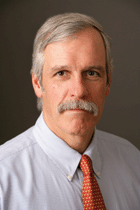 |
“We have been doing this for 35 years,” says Barry Ridings, vice-chairman and co-head of the global restructuring team. “We have a great deal of experience and there are very few things that we have not seen before.” He does concede, however, that this cycle is different. “The capital structures are a lot more complex – you now have second-lien loans whereas before you just had high-yield bonds. CLOs and CDOs are tough to negotiate with and the US bankruptcy law has changed – you can’t just hang around in bankruptcy any more, you must have a plan to get out.” But despite this complexity, Riding says that there is always a key group of creditors to engage with on the debt advisory side – the senior secured group. “Restructuring is all about change of control,” he says. “In order to bind the holdouts you often need to dip a company into bankruptcy temporarily. In north America we are seeing a lot of short-term, technical bankruptcies, many of which may have an M&A solution.” Restructuring is part of Lazard’s financial advisory business, which had operating revenues of $1 billion for 2008 and $163 million for the first quarter of 2009. Restructuring revenue for the first quarter of this year was $61 million compared with $16 million for the same period last year and $47 million for the fourth quarter of 2008. Its financial advisory revenues are split 51% US, 44% Europe, with the rest of the world accounting for 5%. The firm is redeploying resources into restructuring and capital structure advisory and has embarked on a global hiring spree at the senior level. Ridings is co-vice chairman and co-head of global restructuring with Terry Savage and the global co-heads of restructuring are David Kurtz (US), Richard Stables (Europe) and Laurent Rossetti (Europe).
Lazard has been on the ticket for all the big European restructurings this year as well, such as Countrywide, Ferretti, Honsel, Ineos and Vita. “A lot of European LBOs are being renegotiated and these are very complex negotiations,” says Rossetti. “The Monier deal will redefine the space in Europe (see Lenders rediscover their defensive side, EuromoneyJune 2009). There is a strong will from lenders to finance a solution and the ATY consortium is backstopping new money.” Rossetti attributes Lazard’s success in Europe to its regional scope. “We have a strong local presence in every key European market and are run as a pan-European franchise, not a local franchise,” he says. “The fact that there is no single bankruptcy law in Europe can cause difficulties but it can also present arbitrage opportunities.”
Ridings dismisses concern about growing competition in restructuring, confident that the firm will remain pre-eminent and that the independent adviser model is the right one. “You cannot be a lender to a company and its conflict-free adviser,” he states. “We have a very deep bench of restructuring experts who we team with M&A bankers. Very few restructuring firms have that combined skill set and we have all been working together for a very long time.”