 |
|
“I am driven by my stock price. Nothing else but my stock price. All my decisions are based on that and that alone. I go where I smell money – money means my stock price will rise and so I go there” Naguib Sawiris, Orascom Telecom |
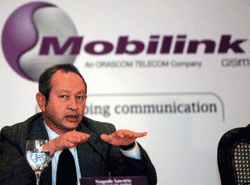
ORASCOM TELECOM HAS something that investors want to be a part of. Once you have spoken to Naguib Sawiris, the company’s CEO and chairman, it becomes clear what that is. “I am driven by my stock price. Nothing else but my stock price. All my decisions are based on that and that alone,” he says in an interview with Euromoney. “I go where I smell money – money means my stock price will rise and so I go there.” Orascom Telecom’s stock market performance suggests that Sawiris’s strategy is working. Since 2002 the share price has climbed from less than one Egyptian pound to the staggering E£78 that it is today. This statistic makes Orascom one of the world’s best-performing companies, and Sawiris, a 57% shareholder of Orascom, one of the world’s richest men, with a $10 billion fortune. But this raises a question. Why can this growing international conglomerate enjoy share price increases when others fail to impress investors? The answer is simple – Sawiris has learnt from mistakes over the years and now he is growing the company with a story that investors understand. There is no sign of Orascom Telecom’s share price suffering from a conglomerate discount, because his strategy is simple. “When there is a high population and a low mobile penetration in a country then Orascom Telecom will look at it,” he says.
At the moment Orascom has operations in Algeria, Tunisia, Egypt, Iraq, Pakistan, Zimbabwe and Bangladesh and holds a leading market position in three of them. From this list of countries it is clear that Sawiris is no stranger to risky countries: “Where there is risk there is often a lot of money to be had,” he says. Just a glance at a couple of Orascom’s markets show that Sawiris has kept to this theory.
Most obvious are the security issues and loss of potential revenues in Iraq. Since the war started, Iraq has lost nearly a quarter of its population through death and migration, and the Orascom subsidiary there, Iraqna, foots a $30 million security bill. But Sawiris is positive: “The war will end eventually and then we will be there. We will never move out of Iraq. It fits the Orascom strategy too well.” And Sawiris is committed to the country in more ways than just business. “I was for the Iraq war at the start because it removed a dictator,” he says, “but there has been mass destruction there now. I think the post-war management in Iraq is one of the worst stories in modern history. I think it should be taught in school on how to screw up.”
In Bangladesh, the subsidiary Banglalink has had to deal not only with being in third position in a market of six operators but also trying to persuade the authorities to reverse a decision to tax SIM cards. By March 2007, revenues had fallen to $30 million from $94 million in December 2006 as the subsidiary realized rapidly diminishing profits. But, as ever, Sawiris remains confident. “We have had very positive talks with the current regime – they are not corrupt and so the problem can be overcome,” he says. “We have shown them our balance sheets and they have seen the losses we are making, and seen the investments that we have put into the country, and so we think this will be resolved very soon. We have seen understanding from their side.” As ever his long-term vision and discipline in sticking to a clear-cut strategy mean that Orascom will not leave a market such as Bangladesh.
Looking forward
Despite the problems that Orascom’s businesses have to deal with, growth targets have been revised down only marginally. “Only slight changes were needed to our targets and we still expect growth of 20% to 25% in ebitda and revenue,” says Sawiris. “We are looking at 70 million to 75 million subscriptions by the end of 2007, and are aiming to cross the $5 billion revenue mark.” That is an impressive objective since subscriptions passed the 50 million mark only in December 2006. This was up from 30 million in just 12 months.
Sawiris maintains that Orascom’s subsidiaries now have an economic presence that means they cannot abandon markets. “When mobile phones are introduced to a country the GDP quickly jumps by up to 2%,” he says. “Obviously it is profitable for us, but you also feel you are helping the community.” Orascom subsidiaries have also been linked to driving forward the capital markets in countries they operate in. One such example is the bond issued by Mobilink, the Pakistan subsidiary, in November 2006.
Mobilink placed $250 million of 2013 notes that became a benchmark for Mobilink and Pakistan because it was the first international corporate bond issuance by a Pakistani issuer for 12 years. This was also the first international bond issued by one of the Orascom subsidiaries, which complete all financing at the subsidiary level. Aldo Mareuse, CFO of Orascom Telecom, says: “This offering expands the range of financing alternatives available to us to fund the development and growth of our operations in respective markets.” No further bond offerings are in the pipeline.
Naguib Sawiris is not a retiring man – his risk-taking strategy and quick tongue are viewed positively by leading businessmen worldwide. But in 2001 his foray into acquisitions left his short-term debt stretched and the telecoms company on the brink of bankruptcy. How did the situation arise? “You could call it over-ambitious from my side – I was a bit of a novice back then,” says Sawiris. “But with time I have matured and the company has evolved into what it is today with a balance sheet that is very different to what it was back then.”
Once the debt situation had been settled, Sawiris changed his strategy – he went from being in 26 markets in 2003 to focusing on a few big markets. He says: “I woke up one day and I did some calculations and I found out that 14 countries are giving me 10% of my revenues and 5% of ebitda but they were giving me 90% of the headaches and taking 90% of management time. And so if we dispose of these, if we take 90% of management and put them on the six biggest assets, although we lost 5% at the start, we made it back in no time.”
Disciplined acquisition strategy
He adds: “We are very disciplined in our acquisitions now. The last 10 deals that we have looked at, we have lost. This is because we were not willing to pay the horrendous prices that are on the market at the moment. We will not pay over the odds, I only buy if I think that I can create real value from the asset and the sale price of assets recently have been beyond this threshold – if the price is at the value that means the growth potential isn’t large enough then I do not buy.” As ever the stock price of Orascom, and so indirectly his personal wealth, are at the forefront of any decision.
Some telecom specialists claimed that Orascom overpaid for the licence in Algeria in 2002. The licence was brought by Djezzy, the Algerian subsidiary of Orascom, for $757 million and has since turned out to be the leader, as the incumbent is so inefficient. When contrasted with Egypt, a country where mobile penetration is already at 30% to 40% and whose third licence sold for $3 billion to Etisalat, an expansionary telecoms group based in the United Arab Emirates, it becomes clear that the Algeria deal was a sound business move – especially since revenues for Djezzy in 2006 were $401 million.
Scarce and expensive assets
Sawiris has recently taken an interest in Brazil, with the possibility of a bid for Brasil Telecom. “We are looking at Brazil, but these assets are not cheap, we are also looking at other Asian markets, but on the Orascom emerging market side of my businesses the opportunities are scarce and expensive,” he says.
But despite huge price increases, these licences are still selling. In March, Vodafone and Orascom entered a bidding war for a 67% stake in the Indian arm of Hutchison – Hutchison Essar. Eventually the stake was sold for $5.5 billion to Vodafone. Just a year before, Orascom had paid $1.3 billion for a 19.3% stake in the holding company Hutchison. “I don’t believe that the asset was worth the value that Vodafone paid for it and I don’t believe it is going to be as profitable as they expect,” says Sawiris. “In my view they have entered into a bigger problem than they think they have.” But when asked why Vodafone is paying these prices, Sawiris’s answer is clear: “It is nobody’s money. Vodafone’s largest shareholder owns less than 1% of the company, whereas the largest investor in Orascom is myself and I hold 57% of the company – I am not going to buy something stupid.”
Nevertheless several analysts feel that Sawiris was disappointed that he did not win this stake. “I think one of the main reasons why he went into Hutchison is because he was interested in opportunities in India – with the loss of the stake the company becomes a lot less interesting to him,” says one.
A problem has arisen in the past 12 months or so – there are no more greenfield emerging market sites left – nowhere is particularly risky, or has a very low mobile penetration level. “It is very simple,” says Sawiris. “In the emerging markets today licences are getting horrendously expensive, and so the only way to expand my telecoms operation is through acquisitions and organic growth in the markets I am already in.” But as with all the challenges he has faced in the past, Sawiris has an answer: “We believe that an operation like ourselves, with excellent management skills, can extract value out of saturated market assets that are, in our opinion, not optimally managed.” And so Sawiris has gone to Europe.
Weather Investments, is the holding company for all of Sawiris’s interests and is 97% owned by the Sawiris family. Sawiris used this entity to start the second branch of his telecoms empire. A clear distinction has been drawn between Weather Investments and Orascom: “Orascom is an emerging market operation, whereas through Weather I am investing in assets that can have value extracted if management is improved,” says Sawiris.
In 2006, Sawiris finalized the leveraged buyout from Enel of Wind Telecom, the third-largest Italian fixed-line telecom provider, for an amount that valued Wind at $12.1 billion, after beating an equity consortium made up of Blackstone and Goldman Sachs. This gave Sawiris a company with 15 million mobile phone subscribers, 2.5 million fixed-line subscribers, and Italy’s largest internet portal, Libero. Also included was a 50% plus one share stake in Tellas, a Greek fixed-line and internet carrier.
Because Enel, Italy’s largest power provider, did not have telecoms expertise, Sawiris saw an opportunity. “The previous owners did not have the depth of knowledge in telecoms and so the management was not optimal,” he says. “In contrast with our level of experience we saw we could extract significant value out of the asset – we have proved that now.”
The Wind purchase was just the start of a new Mediterranean telecoms empire. Since then, Sawiris has completed a leveraged buyout for a 100% stake of TIM Hellas in Greece. This purchase was seen to offer gains that could be retrieved through improved management but also because of possible synergy with Tellas and Wind. The group Wind Tellas has now been formed.
Weather Investments funded the acquisition of TIM Hellas with proceeds from a €1.2 billion three-year collateralized loan. The new loan was also used to partly pay off an existing €500 million loan. By funding the acquisition this way, Weather Investments improved its cash position and lowered the debt service requirements of its finance subsidiaries.
In May 2007, Sawiris placed a “very lucrative” offer with the state-controlled electricity utility Public Power Corp (PPC), the owners of the final 49.9% stake of Tellas, that will tie up his claim to the Greek telecoms industry. In the first week of August, Sawiris prevailed. “PPC’s board decided to accept the offer… of €175 million,” said a PPC statement. If there had not been a sale agreement, and Sawiris did not sell his stake, he would break one of his business principles – to eschew business partnerships with government-run entities. This principle emerged after business deals with Syria and Yemen went sour several years ago and was the reason Sawiris gave for not being interested in the upcoming partial privatization of Hellenic Telecoms (OTE).
Future merger
Investor jitters were a minor problem that arose during this period of European leveraged buyout activity – several shareholders feared that a new debt burden, which totals €12.3 billion with Wind and TIM Hellas combined, would come in tandem with these purchases. But this was not the case. “Several shareholders feared that there was a connection between my European interests and the emerging market assets. But there is a clear distinction between the two – I personally funded the European purchases,” says Sawiris. Now Weather Investments owns his Mediterranean investments and, through Weather Capital, a non-recourse 50% plus one share controlling stake of Orascom Telecom. “We reassured our shareholders when we brought Wind that the two are very separate entities, if you look at how the transaction was financially engineered you can see that there is no recourse on the debt of these assets on any of the Orascom telecom books,” says Sawiris.
Financing for Weather Investments has involved, to date, a €825 million seven-year exchangeable bond. This bond is seen as part of a broader financing package of the Weather Group, including a commitment of $2.5 billion of bank financing for Orascom Telecom. This aims to improve the capital structure of Weather Capital and Orascom Telecom and secures the long-term financing needed for the Hutchison purchase made in 2006.
At present, Orascom Telecom has $4.7 billion of debt. The proceeds of February’s $750 million bond, the largest debut bond by a sub-investment-grade issuer in EMEA, were used by Orascom for general corporate purposes and for the buy-back of 5%, out of the 47.52% public float, of the Cairo and London GDRs over a 12-month period. A certain amount was also earmarked to be ready for investments as and when telecom licence auctions came up.
But as Orascom’s targets become markets that have higher mobile penetration, a fundamental strategic question has been raised – will Sawiris merge the two entities operations, Orascom and Weather Investments, and complete his dream of a world-leading telecoms empire?
“I don’t think so,” he says, “The different nature of the assets, and the different debt situation of these assets, make it unlikely. Orascom shareholders would not want to take on the debt burden that Weather and Wind hold at the moment.” But Ziad Wael, an analyst at EFG Hermes, speculates: “There will come a time, as the markets mature, when Orascom will no longer be the growth story that it is now. When this happens so a merger with Weather Investments could make a lot of sense. It could be five to six years down the line.”
Either way, if a merger does occur, it will only happen after Sawiris has carefully considered the possible impact on his share price.