|
|
|
Andreas TreichlErste Bank |
|
Not many bank CEOs in Europe have been in post as long as Erste Group’s Andreas Treichl. To put it in perspective, an edition of the Wall Street Journal Europe that included a profile of him after his first eight months on the job also featured pieces on president Yeltsin’s choice of Sergei Kiriyenko as his successor, the potential implications of a single currency for Europe’s banking sectors, and the uphill struggle faced by the Czech Republic, Poland and Hungary to get into the European Union.
Europe has seen a lot of changes since then, and so has Erste. When Treichl took over in 1997, it was a traditional Austrian savings bank owned by a venerable foundation with a small footprint in central Europe. Brought in to shake up the group and lead an expansion into the untapped markets of emerging Europe, Treichl more than fulfilled his brief.
In his first six months in office, he took Erste public, overhauled the bank’s management and bought a leading lender in Hungary – prompting the Wall Street Journal to headline its profile ‘Treichl rides Erste as hard as his Harley’, a reference to his penchant for motorbike racing. Acquisitions in Czech Republic, Slovakia and Croatia followed rapidly, and proved so successful that the bank was emboldened to move further afield into Serbia, Romania and Ukraine.
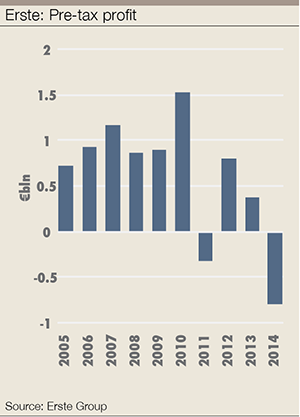
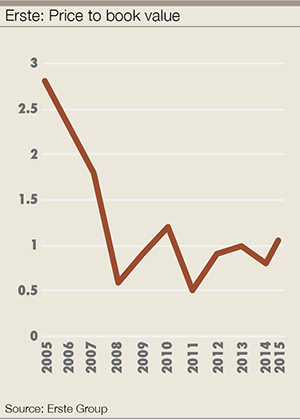
For nearly a decade, this strategy paid handsome dividends. For 10 years after its IPO, Erste posted record profits every year; the bank became a darling of emerging market investors, trading at close to three times book value.
Then in 2009, as for so many of Erste’s European peers, everything started to go wrong. Large portfolios of corporate debts at BCR, the Romanian market leader acquired by Erste for a substantial sum in 2005, turned sour. Hungary’s government embarked on a five-year drive to bleed its banks dry through taxes and penalties for foreign currency retail lending. Croatia began a slide into six years of recession, while economic stagnation and rampant corruption made Ukraine difficult for foreign banks.
Plummeting profits
Emerging Europe’s other big regional banks, Raiffeisen and UniCredit, faced many of the same challenges but were able to make up the shortfall with stunning profits from Russia. Erste, which had resisted the temptation to push further east, saw its profitability plummet.
From close to 20% in 2005, the bank’s return on equity slumped to low single digits, and in 2011 it registered its first loss since going public. Hopes that this represented a nadir in Erste’s fortunes were dashed when the bank again plunged into the red last year, posting a €1.4 billion net loss on the back of a second round of massive provisioning and goodwill write-downs on its CEE subsidiaries.
None of this, however has dented Treichl’s faith in Erste’s strategy – which remains today, as it was in 1997, to be the leading regional retail bank in what is now the eastern part of the EU. “The crisis changed the fundamentals of our region but it didn’t alter our belief that it will outperform the rest of Europe for many years to come,” he says.
|
We have nothing to offer the hyper-rich and we have nothing to offer the big corporations. That is not our role. Our job is to create wealth for the lower to very upper middle classes Andreas Treichl, Erste Bank |
In economic terms, his faith already appears to have been justified. After a sharp slowdown post-crisis, central Europe and much of the Balkans have made an impressive recovery. Czech Republic, Slovakia, Poland, Hungary and Romania are all growing at 2% to 3% a year, much faster than most western European economies. Public debt levels remain low across the region, which is due to receive as much as €167 billion in development funding from the EU over the next five years.
From a banking perspective, there is also still substantial room for growth.
More than 25 years after the fall of the Berlin Wall, financial penetration in CEE remains extremely low. Even in Czech Republic, the region’s most advanced economy, bank lending stood at just 62% of GDP at the end of last year, while in Romania the figure was as low as 33%. That compares with around 127% in Erste’s home market, Austria.
“All the CEE markets that we are in are to a greater or less extent still developing markets,” says Treichl. “That’s what we find so attractive about them. Retail banking in western Europe can be profitable, but in saturated markets it’s hard to see where growth is going to come from, so the next 25 to 50 years will basically be a battle to maintain position.”
Of particular interest for Erste in emerging Europe is the potential for rapid growth of the middle classes – a customer base that, Treichl says, the bank sees as peculiarly its own. “We are not an investment bank, we have nothing to offer the hyper-rich and we have nothing to offer the big corporations,” he says. “That is not our role. Our job is to create wealth for the lower to very upper middle classes. We are ourselves middle class and we are here to serve the middle class. That is a very different story in CEE, where the middle class is still very small.”
In describing himself as middle class, Treichl is being rather modest. His father, the son of a baroness, was chairman of Creditanstalt through the 1970s and led the bank’s expansion outside Austria, thus laying the foundations for UniCredit’s CEE empire. His mother came from a famous German publishing family and he himself is married to the extremely aristocratic Desirée Treichl-Stürgkh, a jet-setting fashion journalist and organizer of Vienna’s annual Opera Ball.
Another key advantage of emerging Europe, Treichl adds, is the flexibility of its labour markets – something conspicuously lacking in western Europe and particularly in Erste’s heavily unionized home market, Austria. “In CEE, you can adapt your business to economic circumstances,” he says. “You are not stuck in a framework that can’t be changed rapidly. If you want to grow, you can. If you want to shrink, you can.”
Since the financial crisis, the emphasis has been more on shrinking than growing. In the past five years, Erste has shed 15% of its staff in Hungary and cut its Romanian workforce by more than a quarter. The group’s balance sheet has also contracted. By the end of last year, total assets had fallen to €196.3 billion, the lowest level since 2006, due to a combination of bad-debt work-outs, weak credit demand across CEE and the sale – at a €75 million loss – of Erste’s Ukrainian subsidiary.

|
|
|
Andreas Treichl insists Erste is not at present in acquisition mode |
After six years of fire fighting, however, Treichl says Erste is finally ready to move into a new phase of recovery and even expansion. Last year’s loss, while painful, eliminated the last remaining goodwill entries for its Romanian and Croatian operations from the group’s balance sheet. An increase in provisioning in Romania also set the stage for the disposal of large chunks of BCR’s legacy impaired real estate loans. The bank sold €670 million of bad debts last year and is currently finalizing the sale of another €2 billion portfolio, dubbed Project Neptune.
Meanwhile in Hungary, Erste’s other problem market, Treichl took the bold step of negotiating directly with Viktor Orban, the country’s populist and bank-bashing prime minister. The result was a landmark three-way deal between Erste, the Hungarian government and the European Bank for Reconstruction and Development, in which Orban promised to slash bank taxes, stop making unjustified demands on the sector and take a 15% stake in Erste’s local subsidiary. In return, Erste undertook to boost lending to the Hungarian economy.
Signed with great fanfare in February, the deal lost some of its lustre a month later, when Hungary’s government announced plans to force its banks to stump up several hundred million dollars to compensate clients of a failed – and completely independent – brokerage house. Erste and the EBRD have both strongly protested the levy, which they say is in clear breach of the February agreement, and Treichl is clear that until the issue is resolved the sale of an equity stake to the Hungarian government will remain on hold.
Nevertheless, he says, the fact that policymakers have kept their promise to reduce the banking tax is a very strong signal.
|
If we want to still be here in 25 years’ time, we have to be able to help young people solve their financial problems Andreas Treichl |
Certainly, the issue does not seem to have affected Erste’s appetite for expansion in Hungary. The bank announced in March that it had joined the bidding for Citi’s Hungarian retail operation, which would boost its local balance sheet by around 10%, and reports in June suggested it was likely to win the process.
It is not the only purchase Erste has attempted in recent years. In 2013, the Croatian government named the bank as one of two shortlisted bidders for state-owned lender Hrvatska Postanska Banka, but the sale was subsequently aborted.
Treichl insists, however, that Erste is not at present in acquisition mode. “We are looking at smaller transactions in the markets that we are already in if they fit our business strategy, but acquisition will not be at the forefront of our strategy over the next few years,” he says. “We have faced considerable challenges in recent years and we need to focus on strengthening our present businesses.”
Polish market
That means that, once again, plans to enter the Polish market – an aim of the bank since well before the financial crisis and one that recurs in every Erste annual report – have been put on hold. Treichl confirms that a Polish acquisition is unlikely in the near term. “One of the foundations of our strategy is that in every country we want to stay in for the long term, we want a market share of at least 15%,” he says. “You can’t be a broad retail bank holding a 2% market share, it’s just not profitable.”
As he notes, that severely limits opportunities in Poland, given that leading lender PKO BP has a market share of just 15.9%.
Regrets at missing out on the large and lucrative Polish market are tempered, however, by an increasing feeling of vindication over Erste’s refusal to push into emerging Europe’s wild east. The group has only made two small-scale purchases in countries that are still outside the EU today, Ukraine and Serbia, and – unlike Raiffeisen and UniCredit – it lost no time in disposing of its Ukrainian operation once the operating environment deteriorated.
“We have always been very nervous about countries that are not in the EU because we believe that the political risk there is substantially higher,” says Treichl. “The EU has its problems but we believe that it provides an institutional framework that in the longer term ensures that corruption is reduced or even eliminated. We left Ukraine when we lost faith that it would become a member of the EU. We are still in Serbia, which we are confident will join.”
If Treichl has been less adventurous in CEE than some of his fellow regional bankers, however, his recent record in his home market clearly shows that he has lost none of his dynamism and enthusiasm for innovation in his 18 years at the helm of Erste. Three years ago, just after the group’s first annual loss, he took the bold step of initiating the building of both a cutting-edge digital platform and a massive new headquarters in Vienna.
Both projects represent big advances for the conservative bank in the Austrian market. Launched in January, the digital platform – known as George – was designed by a team of young tech specialists from mainly non-banking backgrounds in collaboration with Erste’s customers. If it doesn’t actually ‘think for itself’ as the bank’s marketing claims, it does have impressive functionality and flexibility. Customers can not only perform complex analysis on data from their Erste accounts, using either free tools or paid-for add-ons from the George Store, they can also input details of accounts with other providers.
George has already attracted more than 270,000 users and is being continuously developed at the ‘Erste hub’, the project’s base in central Vienna – which, with its informal vibe and walls covered in statements such as “we are connected, baby” and “from geocentric to heliocentric”, feels more Silicon Valley than central European. The platform is due to be rolled out across Erste’s CEE network from later this year, starting with its most advanced and profitable markets, Czech Republic and Slovakia.
For Treichl, George is about much more than offering customers new banking channels. “Obviously young people don’t go to branches and want to have everything on their mobile phones – but if we want to still be here in 25 years’ time, we also have to be able to help those young people solve their financial problems,” he says. “George creates a platform where we can build a menu for our clients for different situations in their lives rather than just sell them a product. If a client wants to buy a home, for example, we can give advice on whether they should buy now or wait until they have more equity.”
This approach could also help to prevent a repeat of the issues that have plagued Erste – and other lenders – over the past seven years, adds Treichl. “Financial literacy is a key part of this. Many of the problems of the past came about because we sold people products they didn’t understand and we didn’t explain them fully.”
As Treichl acknowledges, this new model will also have profound implications for Erste’s staff. “In future we will probably need a lot less employees than at present, but we will need people who can service a mass affluent, affluent and wealthy client base in all aspects of their financial lives,” he says. “We are therefore going to spend a huge amount of money over the next few years, not only on developing our digital network but on educating and re-educating our employees.”
Erste is already spending a sizeable sum on relocating them. The group’s new campus, in the regenerated Quartier Belvedere district next to Vienna’s main train station, is scheduled to cost close to €300 million and is almost as cutting-edge as George. In return for benefits such as restaurants, a health centre and a crèche, staff will be expected to hot desk at a range of workspaces, from standing desks and quiet rooms to meeting spaces and chill-out sofas.
Perhaps to help reconcile his employees to such drastic changes, Treichl says he will be leading by example when the complex opens in December. “I will have a desk but not an office,” he says. “It would be absurd to move 5,000 people into the new building and only give the board members offices. It wouldn’t feel right.”
Given that the six board members will be sharing a vast suite with panoramic views of central Vienna, this should not be too much of a hardship. It does, however, demonstrate once again Treichl’s determination to be at the forefront of change. By building Erste into a leading CEE player, he has already transformed the bank once. Reinventing a nearly 200-year-old institution into a leading digital player should be well within his means.