Illustration: Jane Webster
At a time when the likes of N26 and Revolut are capturing millions of French customers, the growth of Compte Nickel – arguably France’s biggest neobank – is stepping up a gear. But Nickel is not your stereotypical London- or Berlin-based, consumer-facing fintech firm. It’s based in a slightly drab building in an unfashionable district just outside Paris’ inner ring road. Unlike its peers, it’s making more profit, rather than bigger losses, as it expands abroad.
Nickel’s greatest difference with other fintechs and neobanks is that it does not try to recruit urban millennials and digital natives. Its success is based not just on using new technology but also on a unique ability to distribute bank accounts cheaply, in a vast physical network reaching thousands of isolated and marginalized French communities.
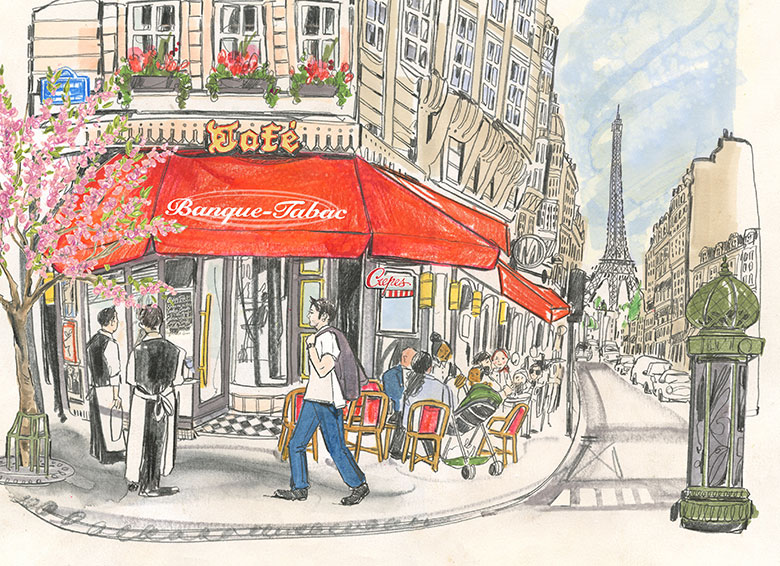
It does it through France’s ubiquitous bar-tabac network – tens of thousands of tobacconists, typically doubling up as bars and selling newspapers and lottery tickets, as well as cigarettes.
Nickel struck an exclusive agreement to deploy electronic terminals in the network in 2014 in return for a 5% stake in Nickel still held by the tobacconists today. It gave Nickel a readymade sales force to operate the terminals to check identities, issue cards on the spot and take deposits; all for a €20 fee paid by the client.
No wonder Nickel’s leadership made so little effort to strut their stuff at the Paris Fintech Forum in January; an event that otherwise epitomizes France’s determination to rival the UK fintech sector.
We didn’t even know the word fintech when we started in 2014… Everyone uses finance and technology, even the big old companies. For me it’s just a word – Hugues le Bret, Compte Nickel
Many of Nickel customers use the account precisely because they are uncomfortable with banking solely online.
While technology is vital to a business relying on real-time information processing, co-founder and chairman Hugues le Bret is not even sure Nickel is primarily a fintech company.
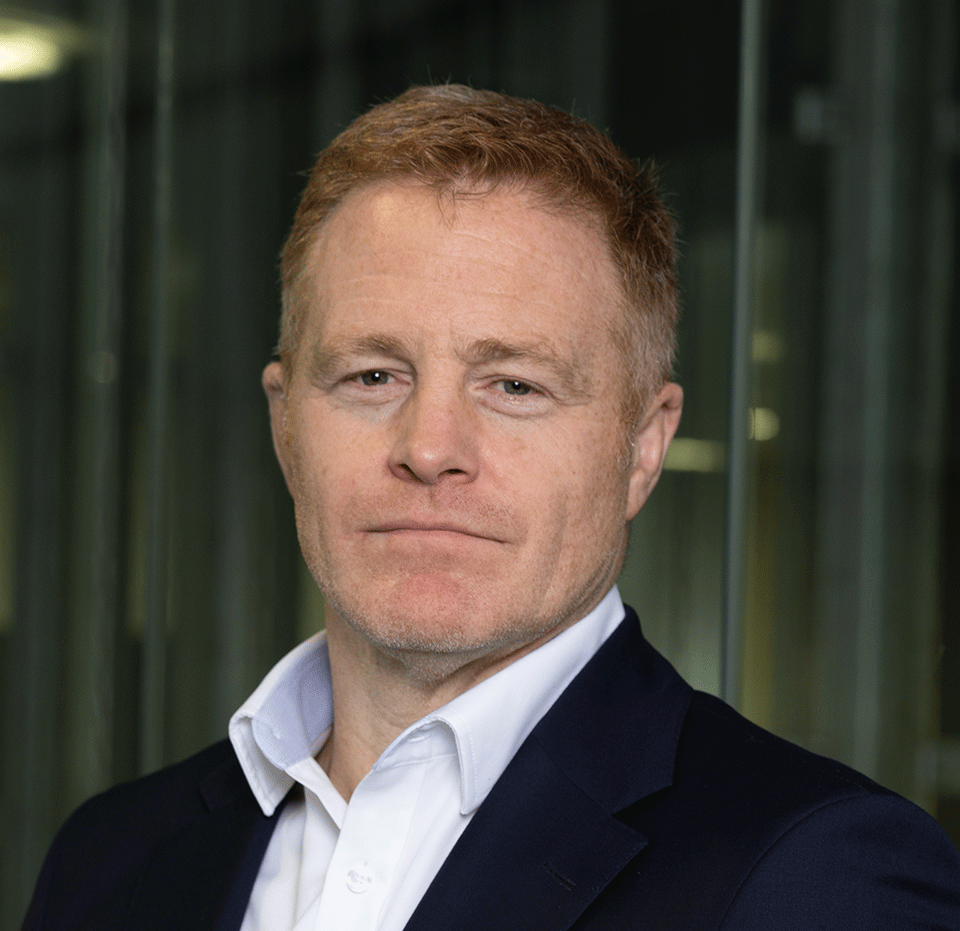
“We didn’t even know the word fintech when we started in 2014,” says Le Bret. “Everyone uses finance and technology, even the big old companies. For me, it’s just a word.”

Hugues le Bret, Compte Nickel
Nevertheless, Nickel can claim to be France’s answer to the likes of UK-based Revolut, which offers a similar payments-focused service.
Although some way off Revolut’s 10 million clients, Nickel has won over more than 1.5 million people with only a few hundred employees and has installed terminals in some 5,600 bar-tabacs. It is targeting 10,000 tobacconists and four million clients by 2024 in France alone. Even that big number would still leave most of the 27,000-strong French tabac network to develop.
This spring, and under the same name, Nickel is launching in Spain. It thinks it can get a million Spanish clients by 2024, by which time it wants to be active in six other European countries.
Distribution partnerships
BNP Paribas’ 2017 acquisition of 95% of Nickel seemed a strange marriage. It is the epitome of the French banking establishment: the closest thing Europe has to a champion to compete with the likes of JPMorgan, and it is known as a bank for multinationals and affluent people in cities.
Mutual groups traditionally do more to serve retail in France. Perhaps wisely, BNP Paribas does not make its backing of the company obvious to most users.

Thomas Courtois, Nickel
“Our strategy is not to cross-sell BNP Paribas products,” Nickel’s chief executive, Thomas Courtois, a BNP Paribas lifer, tells Euromoney. “We don’t want to transform Nickel into an online traditional bank.”
Yet in a novel approach to BNP Paribas’ wider efforts to become a continental champion, Nickel is trying to forge distribution partnerships similar to the one with the French tobacconists’ association.
Effective this spring, and thanks to an introduction from BNP Paribas, Fenamix, an association of distributors of the Spanish state lottery, has agreed to let Nickel roll out the terminals used to check identities in its 7,000-odd stores.
Euromoney understands Nickel and the 13,500-member Spanish tobacconist’s union are close to a similar tie up.
With luck, and support from BNP Paribas, similar networks in other countries could follow.
Le Bret says Nickel’s next partners will not become part owners of Nickel. But tobacconists elsewhere in Europe face the same pressure to retain footfall, as fewer people smoke and it becomes easier to pay for things online. These outlets are widespread in Austria, Spain and especially in Italy, where they are like mini-stores that also sell things such as stamps and bus tickets.
So could Nickel become a fintech champion for the French and European financial establishment? Its strategy is more international than Société Générale’s slightly older online bank, Boursorama, which Le Bret previously ran.
It also has a much bigger client base than newer Orange Bank.
Such a status would be paradoxical, because tobacconists don’t enjoy any of the prestige of traditional banks. They are more likely to be down an alleyway than on the high street; or in a far-flung district with poor transport links that banks no longer deem economically vibrant enough to justify a branch.
As one senior French fintech investor says: “Nickel is the bank of the gilets jaunes.”
Naturally, Nickel does not boast any affinity to a group known for vandalizing high-street bank branches. But its advertising – with the word ‘bank’ crossed out and replaced with ‘account’ – emphasizes that it is not an elitist offering. It’s proud to serve all society, which necessarily includes young people and ethnic minorities in cities and suburbs, as well as the alienated ex-urban demographic that has taken to the streets over the last year and a half sporting high-vis yellow vests.
[The network] has to be very popular. The best is when there’s a federation or a union of networks, and especially if each person is the owner, so each one is interested in the profit and loss – Hugues le Bret
One of the reasons why Nickel’s physical network has been so important is the requirement in France to do an in-person identity check when opening a bank account for someone who doesn’t have one. Other online banks have got around it by getting the client to transfer money from one of their existing accounts, which, in effect, excludes the unbanked.
According Courtois, Nickel’s clients often find depositing money at a traditional bank intimidating. Moreover, you can only spend what you have with Nickel, so there’s no chance of getting sucked into a debt cycle through an overdraft.
About three quarters of Nickel’s clients earn the minimum wage. A third are among the 2.5 million people in France who the banks have blacklisted for being bad borrowers, often thanks to an overdraft.
Even under BNP Paribas, Nickel has cultivated its outsider appeal, targeting migrants from outside the European Union. Last year, it started accepted all foreign passports with an electronic strip – that is to say about 150 countries – as long as the person can show a French address.
Perhaps this is because, according to Le Bret, banks previously blacklisted Ryad Boulanouar, Nickel’s other co-founder and the real mastermind behind the company.
An engineer, Boulanouar designed Nickel’s terminals after building Navigo, the electronic ticketing system for the Paris metro, in the late 1990s. More recently he has been involved in a project to make it easier for people to get help from charitable organizations via a chatbox, Mon Ami Poto.
Almost a decade ago, after friend introduced him to Boulanouar, Le Bret quickly recognized the potential of the idea for Nickel. Previously chief executive of Boursorama and before that Societe Generale’s head of communications, Le Bret brought knowledge of how to handle the media, investors and the banking establishment.
Although Le Bret seems to fit neatly into the stereotype of privileged banker, he too can point to his outsider status. He published a book in 2010 about his experiences during the Jérôme Kerviel affair, SocGen’s rogue trader, which irritated old colleagues – including Frédéric Oudéa, now SocGen’s chief executive, and Jean Pierre Mustier, now chief executive of UniCredit.
Le Bret quit Boursorama just before it was published.

Stronger backing
Today, neither Le Bret nor Boulanouar own a share in Nickel. San Francisco-based French-led Partech Ventures led an initial €10 million funding round in 2015, when the founders still owned a majority stake. By 2017, however, Nickel needed to replace these initial backers with an investor that would not only offer financial muscle but also strengthen its audit process and build its resilience in areas such as cybersecurity and anti-money laundering.
Stronger backing was essential as Nickel grew and as its potential became clear, especially in terms of international expansion. Indeed, it will need to be especially careful in forging a partnership with the Spanish tobacconists. In May last year the Bank of Spain removed authorization for another firm, Ekuantia, to provide a similar service through that network, using a card branded PocketPay, after a compliance lapse.
Le Bret accepted BNP Paribas’ offer without an adviser, partly as the bank made its decision quickly, in a matter of weeks. But snowballing clients and imminent profitability brought offers from other big consumer-facing companies – banks and non-banks – as well as from investment firms.
“A lot of people wanted to buy us,” says Le Bret.
For BNP Paribas, meanwhile, Nickel is a new fourth leg to its retail offering, alongside the traditional green-branded bank, the private bank and Hellobank, its offering for young adults. Nickel allows the bank to show it is widening access to banking and has more than doubled in size since BNP Paribas completed the acquisition in 2017.
The bet is that branch closures, the prevalence of relatively expensive and opaque bank fees, and social inequality will fuel greater demand for the service. These factors have come into the decision about where it will expand, says Courtois. Nickel is opening about 150 points of sale a month in France, he notes, at a time when bank closures are accelerating.
Austria, Belgium, Italy and Portugal are top of the list of countries where Nickel will go next and it is already scoping out opportunities.
People understand how we make our money. It’s very transparent. We were clear from the beginning: Nickel is different. We said no free lunch and no trap – Hugues le Bret
Italy, above all, is the potential game changer. The Italian tobacconist network is about twice the size of that in France, at around 55,000. It is a country that has seen a big increase in poverty and is experiencing both branch closures and higher bank fees to compensate for negative interest rates and other problems.
As the tie-up with the Spanish lottery shows, the partner need not be a tobacconist. It could be a convenience store, a petrol station, a betting shop or anything else. What’s important is that it is widespread and that everyone feels welcome there – especially the kind of person who might fear being turned away by a high street bank.
“[The network] has to be very popular,” says Le Bret. “The best is when there’s a federation or a union of networks, and especially if each person is the owner, so each one is interested in the profit and loss.”
From the outset, Le Bret and his three co-founders – notably Michel Calmo, still in charge of the international operation – explored how much scope there was to move outside France, especially to Italy, Spain, and Austria. Le Bret says he first met the Italian tobacconist federation in 2014, thanks to his contacts in the French tobacconist union, which is part of a pan-European confederation.
What has changed since then is that Nickel is profitable, thanks to bigger scale and tens of millions of euros in savings from piggybacking BNP Paribas compliance and procurement.
Although BNP Paribas is not providing extra capital yet, it is giving back office support for Nickel’s international rollout in areas such as marketing and human resources. That is the case in Spain, for example, where the group is already present through consumer finance subsidiary Cetelem, fleet-management company Arval and in corporate banking.
As Nickel moves to a multilingual and multi-jurisdictional operational set up, opening in a third country could be a much smaller leap than opening in the second.

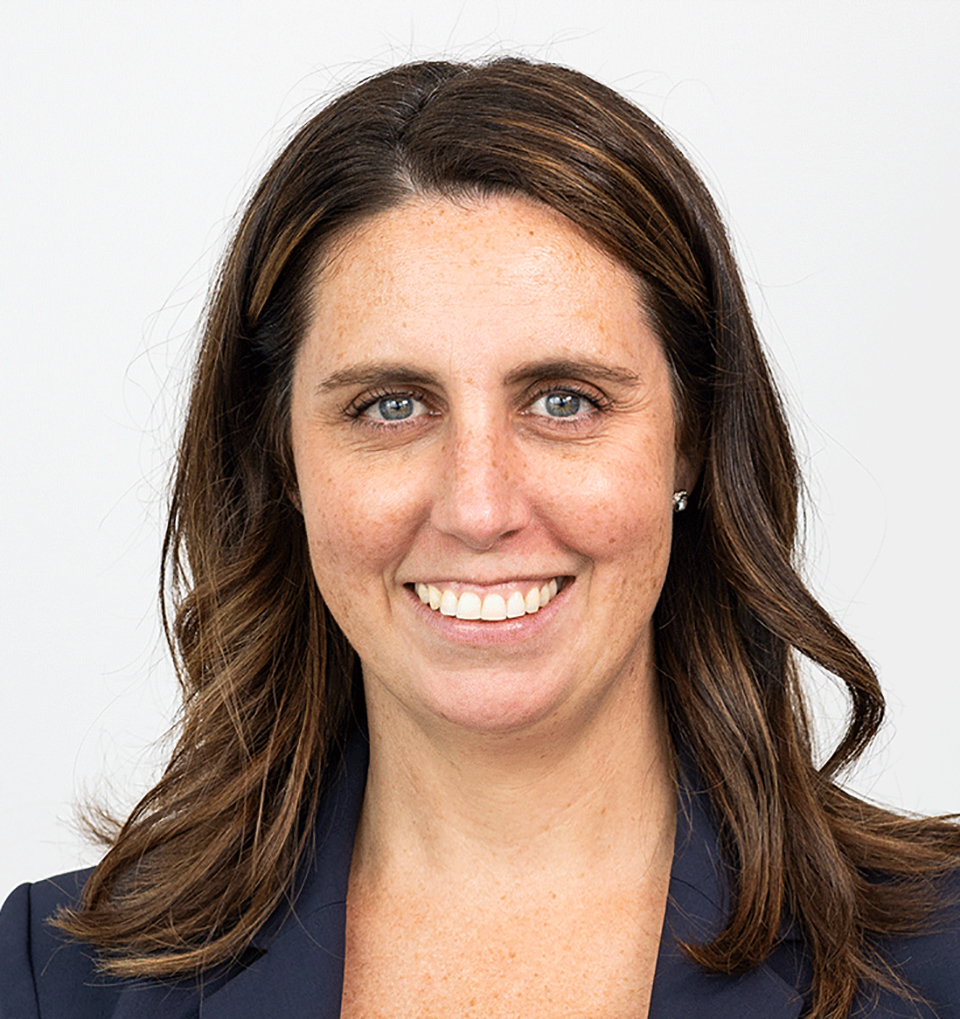
Marie Degrand-Guillaud, Nickel
“Whereas before we were a French company, now we’re an international company,” says Marie Degrand-Guillaud, Nickel’s director in charge of communications and partnerships.
The plan is to open in one country a year until 2022, then two a year in 2023 and 2024.
All this is in contrast with Hellobank, which has disappointed those who hoped it would be a low-cost way to expand rapidly in retail financial services across Europe without the risks of buying a big rival institution abroad.
Nickel benefits from similar freedoms of movement in the European Union, such as license passporting, as well as a more agile IT system.
Cross selling
So, what’s the end game? One prevalent view in the French banking community is that Nickel could be a vehicle to acquire clients to whom it could later offer BNP Paribas consumer finance and insurance. Does Nickel therefore face the same old-tech problem of choosing between high growth and profitability?
Thanks to its electronic terminals in tobacconists, which require minimal training, Nickel is exceptionally cheap to roll out and run, although it is not especially cheap for its clients, at least compared with other neobanks. Its turnover is similar to Revolut, at around €60 million – although it has far fewer clients – because its average revenue per client goes way beyond its €20 account fee. Most of its revenues come from card fees, including a €1 charge each time clients take out cash from an ATM.
However, largely because of its clientele, Nickel is unlikely to become a stepping stone to BNP Paribas’ branch banking products. Again this is in contrast to Hellobank, many of whose clients in France and Belgian were previously in the green bank and will move back there when they reach 28.
Le Bret is adamant that, unlike the neobanks, there is no plan to snare young middle-class people who might later become ripe for cross selling. He says Nickel’s less upwardly mobile target market is partly why the rise in France of companies such as Revolut, N26, and Orange Bank has not slowed growth.
Insurance could be part of the future, he says, but not soon, and not necessarily using BNP Paribas’s Cardif, which does not provide the basic insurance offering attached to Nickel’s premium card.
“Credit is not on the roadmap,” says Le Bret. “People understand how we make our money. It’s very transparent. We were clear from the beginning: Nickel is different. We said no free lunch and no trap.”
Nickel is also marked out from BNP Paribas and Hellobank by an entirely separate IT system. The latter remains plugged into a national IT system shared with the main bank.
Nickel outsourced its IT platform, but has been developing its own core banking system over the last two years. The new one has similar technology to Netflix, according to Degrand-Guillaud. The decision to bring it in house was, again, made before BNP Paribas’ arrival.
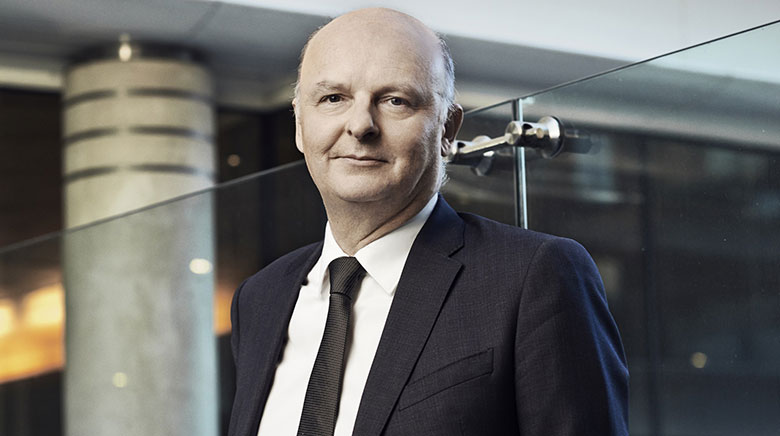
Thierry Laborde, BNP Paribas
“We’ve kept the spirit of Nickel and its autonomy” says Thierry Laborde, BNP Paribas’ deputy chief operating officer and head of domestic markets.
Out of about 350 employees at Nickel, only a handful are from BNP Paribas. One of them, however, is the chief executive.
Since Courtois’ arrival, Le Bret has stepped even further away from the day-to-day running of the company, and says he only spends about 15% of his time on Nickel today.
Mostly, he works under Laborde evaluating the group’s opportunities in the fintech sector. He spent four months in Italy last autumn consulting at BNP Paribas subsidiary Banca Nazionale di Lavoro, Italy’s sixth biggest lender.
Courtois, meanwhile, previously managed various BNP Paribas’ retail operations in France and internationally. He is also reluctant to factor in the distribution of consumer credit and savings through Nickel.
“Our main objective is to expand our customer base, not our product range,” he insists.
Laborde agrees: “We have to be cautious on this point. Nickel clients want easy payment and money transfer services. They are not looking for credit offers.”