Almost half of the population lives below the poverty line and spends almost half of its income on food. Rising food prices are a crucial issue for finance minister Mirza Azizul Islam, who is also seeking ways to bring the country into the club of Asian growth economies. Chris Wright reports.
ARMY CHIEFS ARE rarely to be found touting the virtues of potato recipes. But these are remarkable times. So it was that Bangladesh’s general Moeen U Ahmed – who under the military-backed interim government commands much of the real power in this country of 158 million people – addressed a press conference at the Dhaka Radisson hotel in May urging people to eat more spuds.
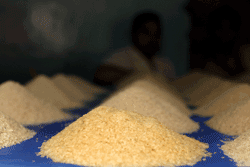
Moeen’s entreaties were designed to ease pressure on rice supplies, and were one of the more oblique side effects of a food crisis that, at its peak, more than doubled the price of rice imported by Bangladesh.
Bangladesh is very much at the sharp end of the world soft commodities boom that has made others rich. The increase in minimum rice export prices from India from $425 a tonne in October 2007 to $1,000 a tonne in March 2008, feeds directly through to people in importing countries who are on the survival line already – Bangladesh gets most of its rice imports from India. The Centre for Policy Dialogue, a key local think-tank, estimated that during the first quarter of 2008, the section of the population below the poverty line – which already spends 46% of its income on rice – experienced an income erosion of 36.7%. As JPMorgan economist David Hernandez has noted: “If you are looking for a symbol of how higher food prices are really hurting poorer countries, then Bangladesh is it.”
High prices are bad enough, but in the worst circumstances this year, Bangladesh couldn’t get rice at any cost. Twice, in April and May, Bangladesh put out tenders for rice and didn’t receive a single response, a product of panicked export bans in many of the world’s biggest exporters, among them India, Vietnam, Cambodia and Thailand.
On top of everything else, Bangladesh also faced poor yields from two of its key domestic rice harvests after the impact of one of the cyclones (this one called Sidr) that so frequently blight the country.
Things looked apocalyptic back then. However, three months on, Bangladesh has managed to step back from the brink, chiefly because of the bumper harvest known as the boro, the single most important of the year, which yielded 17.3 million tonnes on its own. Just as important, Bangladesh struck a deal to import 500,000 tonnes from India; and, to the relief of all, international rice prices have started to fall. So the country and its poor live to fight another day. But the experience has been alarming.
Euromoney met Mirza Azizul Islam, the financial adviser (the equivalent of finance minister) in Dhaka in August to get his perspective on the impact of food prices and what it means for Bangladesh. “Bangladesh being a net food-importing country, it did have a significant impact on domestic prices,” he says with some understatement. “In a globalized world, you cannot insulate domestic prices from the international price levels.”
|
How Bangladesh goes hungry |
|
Trends and contribution (GDP) by expenditure, year-on-year |
![]() |
|
Source: Bangladesh Bank, CEIC Data Company, Citi estimates |
Getting past it was a combination of luck and judgement. The government ensured there was adequate electricity to power irrigation plant, tried to stamp out instances where dealers refused to sell fertilizers at official prices, and increased the procurement costs of rice to give a sufficiently good margin to make life bearable for the farmers (and to stop them succumbing to the attraction of producing other, non-staple crops). But he acknowledges some good fortune too. “We were lucky that the last crop of rice was a bumper crop,” he says. “All this worked to ensure that, at least in terms of available quantity, there is no shortage. But that does not fully address the pricing problem.” In a country with so many in poverty – studies tend to estimate 40% to 45% of the population, or at least 60 million people – there’s no choice for a government but to try to help them out. Bangladesh extended its social protection net, both in terms of the number of people it covered and the quantum of financial entitlement within it, and launched a new programme called the 100 Days Employment Guarantee Scheme, ensuring that at least one person in each poor household got at least some employment, typically in some form of rural infrastructure.
Economic drag
While that keeps the wolf from the door at an individual level, it’s an inevitable drag on an economy that wants to grow. The fiscal budget in June doubled subsidies for fertilizers, petroleum and rice, although some pass-through prices have been adjusted since; these subsidies accounted for 14% of the total budget, or 2.3% of GDP. “A substantial amount,” Mirza says. Citi economist Anushka Shah in Mumbai puts subsidies at 38% of total government expenditure, and estimates they will be 12.5% higher in the 2009 financial year budget than in 2008’s.
Multilateral assistance has helped – the Asian Development Bank is already in for $170 million of budgetary support, and the World Bank is likely to commit $130 million, Mirza says – and Bangladesh has made strides in improving domestic revenue collection. However, the feeling is nevertheless of a bandage applied to an inoperable wound. At 6% in recent years, there’s certainly nothing wrong with Bangladesh’s recent GDP growth but obligations like this can’t help it grow. Citi expects a decline to 5.7% growth in financial 2009 and probably a further slide from there.
|
Nominal GDP |
![]() |
|
Per capita income |
![]() |
|
Real GDP growth year-on-year |
![]() |
|
Source: Citi |
In such an environment, what does the minister think of the export bans that have done so much to raise food prices? Mirza is pragmatic about the behaviour of other countries in the region. “This was driven by their own domestic considerations,” he says. “As prices rose, they came under pressure to reduce domestic prices to satisfy their own electorates. But it does affect importing countries. And of course it is very difficult to generate any global or even regional consensus on the right approach.” If that sounds stoical from a country that found itself in such a perilous situation, it’s perhaps because Bangladesh put in place an export ban of its own in May, on non-aromatic rice. But, as Mirza says, that was something of a gesture, a shout in the dark. “For Bangladesh, I would say it was more of a symbolic kind of exercise, because in any case Bangladesh does not export non-aromatic rice.” Of course not – its own population needs to eat it. But Mirza is less placid when it comes to some of the solutions that have been proposed in recent months, particularly the idea that came out of Thailand to form a rice cartel, somewhat in the style of Opec.
“Obviously the Thai proposal of some sort of international cartel didn’t go very far, because if you look at Asean countries other than Thailand and Vietnam, they’re all rice importers. Obviously, they didn’t support this particular proposal,” he says. There is, besides, a substantial technical flaw in the idea. “One cannot hold the rice for a very long time,” he says. “In the case of oil, you simply don’t extract it: you don’t have to store it. But once farmers plant rice, they have to harvest it. Because of that it becomes very difficult to operate a cartel.”
Rice buffer
More broadly, though, the thinking behind the idea bothers Mirza. “The important point is what would be the objective of such a cartel? If the object is to manipulate prices to the disadvantage of importing countries, that is not something that is morally defensible.”
He has more sympathy with an idea being supported from the Philippines to create an international rice buffer against emergency need. “There has been some talk at the regional level: at the last summit of the SAARC countries [South Asian Association for Regional Co-operation, held in Colombo] some governments agreed to rationalize the SAARC food bank. That is something one could attempt; to the best of my understanding there doesn’t have to be any physical movement of food, you simply earmark a certain portion of any particular country’s reserve to make it available to any other country belonging to the food bank, as and when they might need it. But we’ll have to see.”
Mirza, like anyone else, has difficulty working out where commodity prices will go from here (Bangladesh is also an importer of oil and so has suffered with that too). Rice prices have come down, as have those of wheat but, Mirza notes, “longer-term factors indicate that even though the price has come down it will probably not come to the level prevalent a year or two ago”. Part of the increase is to do with demand: Mirza notes that as people move above the poverty line, their demand for food increases more than proportionately, which means that as wealth grows in such places as India, China, Vietnam and Bangladesh itself, the demand for rice and other crops grows dramatically too. The arguments on the supply side are well known, from diversion of agricultural land to biofuels and urban development, to natural disasters from the Australian drought to Bangladesh’s floods and cyclones.
Visiting Bangladesh one is struck by how much and yet how little it has in common with its high-population peers. The world’s truly populous emerging markets – India, China, Brazil and, to an extent, Pakistan, Indonesia and even Vietnam – are engines of global growth, turning their vast numbers of people into an advantage through manufacturing and the emergence of a wealthy middle class. Bangladesh is right up there in population, ranking sixth or seventh in the world, yet its growth rates lag behind the other names on the list, and in particular it doesn’t turn up in emerging market equity portfolios or the hit lists of foreign investors or private equity. Foreign direct investment was just $625 million in 2006, the last available number, a substantial fall on the previous year; it was more than $16 billion in India the same year.
Does Bangladesh have a chance to join that club? “I think it has,” says Mirza. “For one thing labour costs in Bangladesh have remained low. On the human resources side, even if the percentage of people coming out of [top] schools is not all that high, the absolute number is quite large. Third, our private sector has become a lot more dynamic now. And young entrepreneurs are emerging, mostly sons and daughters of established businessmen who have been educated abroad, come back home and tried to make their enterprises more professionally managed. Farmers are learning to switch crops, adopt new seeds and use greater irrigation.”
But there are, as Mirza says, “substantial problems”. Perhaps the biggest is infrastructure, particularly power. Bangladesh has gas reserves “but the findings by local researchers suggest that if we can’t discover new gas fields the country may run into a serious shortage by 2050”. That’s bad news for a country already heavily dependent on petroleum imports.
From the foreign investment perspective, there is another problem: politics. The government in which Mirza serves seized power last year on the justification that both the major political parties to have run Pakistan since 1991 – two women, Begum Khaleda Zia of the Bangladesh Nationalist Party and Sheikh Hasina of the Awami League, have alternated in power since then – were fundamentally corrupt. Both leaders were imprisoned on corruption charges, and the interim government – which initially said it was taking power for three months – said it would clean things up before allowing democratic elections. Progress has not been smooth: the government has taken more and more time as it said it was purging phantom voters from the electoral roll, but has become increasingly heavy-handed, arresting between 10,000 and 12,000 local leaders and politicians in a two-week period starting on May 28. Elections are now slated for December but even then it is not clear who, if anyone, is going to participate in them.
Good chance of growth
Mirza acknowledges that “there is still a bit of uncertainty in some countries where people are not too sure what will be the result of the next election: will there be a stable government? Will the same sorts of people who were responsible for endemic corruption come back to power? But I think these uncertainties will disappear within the next few years. And if we can improve the electricity supply situation through the exploitation of oil, I think we stand a good chance of creating something like 7% growth.”
Things are happening – the forthcoming IPO of Grameenphone will be the country’s largest ever flotation, and a big investment by NTT DoCoMo in a local telco is an important step. (See the Asia news on page 60 for more on these transactions and the outlook for privatization.) But there is no question that wholesale foreign participation needs stability to give it enough comfort to come in.
“The entrepreneurs of this country do not mind accepting a bit of a reduction in GDP growth and accepting an interim government that will pave the way for future sustainable success,” says Mamun Rashid, managing director and country officer for Bangladesh at Citi.
Rashid, who leads a Citi office enjoying growing momentum not just in corporate transactions but particularly microfinance, is extremely bullish on his country. “Bangladesh has shown in the past that despite its natural calamities it is very much on a growth path,” he says. “Bangladesh has a story to tell.”
But while it tells it, it’s a tough job for policymakers. Balancing the twin pressures of inflation and the need for growth is a hard job in any market but it is nowhere tougher than in a nation where people are constantly on the verge of not having enough to eat. All being well, Mirza and his colleagues will hand over power to a new team after the December elections; that team, like others before it, will take custody of a country with so much potential and yet so much to lose.