Family business on the brink of change
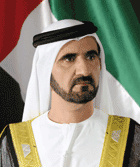 |
Sheikh Mohamed bin Rashid Al-Maktoum has transformed Dubai from a backwater town into a global trade and tourism hub |
Maktoum The Maktoums are the ruling family of Dubai, the most dynamic and media-savvy of the seven emirates of the UAE. The family is headed by the high-profile Sheikh Mohamed bin Rashid Al-Maktoum, who in a remarkably short space of time has transformed Dubai from a backwater town into a global trade and tourism hub.
As elsewhere in the Gulf, it is difficult to pinpoint where government interests begin and family interests end. Analysts say that some public-sector companies in Dubai are more closely family-controlled than others. The line remains blurred in most cases but the country is often considered to be run along the lines of a private corporation – hence the tag “Dubai, Inc”.
With oil generating only some 6% of Dubai’s GDP, other key assets include the Emirates airline, infrastructure, telecoms, land and several huge but loose-knit holding groups. These include Dubai World, which includes global port owner and operator DP World, various free-zone authorities and Nakheel, developer of the ambitious Palm Island projects. The vast Dubai Holding is also present in most areas of the economy.
Through its private equity arms, which include Dubai International Capital (DIC) and Istithmar, Dubai has also invested billions in high-profile overseas acquisitions, as well as buying up large amounts of prime real estate in London and New York.
None of these entities publishes financial statements, which makes it difficult to gauge their value but most estimates put the Maktoum wealth at more than $13 billion. Forbes ranks Sheikh Mohamed as the world’s fifth-richest man, although he is still outranked by Sheikh Khalifa bin Zayed Al-Nahyan, the ruler of neighbouring Abu Dhabi, which produces most of the UAE’s oil.
 |
|
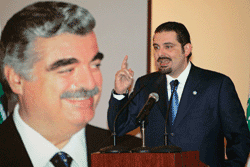
Saad Hariri has inherited his father’s difficult political role in Lebanon as the leader of the largely Sunni pro-western Future Movement |
Hariri The man behind the Hariri family empire was the late Rafik Hariri, the self-made Lebanese billionaire who is now perhaps more associated with politics than business after having been assassinated in a Beirut car bomb in 2005.
Hariri originally made his fortune in construction and contracting in 1980s’ Saudi Arabia, winning favour and massive contracts from the royal family to build the Kingdom’s infrastructure. After expanding into other fields, notably telecoms and finance, the charismatic businessman returned to Beirut after the 15-year Lebanese civil war came to an end in 1990.
There he entered politics, becoming prime minister and masterminding a controversial project to rebuild devastated central Beirut. By the early 2000s, Hariri headed a multi-billion dollar empire that spanned banking, real estate, media, telecoms and construction, while also wielding considerable political influence through close personal ties with the Saudi royal family and former French president Jacques Chirac.
His now-infamous death on the Beirut seafront led to his empire being turned over to his children.
Rafik Hariri’s oldest son Bahaeddine has focused on the family business, Oger, which is still thought to derive most of its turnover from the Gulf, and daughter Hind is one of the world’s youngest billionaires. Rafik’s younger son, Saad, has inherited his father’s difficult political role in Lebanon as the leader of the largely Sunni pro-western Future Movement, as well as playing a prominent role in the family firms.
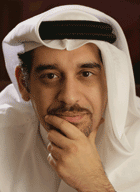 |
Mishal Kanoo is the most high-profile member of the family shipping-cum-trading business |
Kanoo The Kanoo Group is probably the wealthiest private family business in the small island Kingdom of Bahrain. Together with its other substantial interests around the region, particularly in the UAE and Saudi Arabia, the group is reckoned to be worth some $4 billion.
Its founder, Yusuf bin Ahmed Kanoo, laid the foundations for the group in the late 19th century, before expanding in the 1930s into other parts of the Gulf, particularly the areas that would later become the UAE and Saudi Arabia. Once Bahrain won full independence from Britain in 1971, the family was able to benefit further from its dominant position in the local market.
Much of the Kanoo wealth is derived from shipping, and the group still claims to be the region’s largest shipping agent today. However, it also has a long history in the travel industry, as well as general trading, contracting for the oil and gas industry, machinery and more recently in exhibitions and IT. The group is also the local agent for many airlines, as well as running joint ventures with foreign partners including Norwich Union, BASF, Johnson Arabia, Axa Insurance, Maersk, P&O and Halliburton.
Shareholders are all family members based in various parts of the Gulf, although probably the most high profile is Mishal Kanoo, the American-educated deputy chairman in his late thirties, who was to host an Arab-world version of The Apprentice before the show was reportedly scrapped for legal reasons.
|
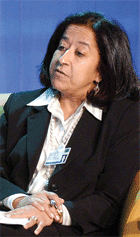
Lubna is one of the world’s most powerful businesswomen, heading the Olayan Financing Group and sitting on the board of several multinationals |
 |
Olayan Celebrating its 60th birthday this year, the Olayan Group traces its roots to 1940s’ Saudi Arabia where Suliman Olayan, the founder of the family business, set up a small transport company contracting for what would later become Saudi Aramco.
As the oil started to flow, the Olayans diversified from construction and contracting into food and consumer product distribution and then into financial services, creating the first commercial insurance company in the Kingdom.
Now active in most sectors in its home market, including industry, tourism, finance, real estate development, transportation and manufacturing, the group also owns highly lucrative Middle East distributorships for a large number of brands such as Colgate-Palmolive, Burger King, Nestlé and Coca-Cola.
Its substantial overseas holdings include stakes in blue-chip companies including MetLife, Credit Suisse, JP Morgan, Goldman Sachs and American International Group (AIG). The family has particularly strong ties with the US, where most of the Olayan children were educated. In total, the group now controls more than 50 companies, with an estimated annual turnover of at least $5 billion.
Unusually for Gulf family groups, women play perhaps the most prominent role in business affairs. Eldest son Khaled has chaired the group since the death of Suliman Olayan in 2002 but his sister Lubna is one of the world’s most powerful businesswomen, heading the Olayan Financing Group and sitting on the board of several multinationals. The family’s US interests are managed by another daughter, Hutham, who also sits on the board of Morgan Stanley.
 |
|
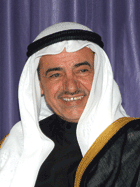
Nasser Al-Kharafi, whose estimated wealth of $12 billion makes him one of the richest men in the world |
Kharafi Headquartered in Kuwait City, the Kharafi family controls one of the largest diversified trading and investment groups in the Gulf. It is headed by Nasser Al-Kharafi, whose estimated wealth of $12 billion makes him one of the richest men in the world.
MA Kharafi and Sons takes its name from Mohammed Abdulmohsin Al-Kharafi, who established a small contracting business in mid-1970s Kuwait. Construction, engineering and maintenance projects formed the family’s core business, particularly lucrative build-operate-transfer contracts. Although this remains central to turnover, and is likely to remain so given future opportunities in the reconstruction of neighbouring Iraq, the Kharafis now control a diversified conglomerate with annual turnover estimated at $5 billion.
Interests span everything from food distribution – its Americana Group subsidiary holds the Middle East franchises for Pizza Hut, Baskin Robbins and Kentucky Fried Chicken – to hotels, tourism, real estate, finance, trading and an airline in Albania.
The group has sizable stakes in a number of Kuwait-listed companies, including 9% of Mobile Telecommunications Company, one of the biggest regional network operators, and a 16% shareholding in National Bank of Kuwait, which the original Kharafi founder helped to create in the 1950s.
Other Kharafis are also influential. Nasser’s older brother, Jassem, is a former finance minister and now speaker of Kuwait’s parliament, and sister Faiza was the first woman president of Kuwait University. Nasser’s three sons are also actively involved in managing various divisions of the group.
Al Futtaim
Originally a single entity established in Dubai in the 1930s, the Al-Futtaim trading business was split into two following an inheritance dispute between two brothers in the early 1990s. The row was reportedly so serious that it was only solved by the intervention of the emirate’s ruler, who told the rival brothers, Abdulla and Majid, to bid for each other’s shares of the family business.
Intense competition has ensued ever since the two went their separate ways, and has doubtless fuelled the phenomenal growth of what are now two of the most powerful business conglomerates in the UAE, collectively worth more than $5.5 billion.
The original Al-Futtaim group, controlled by Abdulla, has made billions through acquiring exclusive distributorships for big-name retail brands, especially automobiles, jewellery and electronics. As the UAE’s population and disposable incomes have soared in the past three years, so have profits.
The other – and competing – side of the family is headed by Majid, who is so low-profile that he reportedly refuses to have his photo published in his own company’s annual report. He heads the retail-focused MAF Group, which has developed some of the Gulf’s largest shopping centres, including the Mall of the Emirates in Dubai. MAF has also been highly successful in bringing the French hypermarket Carrefour to the Middle East, where it now has 23 outlets.