IN THE UK, where the hostility of fund managers to public-to-private (PTP) deals led by private-equity houses is most pronounced, several banks are working on structures to enable fund managers to participate profitably in such deals. One such structure, using convertible unsecured loan stock (Culs) listed on London junior equity market AIM, is arousing particular excitement.
The Culs structure was developed by Kinmont, a corporate finance advisory boutique, with Travers Smith Braithwaite, a 200-year-old City of London law firm. Kinmont was set up in March 2003 by four former senior UBS executives with expertise in corporate finance, property fund management, equity sales, and European banks.
According to Kinmont, between 30 and 40 buy-outs are now considering using the structure, with at least one deal dubbed “partial private” expected to be executed within the next few months. Another two or three might take place later in the year.
Data from Dealogic show that in 2003 almost half as much equity as the $48.4 billion raised in initial public offerings was taken off stock markets globally through PTP deals. In the UK, the $7.2 billion of equity sunk in PTP deals was greater than the $4.7 billion that was raised in IPOs.
The high volume of PTPs relative to IPOs can be explained by low equity valuations and low interest rates. If debt is cheap and the ability to raise equity constrained, then the case for being a publicly traded company is less compelling for many firms than at the height of a bull market.
Despite the buoyancy of the PTP market, though, the majority of proposed deals are smothered at birth. In the UK, leading law firms in the field estimate that up to 80% of PTP deals fails. This suggests the volume of deals could be many times greater were hurdles in their path to be removed.
A growing obstacle to PTP deals is fund managers’ activism springing from their hostility towards private-equity houses that buy stakes in companies from them at low valuations only to sell shares back to them later at a substantial premium.
At least one prominent fund management firm has privately said that it would boycott any private equity-sponsored IPO unless the vendor could prove that it had made substantial changes that added value to the company.
Fund managers are suspicious of any purchase price offered by a private-equity team, even if it looks relatively attractive. They often believe that the private-equity house backing a deal must have an inside track on the target company through the management buy-out team and that it would not be involved in the transaction unless it thought it could triple its money within five years.
If a management team has a fantastic new strategy to improve a listed company’s performance, shareholders can fairly ask why it could not be executed under their public ownership.
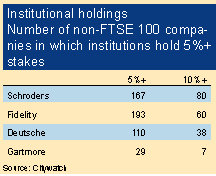
Such views are increasingly being acted on. In June last year, for example, Deutsche Asset Management, a big player in the UK small-cap and mid-cap market, resisted management pressure to sell a stake in Fitness First to private-equity house Cinven, which planned to take the health club group private. Instead Deutsche raised its stake in the company from 7.2% to 10.2%, just above the mandatory squeeze-out level, forcing Cinven to accept it as a shareholder in the delisted company.
Similarly, in the same month, first Fidelity and then M&G Investment Management refused to sell their shares in restaurant chain PizzaExpress to private-equity houses TDR Capital and Capricorn Ventures, again forcing the bidders to accept just 90% of the equity.
Not such a good deal
A bid with a high-sounding premium of, say, 50% might be ostensibly reasonable, but if that is based on a current share price of just $2 compared with, say, the $5 that a fund paid for the shares in the first place, it might not feel like a good deal.
For the first time in a while, institutions believe that the market might continue heading upwards, so an offer of hard cash from a private-equity group might not be as attractive as holding shares that are likely to increase in value and yield dividends.
Given the scale of the PTP trend, which is also being driven by the strong growth of private-equity funds, fund managers also have another concern. The private-equity community naturally tends to work its way through sectors, taking out a number of companies in succession, because the factors that make one company in a sector ripe for plucking are often to be found in others. In the past 12 to 18 months in the UK, for example, PTP activity driven by private-equity houses has been concentrated in the retail, property, and health and fitness sectors.
By acceding to a number of PTP deals concentrated in a particular sector, fund managers are limiting the number of companies and quality management teams that they themselves can access, affecting the potential performance of their own portfolios. Private-equity funds will tend to focus on the best management teams (themselves attracted by the prospects of self-enrichment), and the best growth and recovery stories.
Fundamentally it is not in the interests of fund managers to allow private-equity funds to profit at their expense. They do, after all, compete for asset allocations and in that competition alternative asset classes such as private equity and hedge funds are gaining ground.
If more PTP deals are to succeed, their financial sponsors might find it necessary to offer something more enticing than cash alone. Effectively, this means allowing participation in the deals themselves. B
Private-equity houses do not like to share profit and normally only do so among themselves when as individual houses they have insufficient money to finance an acquisition. Helping fund managers boost their performance with private-equity exposure is not exactly appetizing.
That said, a public fund manager with a 5% to 10% equity stake in a target company has a strong hand. It cannot easily hold unlisted securities, but could still try to scupper a PTP deal.
The only way to enable most fund managers to participate directly in a buy-out or maintain an interest in a PTP deal is through a listed security. The security must also be equity because institutional shareholders and fund managers are running equity portfolios. Conventional shares or warrants that could be issued by the private company or the bidder could meet the necessary criteria.
The problem with shares or warrants, though, is that neither guarantees an income stream for their holders, so any value from the investment might only crystallize when the company is resold or brought back onto the stock market. Private-equity investors typically might not expect their investment to show any rise in value for three to five years. In the meantime, while extensive restructuring is under way, they are not concerned about the interim value of the company’s equity.
Including coupon-bearing Culs would provide the option of an income stream. “There’s a bit of basic corporate broking homework to be done on this,” says Fraser Shand, director at Kinmont, “but above all the message from listed investors is that they want dialogue and they want choice.”
Shand,argues that the Culs would be a more suitable if the carried interest instrument requires underwriting by institutional investors. “The issue comes back to the underwriting,” says Shand. “In discussions with a number of investment houses including hedge funds, the convertible seems to be the more readily underwritable instrument.”
Performance imperatives
|
Average deal size 1997-2003 Public to private in the UK (£mn) |
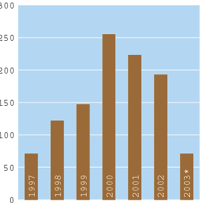 |
| *First half Source: KPMG |
Moreover, it is a structure that several prominent private-equity houses, including Alchemy, Bridgepoint and 3i, are amenable to.
It could also be used in a number of European markets and in the US.
A bid vehicle could use Culs because they are listed on a stock market such as AIM (the Alternative Investment Market of the London Stock Exchange) and so would be securities that fund managers should be able to hold under their investment policy rules. The rules might prevent them from holding unlisted securities but do not prevent them, per se, from holding listed securities in unlisted companies.
The instrument would convert into ordinary shares of the bid vehicle when the bidders exit via a trade sale or an initial public offering. The maturity would be set long enough to ensure a good chance of achieving an exit before maturity, and likely beyond the maturity of any bank acquisition financing or shareholder loans. Culs would also most likely be heavily subordinated, ranking below mezzanine debt.
Culs have several benefits that shares and warrants lack. For a start Culs offer a coupon, so fund managers holding them will receive some income before a private-equity house makes its exit. The coupon’s size will depend on the target company’s ability to pay. Culs do not entitle the holder to votes, leaving the private-equity house and the management team the independence and flexibility they desire.
Another benefit of Culs is their flexibility. The size of the coupon can be varied, which means that a higher coupon could be used to compensate for a lower bid premium, for example.
The conversion price could also be set at the same level as the private-equity house’s entry price or, alternatively, at a premium.
Additionally, covenants addressing anti-dilution protection for the conversion rights, or limited information rights, could be written if the parties agreed.
Other possibilities include a payment-in-kind feature that would involve the Culs paying interest in the form of additional bonds instead of cash. This feature would make the bonds particularly attractive to life insurers, which could be important shareholders, because of their long-term liabilities.
The purpose of the instrument is to enable institutional shareholders in a target company to participate in a PTP deal and so give them an incentive to support and help finance the deal. It is envisaged that it would be used in a mix-and-match selection such that those involved in the deal could choose proportions of cash, shares, and Culs.
“There is often an impasse in PTPs because the price can’t be agreed,” says Anthony Bolton, investment director at Fidelity, who led fund managers’ rejection of Capricorn and TDR’s bid for PizzaExpress. “If there was an option of allowing investors to maintain some listed participation it could allow us to accept deals that we currently wouldn’t and allow more of these deals to happen. We’re pretty interested in it [the Kinmont/Travers Smith Braithwaite partial private structure] but the devil is in the detail.”
Andy Brough, a fund manager at Schroders, takes a similar view. “Anything that allows both parties to make money together is good,” he says. “Deals using this structure will be more of a partnership.”
Institutional shareholder participation in PTPs via the partial-private structure has two important implications. The first is that it should help increase a deal’s chance of success by giving institutional shareholders a greater incentive to support it. The second is that it raises the potential size of such deals.
Most private-equity firms are unable to commit more than 10% to 15% of a fund to an individual transaction. Typically, this means that with a syndicate of four to five private-equity firms there is a maximum of about $1.5 billion available for a deal. The $1.5 billion can normally be used as for collateral for about $3.5 billion in debt, which takes the maximum possible size of a buy-out by a private-equity sponsor to about $5 billion.
If private-equity teams could interest a few institutional shareholders in joining them, the maximum size of buy-outs could be increased substantially. With $1.5 billion from private-equity players and, say, another $1.5 billion available from institutional shareholders in the form of Culs, much more could be borrowed.
Kinmont claims that several deals of over $5 billion are already being worked on and that a buy-out costing up to $10 billion is possible.
The largest private-equity sponsored leveraged buy-out to date is that of TRW Automotive Inc in November 2002 by the Blackstone Group, according to Dealogic, which has data that goes back to 1995. The bid value of that deal was $4.7 billion.
The largest private-equity sponsored PTP deal is that of UK department store group Debenhams, which was taken private in September 2003 by CVC Capital Partners, Texas Pacific Group and Merrill Lynch Global Private Equity for a bid value of $2.7 billion.
If the partial-private structure gains acceptance it would, in theory, catapult private-equity-led PTPs into a whole new league, and not just because it could allow them to finance larger acquisitions. By offering institutional shareholders the chance to gain returns equivalent to those achieved by private-equity houses on their investments it also has the potential to promote private-equity bids that are more competitive with offers from industry bidders.
Private equity bids are generally less attractive in a rising market because a cash-only bid cannot offer shareholders synergies and an enhanced growth story in the way that a trade buyer can. If private-equity bids could include an offer to shareholders to participate in the benefits of its restructuring plan and the rising market it would help level the playing field.
Giving fund managers the chance to participate in a PTP deal through a listed security sounds like a great deal because of the enhancement of returns. Doing so, though, is not without its drawbacks for fund managers.
Most managers have rules that preclude their holding unlisted securities because these are relatively illiquid. This makes them harder to dispose of should their value fall. They are, therefore, intrinsically more risky. Buying a security that is listed but lacks liquidity may comply with the letter of these investment guidelines but not the spirit.
Kinmont argues that various types of investors would be interested in owning Culs as they are an attractive security in their own right. But the problem is not so much the attractiveness of the security as the ability to sell it. The real value from the security comes on conversion into public equity three to five years down the line; the value of the coupon is incidental in comparison.
Private-equity houses take companies private because their plans for transforming them and realizing substantial returns might involve actions that are temporarily damaging to the equity value of the company. This means that they could not be done in the public domain without causing great anxiety to public investors, which have much shorter time horizons.
Illiquidity in the dark years In order to get the attractive returns theoretically offered by such structures as Culs, fund managers would therefore have to be prepared to sit tight through those dark years. The current value of their security might fall frighteningly low, dragging down the marked-to-market value of their portfolios.
To sell out when this became unbearable would, however, be difficult. You need sellers as well as buyers to make a market and create liquidity. The only good reason to sell the security would be if it was thought that the deal was going to be a flop and that there was likely to be loss on the exit, in which case a buyer would be hard to find.
Another potential problem for fund managers participating in such deals is the strong likelihood that clients who have placed their pensions in the hands of a long-only equity fund manager have done so because they want to take on only conventional risk. Clients might not want private-equity exposure. It is the job of pension fund trustees to decide if they want to allocate their money to private equity, not the job of the conventional equity portfolio manager. And if trustees do want private-equity exposure, they will probably want private-equity experts to choose the deals for them, not long-only fund managers that only dabble in the sector occasionally.
For private-equity houses, too, the partial private structure has drawbacks. Essentially it is a compromise. It reduces public-to-private deals to only partially taken private deals and means that they have to share the profit with others.
Listing a security also inevitably requires some degree of transparency and reporting, although on the relatively lightly regulated Aim this would be only on a biannual basis.
A listed security with a value that can be seen at any time might also put some of the same pressure on the management team and private-equity sponsors to show upward-only performance that conventionally listed companies now feel. The fact that the participating fund managers holding Culs have no voting rights should, however, limit that pressure.
Jim Kiernan, managing partner, Europe, at Debevoise and Plimpton, an international law firm specializing in private equity, is sceptical about the partial private structure: “I’m just not sure they [private equity and equity fund managers] will get along. They don’t have the same investment criteria. It sounds like a last resort to save a deal from falling through.”
Graham Clempson, European managing partner of MidOcean Partners, thinks that the innovative structure is a positive development. “It is a clever way of trying to create an alignment of interests, which is always beneficial for the market,” he says.
The partial private structure won’t be ideal for every deal, every investor, or every private-equity house, but it isn’t intended to be.
What it offers is flexibility and a way to ease the antagonism between institutional shareholders and PTP deal supporters by allowing the institutional shareholders to participate, creating new and possibly bigger opportunities.