
|
|
| Glencore | |
| Size | $11 billion initial public offering |
| Date | May 2011 |
| Joint bookrunners | Citigroup, Credit Suisse, Morgan Stanley |
| Issue price | 530p |
| return to the Global Deals of the Year index | |
That same Glencore IPO was another landmark transaction last year – a high-water mark for the IPO market that otherwise endured a traumatic 2011. And trauma can play strange tricks on the memory. The head of investment banking at a lead bank on the deal, which priced in May 2011, looks back at it now across the barren deal-making wasteland in the second half of last year and recalls a golden age. “Thank goodness we had such a good first half and got a lot of deals done, Glencore most notable of all, because the result is that our full-year numbers won’t look so bad despite what then followed.”
In reality, the first half of 2011 was pretty tough in the equity capital markets. True, in the first seven months of the year 143 IPOs were priced for European issuers. But almost a third as many, 50 in total, were either delayed, called off or pulled after launch: a high failure rate that was even more pronounced among larger deals. Half the European IPOs of over €350 million announced in the first half of last year were withdrawn without being completed. Trust broke down between IPO vendors and institutional investors, the latter accusing the former of seeking unrealistic valuations, failing properly to manage syndicates and the price-discovery process and using the public equity markets to cash out of misconceived private equity leveraged buyouts.
Into this fractious and anxious market stepped Glencore, the large but little known and even less well understood privately owned commodities conglomerate. Glencore combines producing assets such as mines, large stakes in other public mining companies, notably Xtrata, and a trading, transport and logistics division that was often misrepresented as a proprietary trading operation akin to an investment bank. With many commodities markets looking toppy as the company’s IPO came to market, investors were nervous.
For Glencore the deal was a big success. It managed to raise $11 billion in the largest-ever IPO on the London Stock Exchange, the largest-ever IPO in Europe that was not a privatization and the largest-ever IPO in the commodities sector.
 |
|
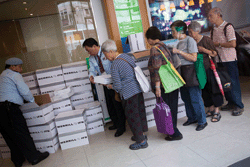
| Cornerstone investors were key to Glencore’s iconic 2011 IPO and brought in big orders from institutional investors, leaving slim pickings for retail investors in the commodity group’s Hong Kong listing. Above: residents in Hong Kong queue for the Glencore prospectus |
Against such a tough backdrop, with many participants labelling the European IPO market as broken, how did Glencore, the offshoot of Marc Rich’s Switzerland-based commodity trading operation bought out by its management in 1994 for $600 million, succeed? The story of the deal is one of long planning, stretching back three years to the start of the financial crisis to attract every plausible pocket of demand, careful preparation on deal structure – securing sufficient free float to gain FTSE 100 index inclusion, incorporating dual-listing in Hong Kong as well as London. Above all it shows the value for a company management of taking personal responsibility for building close relationships with providers of equity capital in the same way as with key suppliers and customers.
The company paved the way for the IPO by attracting large, strategic investors into a pre-IPO convertible marketed in the spring of 2009 and eventually priced at the end of that year. In the interim commodities markets had rallied, boosting the company’s earnings and valuation, but Glencore did not renegotiate the price of the convertible, using it instead to set an early-base valuation for the company to exceed and enable its first round of external equity investor supporters to make good money.
By the time the company undertook the IPO in spring 2011 it was able to go back to some of these early investors and attract other large strategic investors to support a cornerstone tranche of fully $3.1 billion. The cornerstone tranche was oversubscribed. The company could have raised even more but needed to limit the tranche to leave sufficient free float for FTSE 100 inclusion, a key objective in attracting tracker funds. On the first day of bookbuilding the company revealed the size and identity of its cornerstone investors, which included sovereign wealth funds, household-name institutional investors and commodity specialist investors.
Suddenly investors that had been wondering whether other buyers would supply $10 billion realized there was only $6.9 billion left to go for and they submitted their own orders quickly, covering the book inside two days and enabling the company and lead banks – Citigroup, Credit Suisse and Morgan Stanley – to talk up the final price.
The deal was done and Glencore had secured the big strategic competitive advantage of raising big funds to complete its ambitious plans to build hard assets. Investors weren’t so lucky. As the deal proceeded, the commodity markets sell-off spread to equity markets and the price of Glencore stock, and that of all its peers, collapsed. The deal suffered the ignominy of never, even after day one, trading above the issue price of 530p. In late January it still stood 20% below issue price at 420p.
Months after the deal, Euromoney caught up with Glencore’s chief financial officer, Steve Kalmin, who says: “We never intended to be aggressive on price and leave a bad taste in anyone’s mouth. It was always the plan to leave some money on the table. We felt it was priced fairly at the time, taking into account the market and shape of the book, which was heavily oversubscribed at every point in the price range. However complete visibility on markets is often a challenge.”
| |
|
Global markets Cargill Inc/The Mosaic Company |
| Glencore |
| Kinder Morgan |
| European Union |
| Rabobank |
| Crest Nicholson |
| BNP Paribas Emerging Balanced Note index |
| Return to the Deals of the Year main index |