 |
DON’T DO IT right, do it first. The idea that any product that breaks new ground enjoys an indelible branding advantage has become a marketing mantra. But in the debt capital markets, the recent fortunes of the Pfandbrief suggest that holding on to that advantage is an increasingly demanding exercise.
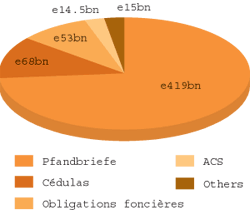
Once content to sell itself as the original and still the best covered bond, the Pfandbrief is now in competition with established or growing rival products in at least six jurisdictions, and with mortgage-backed securities (MBS) in Germany itself. Combined with the downgrading of certain German mortgage banks and the loss of the Landesbanken guarantees in July 2005, until last year the Pfandbrief was losing ground to other European covered bonds.
Pfandbriefe still account for nearly 75% of all covered bond issuance. According to figures from the Association of German Mortgage Banks, gross Pfandbrief issuance increased by 14% between 2001 and 2002, from e174 billion to e198 billion.
But net of redemptions, both years were negative ? 2001 by a narrow e1.3 billion, 2002 by e16.8 billion. As Tim Skeet, head of European Bank DCM at ABN Amro, says: “It is vital that the Pfandbrief regains its premium cachet.”
Says Christof Jütten, head of covered bond origination at ABN Amro: “Investors look at covered bonds as one asset class and they are traded as one asset class.” Because German issuers traditionally saw the Pfandbrief as the best product available, it took them longer to see that a single European covered bond market was developing.
“You can only take the view that your market is separate when your product is trading at the tightest possible spreads,” says Jütten. “But some Pfandbriefe have traded outside the covered bond curve.”
That’s because the German market is no longer homogenous. Investors now distinguish between issuers according to their underlying financial strength and their borrowing strategy. To stop the upheavals in the German banking sector being disproportionately reflected in the poor performance of their covered bonds, issuers have had to address a series of problems. These range from their own business models and structure, to relations with investors, to the legal framework for Pfandbriefe and the views of rating agencies.
Pfandbrief issuers are now more responsive to investors’ demands. They are issuing in shorter maturities, for example.
“Looking back two or three years, issuers only looked at their own funding needs,” says Clemens Schellenberg, head of funding and asset liability management at Hypo Real Estate Bank. “If you had strong new business projections for 10 years, you issued 10-year Pfandbriefe to match your liabilities. In the current interest rate environment, there’s less demand for these maturities so issuers have to be more flexible to attract investors.”
Pfandbrief issuers in particular have measured themselves against their Spanish competitors, whose cédulas have provided the chief competition for Pfandbriefe. By paying more attention to basics such as the maturity of their bonds, the Germans have successfully distinguished themselves.
“Pfandbrief issuers have learnt their lessons,” says one banker. “In 2001 and 2002, if you were part of a primary Pfandbrief deal, you could be sure it would widen in the secondary market. These days are over in Germany. The cédulas market is still for people who are after a pick-up. Germany is for stable-for-life AAA bonds.”
German issuers are using the pot system for their covered bonds, while cédulas are still generally sold through retention deals.
A key legal step in the Pfandbrief’s comeback was on March 12, when Germany’s federal legislature, the Bundesrat, passed the latest amendment to Germany’s mortgage bank Act. It introduces mandatory 2% over-collateralization for Pfandbriefe. It also addresses Moody’s concerns about their bankruptcy-remote status. Moody’s had previously rated some covered bonds with reference to the credit quality of the issuer itself, not just the quality of the cover pools. In providing for the appointment of a dedicated trustee to monitor the cover pool in the event of insolvency, the German Act goes even further than Ireland’s asset-covered securities (ACS) law in confirming the bonds’ bankruptcy remoteness. Within days of the legislation being passed, Moody’s had put some Pfandbriefe on positive watch, with a view to upgrading them once the law comes into force on April 1.
Alongside the mortgage bank legislation amendment, in December, Germany’s federal financial supervisory authority, BaFin, published details of the regulatory requirements for the net present value calculation for cover pools. Issuers have until the end of April to adopt any new procedures and IT systems that they need to comply with the regulation.
While the mortgage bank legislation has hogged the headlines, Louis Hagen, general manager of the Association of German Mortgage Banks, says it really clarifies the theoretical relationship between a Pfandbrief issuer and its paper.
Stress testing
| Outstanding volume |
 |
| Source: WestLB research, Bloomberg |
The legislative changes were widely and accurately predicted and were largely priced into the market last year. But they have still had a positive impact on the market as a whole. The speed of its response suggests that Moody’s is as relieved as everyone else that it can begin to change its ratings.
“Moody’s was waiting for some kind of legal change to save face,” says WestLB analyst Frank Will. “Everyone said that this didn’t work and that for an organization like AHBR to have its mortgage Pfandbriefe rated A1 didn’t make sense. But markets focus on the lowest rating.”
Pfandbrief issuers that didn’t get an AAA rating for their bonds from Moody’s felt that they were being unduly penalized. “We saw spread widening to levels of 25 to 30 basis points over swaps,” says Will. “Then people realized that this wasn’t justified for a secured instrument, and spreads tightened.”
The new legislation’s provision will help complete this recovery, and should have a positive impact on the Pfandbrief market as a whole. “The differentiation between Pfandbrief issuers has been expressed in credit spreads in the secondary markets, as well as in the primary markets,” says ABN Amro’s Jütten. “Now the curve is denser, and narrowing in, because of the changes to the German law.”
As well as lobbying for changes to the German mortgage bank act, the Association of German Mortgage Banks has been boosting Pfandbriefe in other ways. Last year, it revised its standards for jumbo Pfandbrief issues, increasing the minimum issue size to e1 billion. And if jumbo Pfandbriefe are repurchased for redemption purposes or trustee administration, the issue volume remaining in the market must not fall below e1 billion. These changes are subject to approval from the German competition authorities.
“In the last two years, there have been hardly any jumbo issues under e1 billion,” says Hagen. “And in some jumbo issues, there has been a liquidity gap, which has caused some dissatisfaction among the market makers.”
And the association is collecting data on the impact of new EU capital adequacy regulations on Pfandbriefe. It is trying to get the loss given default (LGD) figure for Pfandbriefe dropped from 20% to 10%. Unless an issuer has a very low probability of default, a high LGD figure can push the risk weighting on Pfandbriefe above 10%.
“Banks are a big investor group and if they have to hold more capital against their investment, either they won’t buy, or they will put more pressure on price,” says Hagen.
Despite these undeniable legal and regulatory improvements, commercial concerns mean that some issuers are turning their backs on the Pfandbrief.
On March 1, Depfa Bank announced its decision to sell its German public sector loans business, Deutsche Pfandbriefbank. At the time of writing, no buyer had emerged, although Depfa said it expected to complete the sale by the end of Q3. (Depfa is not selling Deutsche Pfandbriefbank’s Tokyo office.)
The sale will free up capital for international expansion, including in the US. Depfa has always been an adventurous borrower, taking part of its covered bond issuance offshore last year with its first Irish ACS deals. It has made no secret of its US ambitions, and that the main inhibitor to growing its US PPP and municipal credit enhancement activities is the lack of available equity.
With its ACS platform established, Depfa has less need for a Pfandbrief issuer. “The investor base is so similar that there isn’t much gain in having two funding vehicles,” says WestLB’s Will. “There’s a lower tax environment in Ireland, it can be costly to move assets around, and spread levels are similar between ACS and Pfandbriefe.”
The German mortgage bank Act is particularly unsuitable for Depfa given the bank’s US ambitions. Unlike Ireland’s ACS law, the legislation limits to 10% the proportion of loans in Pfandbrief cover pools that are made to borrowers in countries ? including the US ? where Pfandbrief holders do not have a priority claim on the collateral if the issuer becomes insolvent.
“If their strategy is to expand in the US, that could be an obstacle,” says Hagen. And the ACS market is partly Depfa’s own creation. “In Ireland, they are the biggest issuer. They move the market, they are not moved by the market,” says Hagen.
In Europe, EU Directive 2001/24/EC on the reorganization and winding up of credit institutions will remove this cap and open up Pfandbrief cover pools to more loans to borrowers outside Germany. “We would appreciate it if the directive were fully incorporated in national law in all EU member states in due time,” says Günter Pless, treasurer of Essen Hyp, which issued e16 billion of Pfandbriefe last year.
So where will the sale of Deutsche Pfandbriefbank leave the Pfandbrief market? “You have to wait and see who the actual buyer will be,” says Ted Packmohr, director, covered bonds research, at Dresdner Kleinwort Wasserstein. “The sale’s importance to the Pfandbrief market will depend on what strategy the new issuer follows.”
The identity of the buyer will also directly affect the rating of Deutsche Pfandbriefbank’s outstanding Pfandbriefe. Uncertainty over the future ownership of the bank led spreads on Depfa’s liquid Pfandbriefe to widen by one to two basis points after the announcement.
Most observers agree that a buyer will come from outside Germany, since German institutions have been pulling out of public-sector lending because margins have been so slim. Logically, it will be a lender that can run a low-margin public-sector business efficiently. That means a large bank with experience of public-sector lending elsewhere in Europe and a very good credit rating.
Depfa reckons that Deutsche Pfandbriefbank’s funding activities, including its Pfandbrief issuance, are one of its chief selling points. “Deutsche Pfandbriefbank is an excellent platform for short-term and long-term funding,” Gerhard Bruckermann, Depfa Bank chairman and CEO, told investors on the day of the announcement. “It has an excellent position in the money markets in Germany and with international investors, and its strategic value cannot be overestimated. If anything it is over-liquid.”
Still, it is hard to identify a potential buyer. When the Landesbanken lose their guarantees and so their ability to undercut rival lenders to the public sector, the business should be more attractive. But lending to the German public sector just isn’t attractive enough to justify an acquisition to shareholders. “There’s nothing in Deutsche Pfandbriefbank that you can cut the fat out of,” says an analyst.
Any non-German lender that wants to buy Deutsche Pfandbriefbank and use it as a funding platform also faces problems. The difficulties of using non-German assets to back Pfandbriefe, and the cross-border tax problems of repatriating any money raised, particularly to non-euro countries, would make this difficult. “What are the options for actually moving the funds you raise into different parts of your organization?” asks a treasury official at one non-German mortgage lender. “Deutsche Pfandbriefbank is there to be self-funding.”
This is significant because some analysts have suggested that Scandinavian lenders have the best business case for buying the bank. “Germany would be the next logical place for the Nordic institutions to extend their geographical coverage,” says one. “They would see Depfa as a vehicle for entry into the market and for Pfandbrief issuance.” But with most of Scandinavia outside the eurozone, it’s not simple to raise cheap money through Pfandbriefe and use it to fund different parts of a multi-jurisdictional group. The same applies to HBOS of the UK.
Price and quality
|
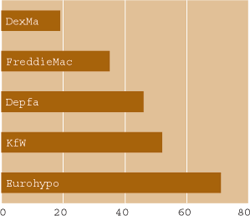
Euro-denominated Outstanding bonds (ebn) |
 |
| Source: Eurohypo |
Another intriguing issue is how Depfa will divide its single treasury team, which until now has managed both Pfandbrief and ACS issues. Competitors are watching curiously to see who ends up in Dublin and who ends up in Frankfurt.
To see how attitudes to Pfandbriefe have diverged in Germany, look at Aareal Bank. Aareal is the property finance business that Depfa spun off in 2002. Its mortgage lending arm, Aareal Hyp, started trading at the beginning of 2003. In its first full year, Aareal Hyp issued e2.1 billion of mortgage bonds. If Depfa can live without public-sector Pfandbriefe, for Aareal Hyp mortgage Pfandbriefe are a crucial funding tool.
“That represented one-third of our funding needs,” says Aareal Hyp head of treasury Bernd Bach. “We hope to fund 50% of our 2004 borrowing with Pfandbriefe, because it’s the cheapest funding for us.”
Aareal Bank transfers its own property loans with a loan-to-value (LTV) ratio of 60% or less, which can back Pfandbrief, to Aareal Hyp. “The success Aareal Hyp had in 2003 was only possible because the bank and the mortgage bank work closely together,” says Bach.
Aareal Hyp’s Pfandbriefe have an average maturity of over 10 years. All its deals have been private deals, sold mostly to German funds and insurance companies. “We haven’t had to pay any spreads, and if you look at how we trade in the secondary market, spreads are stable,” says Bach. “We will do public deals in the future, that is for sure.”
It’s not just the German mortgage banks that are reassessing their attitude to the Pfandbrief. The Landesbanken are weighing up the pros and cons of covered bonds as they face up to losing their state guarantees in July 2005.
In February, Landesbank Hessen-Thüringen (Helaba) launched its first jumbo Pfandbrief for five years. It will now use covered bonds as one of its regular funding platforms.
“We haven’t been committed to benchmark Pfandbrief,” says Rolf Reichardt, head of funding and liquidity risk management. “This is a signal that we will bring an internationally targeted Pfandbrief every year.”
In 30 hours, the e1.5 billion, five-year deal was two times oversubscribed. It was allocated at 1bp over mid-swaps. “The deal was targeted at international investors, so we didn’t tighten it right down,” says Alan Noble of Helaba’s investor relations team.
Nearly two-thirds went to non-German investors, with nearly a quarter going to Asia. Helaba has successfully used a jumbo Pfandbrief to make sure it will be known by, and have access to, international investors when it loses its guarantees. “This is post-2005 positioning,” says Reichardt. European and Asian central banks took 34% of the issue.
Helaba’s success reflects its clearly communicated future strategy of remaining a public institution and finding efficiencies through working closely, for example through joint credit risk management, with the savings banks in its home state.
But while Asian investors responded to Helaba, other issuers need to be careful. Some bankers doubt that Pfandbrief can be effectively targeted at Asian investors. “If it is cheaper to go domestic, go domestic,” says one. “If a German savings bank would like to buy your paper at par and you sell in Asia at 99.99, a German account will buy it immediately at par, so you don’t actually diversify your investor base at all.”
International placement
|
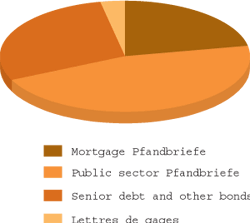
Eurohypo outstanding Total volume: e222.2bn |
 |
| Source: Eurohypo |
Not every Landesbank will automatically want to issue more Pfandbriefe in the future. Landesbank Nordrhein-Westfalen has successfully won development bank status, part of its strategy to keep its state guarantees in place. “When a bank has development bank status, its bonds are 0% risk-weighted,” points out Packmohr. “You won’t expect it to use Pfandbriefe.”
As Pfandbriefe respond to international competition, some issuers might use them less. Many, though, will use them more, and not just as an all-purpose funding tool. Allgemeine HypothekenBank Rheinboden (AHBR) is working on its first MBS deal. It will still issue Pfandbriefe, but alongside other instruments such as senior secured bonds, Schuldscheine, commercial paper, MBS, and repos.
“We have a new investment approach on the asset side, which means replacing a buy-and-hold policy with very active portfolio management,” says Markus Weick, head of treasury at AHBR. “That changes our funding requirements, because of course in some years the focus will be on selling assets and in some years on buying assets.”
AHBR will still issue jumbo Pfandbriefe, but deals will be smaller and more focused. “We did a e5 billion issue once, but we believe that deals of that size are no longer appropriate for us,” says Stafanie Weber, in charge of syndication at AHBR. “Our jumbo deals will more likely be in the area of e1.5 billion now.”
“The Pfandbrief is still the most liquid instrument and the easiest to sell,” says Clemens Schellenberg. As such, it will remain the most important tool for German banks when they borrow in the capital markets. Pfandbriefe, it seems, are improving with age.