IT’S SATURDAY IN Berlin and the streets are thronged with people trying to pack their shopping into the half day German law allows stores to open at the weekend. But the women manning the counters in KarstadtQuelle, Germany’s biggest retailer, have not been that busy recently.
Much of the consumer activity seems to be little more than window-shopping. Marina Schultz is browsing in the shop and checking prices carefully. “I need a new toaster. These are not bad, but I want to check to see if I can’t find a better deal first,” says the 29-year-old student.
Consumers have plenty of money and German savings rates of 10.9% of income are among the highest in Europe. The problem is that like Schultz they are not spending it.
“I’m doing OK,” she says trailing through another department, “but I finish my studies next year and I am not sure what I will do then. There are no jobs for graduates.”
Official unemployment just topped the 5 million mark in January, 12.1% of the population, the highest level since World War II (although much of the increase from previous figures of 4 million is the result of a reform in the way the jobless are counted). Economic growth is among the lowest in the EU and with the pension system in crisis Germans are pessimistic about their long-term prospects.
Birth rates have plummeted and Germans are salting away as much as they can on the assumption that the state will not be able to help them in their old age. Consumer pessimism hampers the government’s efforts to spur badly needed domestic spending, which accounts for 58% of German GDP, and drag the country out of its four-year recession.
Things are so bad that KarstadtQuelle was fighting for its life at the end of last year. Sales had fallen to the point where it was forced to outline an emergency restructuring plan in September to prevent bankruptcy.
By January it had sold off its logistics division, smaller department stores, a stake in the German Starbucks franchise and other assets. In all it managed to rake together €200 million from asset sales plus another €700 million from selling shares and convertible bonds, but was only a third of the way towards meeting its creditors’ demands.
Another 9.5% drop in sales over the last three months of 2004 cast doubts over KarstadtQuelle’s chances of emerging from the crisis.
KarstadtQuelle’s story is typical for German domestic businesses. Its main rival, Metro, is doing better but has also been selling off stores and cutting costs to the bone. It is still in profit only thanks to a management decision to scale back operations at home and expand abroad, particularly in eastern Europe.
Abstinent consumers
|
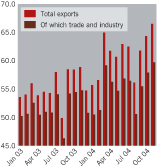
German exports (emn) January 2003 to October 2004 |
 |
German consumers have taken a vow of abstinence over shopping – they look but don’t buy – which has constantly deflated optimism that the economy is about to turn the corner. The Christmas season sales results amounted to another dousing of cold water, with retail sales falling in December for the third month in a row, dropping 0.3% to bring the year’s total to a 1.7% decrease year on year.
This year will be a major test for Germany. The global economy is growing strongly but it is not yet clear if it can drag the federal republic out of its sick bed. However, there are some signs that things are getting better.
Last year’s 1.7% growth failed to meet the most optimistic predictions but was still an improvement on previous years. The irony of Germany’s prolonged recession is that the people don’t seem to be poor. In 2002 alone Germans squirrelled away €120 billion or 6% of GDP – good for pensions, deadly for demand. The restaurants and theatres are full, the cars on the street as posh as ever and more Germans will fly away on foreign holidays this summer than ever before, say the travel companies.
It seems that Germany’s economic woes are as much a state of mind as an indication of fundamental problems with the structure of the economy – and no-one is disputing the need for reform.
The optimists point to chancellor Gerhard Schröder’s success at pushing through reforms. Critics say they don’t go far enough, but then nothing happens quickly in Germany’s consensus-style politics.
Income tax has been lowered for the third and last time, benefits have been slashed and the labour code simplified. The government now has to sit back and see if business bites.
The economy is poised to grow more quickly as there is plenty of slack that could quickly be taken up; the prevailing pessimism is the main obstacle. Predicting a change of mood has proven to be very difficult.
The government is sticking to its forecast of a repeat of last year with 1.7% growth, while the majority of the leading economic institutes are much more pessimistic, predicting growth as low as 1%, with the consensus at about 1.4%.
“Germany is disconnected from the world,” said Hans-Werner Sinn, president of economic institute Ifo, in January. “No other country in central or western Europe has grown as slowly between 1995 and 2004.”
However, leading government economic adviser the Deutsches Institut für Wirtschaftsforschung is bucking the trend, arguing that global demand for Germany’s exports will be high this year and has already kick-started investment that will fuel both growth and consumption.
DIW president Klaus Zimmermann says: “We are predicting even stronger growth in 2005 of 1.8% and this will build to 2% by 2006. Our analysts show that the export market will still perform well despite the weakness of the dollar which has already led to the revival of internal demand and investment.”
After four years of poor growth DIW remains convinced that the economy has a lot more bounce in it than is generally accepted.
Companies are using less than their full capacity and with German inflation running significantly behind the EU average – 0.9% against 1.7% – the economy could snap back given the right stimulus.
German exports seem to be defying the euro’s appreciation against the sinking dollar and hung onto its Weltmeister export title last year. It could do the same this year.
Wild card
Orders for German goods in 2004 increased by 8.2% year on year (to total €730 billion) compared with 5.7% growth in imports (€575 billion), generating Germany’s largest trade surplus on record.
Exports in 2005 are the wild card for growth. Although exports last year added as much as 2% to GDP growth, soggy domestic consumption pulled the growth figure back by 0.4% or so. If global demand for German goods weakens, the case for growth collapses. And if the global recovery comes off the boil Germany will have the last leg of the stool pulled from under it.
However, a mix of mitigating circumstances has worked in concert to counter the euro’s rise.
Europe is Germany’s main customer and it has made significant inroads into the markets of the new central and eastern European members of the EU, insulating it from euro-dollar dynamics.
The economic booms in the US and particularly in China have also fuelled demand for German goods, despite their increasing price. And low interest rates, coupled with pragmatic German managers who hedged against currency appreciation, have taken some of the sting out of the euro’s rise.
“There was a slowdown in exports at the end of last year, but it was temporary,” says DIW’s Zimmermann. “Half of our exports go to EU countries where the strength of the euro makes no difference. As for the other markets, people buy our products not because they are cheap but because they are of high quality. They are not as price sensitive.”
Government adviser DIW expects the export growth rate to be slower this year than last – its experts predict a rate of 5.7% by the end of 2005 compared with 9.4% in 2004 – but this is still strong compared to other major EU countries.
Only if the euro-dollar rate falls to €1/$1.50 and oil prices remain higher than $50 a barrel for a significant period will there be trouble – something that is not likely. Commerzbank’s leading global growth indicator showed in January that the global economy was still displaying above average momentum and that there had been little change in German companies’ price competitiveness.
Most encouraging has been Schröder’s quick realization that markets outside the EU and the US are crucial to sustained recovery.
As a result the chancellor has been scurrying around the world to sell the German story, which has already translated into steady growth in trade with such markets as China.