Nordea Bank
Despite its limited borrowing needs, the Scandinavian bank has established an impressive track record on the international debt markets
|
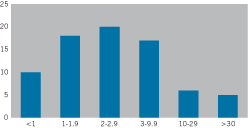
Nordea Bank €500mn CMS-linked tier 1 Number of investors by ticket size (mn) |
|
Several banks could be considered for the award of financial borrower of the year. Some have many billions to raise and will hit a range of markets continuously in order to so, and market participants will argue that their paper is more difficult to sell than that from rare, sporadic issuers. But issuing big volumes during the past year, at a time when investors have a ravenous appetite, has not proved that difficult.
Nordea Bank, however, stands out for having been highly professional while opportunistically accessing the international capital markets. It managed to achieve tight execution on its new issues at the same time as leaving investors with a positive feeling – not an easy balance to strike. Many of the deals it printed created benchmarks for other, more active issuers.
The fact that this borrower is small, and so has few bites at the cherry, reinforces the judgement that it has been on the right track with its new issues. Nordea has enjoyed a notable year during which it managed to access a range of markets, holding to a policy of maintaining some agility in execution.
“We like to maintain flexibility as you cannot trust these markets – they are very volatile,” says Fanny Borgström, head of group funding at Nordea. “The sun may be shining on Monday but you don’t know what the world will look like on Friday.”
Nordea sold its first yankee tier 1 issue for almost six years in April 2005, a $600 million issue via CSFB, JPMorgan and Merrill Lynch.
“We had full flexibility on the tier 1 transaction that we did this year because we could go to either the US or European markets,” says Borgström.
The borrower was reticent on the need for flexibility, so it kept open its options of using either dollars or euros. Borgström decided that the US market offered best price execution and investor interest. With the markets volatile, Nordea used a concise execution strategy to minimize market risk. In fact it announced and printed on the same day. Despite the rapid timetable, the order book on the perpetual non-callable 15-year was oversubscribed within two hours at $1.3 billion.
The past 12 months was notable for the rampant bull market in credit, and Nordea was a key name in signalling to other financials how excellent conditions were for issuance.
Perhaps the best example of this was the e500 million perpetual non-callable five-year deal that it sold in September 2004. This issue established the depth of the retail market for the constant maturity swap-linked tier 1 sector.
At the time, it was the largest CMS-linked transaction issued and the lead managers, ABN Amro, BNP Paribas, JPMorgan and Merrill Lynch, sold paper to mainly private bank networks. In the following weeks an avalanche of deals appeared from various borrowers. This transaction achieved cheap all-in funding for the borrower in the low 60 basis points over Euribor.
The CMS market was extremely attractive for retail investors, who were focused on up-front yield. The coupon on this structure was linked to the 10-year CMS plus 5bp subject to an 8% cap.
“We like to do good deals for both investors and Nordea,” says Borgström. “We are here for the long run – we want to meet these investors in the future. It was a great opportunity to do a deal in the European retail sector.”
The follow-up lower tier 2 trade, later in the same month, also had success stamped on it.
Not only was it a rare fixed-rate coupon but the subordinated issue, via CSFB, Merrill Lynch and Nordea Markets, was again hugely oversubscribed. The fact that the borrower did not take the last basis point on the table, printing at plus 29bp, is also to Nordea’s credit.
Since then, conditions have dramatically worsened, but Nordea has still managed to execute new issues that met market participants’ approval – even in difficult times. A look at the e750 million lower tier 2 issue that it brought in early May, via Goldman Sachs, UBS and Nordea Markets, is a good example, attracting some e900 million of orders despite the market’s volatility.