Why the European government bond markets have failed…and what the European Union would like to do about it
Europe’s primary sovereign debt markets have suffered market failure for many years. But is there anything the EU and its commissioner for internal markets and services, Charlie McCreevy, can do about it? Alex Chambers reports on how sovereign debt managers have coerced primary dealers into subsidizing Europe’s government debt markets by as much as €600 million a year.
European sovereign bond auctions do not work. A lack of price transparency makes participation at auction hazardous for all but the most savvy of operators. Most investors will not even consider using auctions to access the markets.
That doesn’t mean the auctions are failing. Far from it: most public sales of bonds are comfortably covered. In fact bonds sold at auction sell at a premium, and that is a large part of the problem. Around auction time, end investors run for the hills as only primary dealers have an incentive to buy these expensive bonds. This is a real contrast to the US, where investors are participants at auctions.
So why is the European sovereign primary market only open for investors at certain times? And is there any way to get around the problem of how this occurs?
Euromoney has discovered that the EU, in addition to looking very closely at the issue of price transparency in the fixed-income securities industry, is concerned about what it considers might constitute incidents of market failure in the government bond markets. However, as no individual bank, industry association or investor has bitten the bullet and voiced a grievance to the European Commission, that body cannot launch an official investigation that could be the precursor for a shake-up in the way that sovereign debt managers use financial intermediaries to distribute their paper.
The fact that EU officials have their eye on European government debt markets came into the open when, speaking at a Bond Market Association conference in March, David Wright, director of the markets division of the European Commission run by Charlie McCreevy, suggested there might be cause to believe a market failure had occurred. Wright did not elaborate on what evidence there was for this, but his concerns will have raised alarm at debt management offices across Europe.
The speech was part of a consistent message from the commission, which wants the EU to be a dynamic trading space for all securities, including government debt. Since the establishment of the single currency there have been constant complaints that primary issuance could be more open and better coordinated.
What could the EU do? It is currently consulting on the Markets in Financial Instruments Directive (Mifid) that is due to be implemented in November 2007. Primary bond dealers are already worried that new regulations on transparency will be applied to bond as well as equity markets and push their loss-making sovereign debt businesses even further into the red.
| Total outstanding sovereign debt for eurozone issuers | ||
| Market type | Deal value ($mln) | Number |
| Domestic auction | 2,833,046 | 1,515 |
| Syndicated | 613,390 | 407 |
| Total | 3,446,436 | 1,922 |
| Source: Dealogic | ||
For this reason various industry and trade associations are looking at issues surrounding the debt markets in Europe. Perhaps the most comprehensive project comes from a group of trade bodies — the Association of British Insurers, the European Primary Dealers Association, the International Capital Market Association, the Investment Management Association, the London Investment Banking Association and the City of London — that commissioned the Centre for Economic Policy Research to find the answer to various questions relating to market transparency, liquidity and efficiency in the European government bond markets. The report cuts to the very heart of how Europe’s sovereigns distort the marketplace. Market distortion
Talk to any European sovereign bond market intermediary and they will soon complain – off the record, these clients are too important to criticize in the open – about various aspects of the sector’s dynamics. The biggest grievance is that the high cost of being involved in this business far exceeds the meagre rewards earned. Intense competition from international players battling with each other, as well as with domestic banks, is channelled by sovereign debt managers into liquidity in the primary and secondary markets.
So, at sovereign bond auctions, primary dealers express their “commitment” to the market in the form of buying market share. “This configuration leads inexorably to market distortion, in the form of overbidding at auctions, partly because issuers rate ‘performance’ on the quantity bid,” says the CEPR’s report. “Auction prices are normally higher than post-auction market prices. This is clearly a market distortion. Some but not all of the purchases are for clients, so typically both the dealer and clients are at risk.”
This distortion is the chief reason for the absence of end investors at auctions.
Peter Allwright, European sovereign debt fund manager at Threadneedle Asset Management in London, provides a simple explanation of why investors are reluctant participants at auction: “Why take that risk? It’s far safer to buy it in the grey market.”
The risk Allwright refers to is directly related to auction premia. An auction premium springs from price action created by a debt management agency’s primary dealers and is worth as much as 10 to 12 cents. There is always some price movement surrounding a new issue. However there is no economic explanation to make sense of the extent of the new issue premium to secondary markets at auctions. Some might say that the premium reflects the fact that dealers are trying to short the market ahead of the auction. But the wider market normally sells off even further after auctions price. It’s no wonder most investors do not want to be involved until the market settles.
These distortions and market dysfunctions have become steadily more apparent at a time when government debt markets are ballooning.
“In the past two or three years, the message coming out of many of the leading sovereign debt agencies has been ‘bring us your big, bold ideas, because we have so much to do,’” says the head of sovereign and supranational origination at a leading investment bank. Even leaving aside the questionable off-balance-sheet antics of certain sovereign borrowers (see Euromoney September 2005 cover story: “How Europe’s governments have Enronized their debts”), this has led to plenty of innovation in the public markets: the rise of very long-dated bonds, inflation-linked bonds and foreign currency bonds and the use of syndicated deals to augment regular auctions.
Standard & Poor’s estimates that annual borrowing activity across 41 rated European sovereigns has been modestly in decline since its peak in 2003 at €926 billion. This year, the ratings agency estimates, gross medium-term and long-term borrowing will be €863.6 billion. But for some of the larger borrowers, the trend is not so favourable. S&P suggests Germany will borrow €158 billion in 2006, up from €151 billion in 2005 and France will raise €119.5 billion this year, compared with €109.7 billion in 2005.
Meanwhile the UK must raise £63 billion in financial year 2006/07, up from £52.3 billion in 2005/06. That’s a stunning growth from 2000/01, when prudence was still the watchword in the ministry of finance and the UK borrowed only £10 billion.
A system under strain
The mechanisms by which European government’s fund themselves are straining at the edges. “What occupies my mind most now is not whether the market can absorb £63 billion in gilt issuance this year – it could probably absorb much more – but rather how we manage that operationally,” says Robert Stheeman, chief executive of the UK DMO. “In the year before I joined the DMO [2003] we ran 13 auctions and raised £26.3 billion. This year there will be a minimum of 33 auctions. We’ve gone from running one every six weeks or so to one every 10 days and there are operational risks around that.”
| Manfred Schepers, BMA: auctions need to migrate onto a common platform with one set of practices |  |
The UK DMO does not yet have electronic bid capture, though this is planned, and bids still have to be phoned in by 10.30 on the morning of an auction. Most come in the last 10 minutes, indeed that last 90 seconds is particularly frantic. Around the eurozone, there are now roughly 300 government debt auctions each year, some of them quite small, and with only the most informal coordination. “You do make an effort to stay out of the way of the big boys,” says one debt manager.
A banker at one primary dealer recalls being hauled in by the head of a sovereign debt office who had been outraged to visit a leading bond investor during an auction of his government’s debt only to find it not participating. The banker says: “I had to tell him: ‘These investors just don’t care about your auctions. There are far too many European government bond auctions. These investors never participate in them.’”
European dealers’ willingness to overbid at auctions can only be explained by artificial rules and regulations. These participants are willing to own the bonds for reasons other than the intrinsic worth of the securities. Why would banks, the champions of rational markets, behave in such a manner?
The CEPR report states: “Dealers are incentivized to enter the market by the carrot of being invited at a later stage to participate in profitable syndicates. Unless the dealer bids at the auction, it will not be invited to participate in a subsequent syndication. Indeed, in most countries, bidding at auction is only a necessary condition for being allowed to join the syndicate at the later stage. Dealers are ranked by ‘performance’ using various criteria that serve the DMO’s perceived interest. Only the best ‘performing’ dealers proceed to syndication. Part of the reward for participating in the syndicate is that the issuer provides ‘benefits’ to the participating dealers. Well-designed auction syndicates lead to situations where dealers actually make losses at the auction stage spurred on by supernormal syndicate profits in the second stage.”
Sovereign debt managers argue that syndication provides them with direct information on the identity of their end investors. They also argue that syndication provides access to investors that other methods, such as auctions, cannot reach.
Debt managers’ chutzpah
You have to admire the chutzpah of these sovereign debt managers – they have created a system whereby they can fund at uneconomic levels, forcing investors to participate in irregular syndicated deals, which in turn reinforce market distortion by offering the carrot of fees which makes banks participate in auctions at uneconomic levels.
Most debt managers have quantitative measures of performance that include data on both primary and secondary market share. These are used to justify the awarding of mandates that pay fees. Miss out on sovereign mandates and fees dry up, league table positions fall and your whole debt business might come under pressure. So banks feel they have no alternative but to jockey for position and bid up auctions.
Compare this to the much healthier situation in the US, where the whole community – investors and underwriters – is involved at auction. There are no false incentives in the US, such as syndicated bonds or privatization mandates. But, perhaps more important, the US benefits by pooling liquidity in four sizeable events each year, meaning the market is simply too big to rig.
“It’s a very unattractive business being a primary dealer in Europe,” says the head of debt capital markets at one major international bond house. “Banks pay an awful lot more in auction market premia than they get back in direct fees. Net/net when you count in derivatives the Street is probably just ahead – just but no one can be sure.”
Of course the banker’s calculations are slightly disingenuous – banks make healthy profits trading in fixed income of which the cornerstone is government debt markets, and it’s much easier to be in the flows making money when you’re a primary dealer.
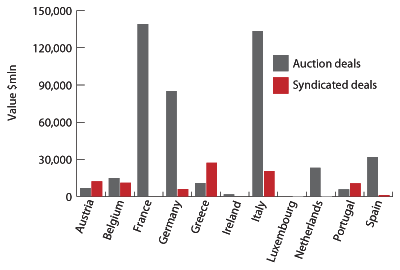
In fact a back-of-the-envelope analysis conducted by one investment bank suggests that the subsidy on BTP auctions in Italy alone is €110 million when spread across bank participants – and that the maximum that can be made back on fees is €105 million. Italy has the biggest debt pile in Europe each year to refinance, about €150 billion, and is by far the most important sovereign issuer from investment banks’ perspective.
| Are syndicated deals really an incentive? |
| Sovereign debt by eurozone issuers: 1 June 2005 to 23 May 2006 |
 |
| Source: Dealogic |
The same bank estimates that the total subsidy that investment banks are providing to Europe’s government debt markets is about €400 million. Another suggests a more modest amount of about €250 million. The CEPR quotes a banker who estimates the sum to be in the region of €600 million. The pain of such losses can spark some bizarre behaviour.
It was this desperate search for some way to make money in trading government bonds that led a bunch of smart traders at Citigroup to launch their infamous Dr Evil trade that exposed the potential downside of the liquidity commitments that governments have sought to institutionalize in their market through electronic trading system MTS.
The German Finanzagentur is unique in that it does not use primary dealers. Gerhard Schleif, managing director, says: “We were pressed to do so in the first two years but have taken the view that it is the cheaper option for the German taxpayer not to.” The agency deals directly as principal in its own debt every day. “We are more than in close contact with the market: we’re part of the market,” Schleif says.
In auctions, it remains completely at risk. So when the agency is about to sell new debt at a certain point on the curve, it can trade around that point and either hold back or issue more bonds at its own discretion. That gives it quite an advantage. “But we recognize that we cannot go too far in smoothing the market,” says Schleif, “we must leave some arbitrages for other participants to trade.”
Perhaps it is no surprise the eurozone’s government bond markets can’t match their US counterpart for transparency and efficiency – at least as yet. The advent of the euro meant that government bond markets changed overnight, and created huge challenges for sovereign debt managers. Investors in any one country could use another nation’s bonds as a benchmark. The biggest countries, such as France, Germany and Italy, understandably became benchmark issuers. But the smaller sovereign debt managers had an even greater need for methods to grab the market’s attention. That is why the whole system of primary dealerships and secondary market monitoring has become so elaborate.
“The wonder is that national governments for the smaller countries within the eurozone attract any liquidity at all,” says the CEPR report. “It is clear that the small country issuers must be providing some form of incentive to secure participation in their otherwise marginal bond markets.” But the incentives the report alludes to are used by all nations, large and small.
The problem with the concept of harmonization of European debt markets is that each government wants to capture the benefits of harmonization and none wants to pay the costs. Away from the public gaze, an argument has been raging recently over preferential tax treatment of euro denominated T-bills by which, so the accusation runs, certain governments have sought to maintain a captive home investor base, contrary to the rules supposedly governing a free capital market.
“I know of countries,” says one debt manager, “where local tax payers are still charged a far lower rate on their own government’s T-bills compared to the tax rate on those of other governments. When I complain, the first response is to deny that happens and point out that laws have been passed to equalize tax rates. When we insist, the second response is to admit that these are not being applied and to promise that they will be.” This source claims that only five EU sovereigns, including three peripheral ones, are properly abiding by the rules.
“We have no proof that this happens,” says another debt manager, “but we certainly hear that certain national central banks will only accept local T-bills as collateral and there are still some rules restricting institutional investors to paper listed on local exchanges.”
It’s not just about primary markets. Secondary market-making commitments on electronic bond trading platforms are part and parcel of scoring well on primary dealerships. It’s a similar story to what occurs in the primary markets: dealers want to show commitment so that they win bond mandates, and that commitment has traditionally been proved via quantitative measures. But is the reported liquidity anything more than an illusion?
Every country has its idiosyncrasies, with some choosing to emphasize performance at auction, others in secondary market trading, while some emphasize a mix of the two.
There are some signs of improvement regarding overbidding. In Italy, the authorities have informed market participants that they will not reward overbidding. The DMOs are aware of the problems but they have a difficult balancing act to manage. The amount a bank bids at auction remains a key measure of performance. Without measurements it is hard to justify exactly why syndicated mandates are awarded to any particular institution – especially a non-domestic one.
A primary dealers’ playground
The extent of overbidding varies from one market to another and one auction to another. But until it is eradicated, it will remain impossible to attract end investors to the process. Auctions will continue as a sector that is the playground of primary dealers with their activity driven by hoped-for ancillary business.
It is hard, though, to see the rationale for membership of the French primary dealerships. France sells very few bonds via syndicate and has few other bits of business on offer.
So what is the value of a primary dealership to the franchise value of a bank? Domestic banks have an understandable need to cosy up to their local debt management office. And almost all international investment banks and larger regional players recognize the importance of being players in sovereign markets. But in the secondary markets bid-offer spreads have disappeared without there being any compensating increase in volumes.
Basic economics suggest that banks should withdraw from the market until profitability returns. But the problem is that once a bank has decided to pull back from its sovereign commitments there is always another bank willing to replace it.
In addition to re-evaluating France, a number of houses are trying to quantify the benefit of operating in Germany. Germany’s recent inflation-linked bond, a €5.5 billion 10-year deal led by ABN Amro, Barclays Capital, BNP Paribas and Deutsche Bank provided some profitable business but it’s the type of trade that only happens once every couple of years.
Some of the larger players are starting to cut the capital they allocate to sovereigns. There was some surprise that BNP Paribas recently withdrew from its Belgium primary dealership as this is one of the few that is relatively rewarding. Belgium has roughly two syndicated deals each year. It also has recently awarded mandates to structure and sell asset-backed securitizations of state assets such as delinquent social security and tax payments. The other bank to withdraw from Belgium was Portugal’s Caixa Geral de Depósitos – which is going back to playing in its domestic market.
Banks are increasingly wondering where the pay-offs are. Are the banks placing their brightest young people into sovereign business? The answer is comprehensively no. The hottest areas in fixed income are structured credit/credit derivatives, securitization, principal finance, leveraged loans and commodities – not sovereign debt.
It might not matter now but at times of stress will sovereign borrowers find that they get service commensurate to the paltry fees they pay?
“There is an awful lot of bullshit from the sovereign issuers about the value of their business. In reality it’s really slim pickings,” says one head of debt capital markets.
“There are a lot of other areas where you can deploy capital.”
Practical issues
The costs of operating in the sovereign sector are not just limited to buying market share in primary and secondary markets. Banks have to deal with the technical demands of maintaining several auction systems.
“We are looking at ways of harmonizing how the auctions technically work,” explains Manfred Schepers, European head of the Bond Market Association (BMA). “They need to migrate onto a common platform with one set of practices.”
Practical issues that face those that wish to participate in auctions across Europe should not be underestimated. Banks cannot have dealing desks in every European location.
In Italy, there is a €50,000 licence fee for the dedicated line needed to operate at auction – and that is before any in-house IT costs are incurred. Unfortunately traders say the line is not even that efficient and suggest that using the Bloomberg network would be much quicker.
As if these barriers are not enough, there are normally language requirements to bid in auctions. The international language of the financial markets might be English, but not in Europe’s sovereign debt markets. Politics are behind these decisions, not economics or even best practice.
DMO managers get together regularly to discuss issues such as how to benchmark their performance and what role they should play as risk managers (see following story). Why not sit around a table and agree certain basic systems that all auctions can use that make it straightforward for primary dealers and, more important, investors?
In addition, banks have taken steps to cope with the fact that this client base is a monopsonistic buyer of liquidity. The European Primary Dealers Association was established at the end of 2004 purely to address specific primary and secondary markets issues. There are whispers that the smaller sovereigns are worried about this trade association because it only has the top 20 dealers in Europe as members – and therefore represents the needs of only larger international banks rather than domestic institutions that might have their own reasons for dealing in a particular market.
What could the EU do?
And if the market fails to regulate itself, what could the EU in practice do? Professor Richard Portes of the London Business School tells Euromoney that he does not think it would be easy for the EU to take steps that would solve the major issues facing the European sovereign market.
“This market differs so substantially across countries that a uniform policy couldn’t work… there are very different market sizes and different investors involved,” says Portes.
The heterogeneity of this marketplace, with markedly varied incentives in place for dealers, stands in the way of EU commissioners putting in place a policy to address the issues.
Talk of mirroring the US with a greater issuance coordination is dismissed by Portes. “I think that gets very close to joint issuance and that is a long way off,” he says. European sovereigns have shown no appetite to merge their debt issuance as this would require mutual guarantees of liabilities.
“We are likely to see a natural evolution over the next few years in this market’s micro structure,” says Portes. “What we have to expect is that banking consolidation across Europe is going to have a significant effect on the micro structure and there is going to be pressure to relax the conditions that issuers put on the primary dealers.”
Portes argues that the nature of the sovereign debt market will improve given less intense competition should there be significant banking M&A in Europe: “Also basic economics has a role to play: the primary dealerships cost banks a lot of money and eventually their desire to lose money in this sector will wane especially as major incentives like privatization mandates are less likely. I don’t think transparency regulation is the answer. There are clearly issues and some market distortions, but you don’t solve them by regulating transparency.”
| How the sovereigns reward their banks | ||||||
| Primary dealer rewards | ||||||
| FRA | ITA | JPN | SP | UK | US | |
| Access to regular auctions | Preferred | Preferred | Preferred | Preferred | Equal footing | |
| Access to other prim. business* | Excl. rights | Excl. rights | Excl. rights | Excl. rights | Excl. rights | No preferred |
| Central bank counterparty | Unrelated | Unrelated | Unrelated | Unrelated | Unrelated | Exclusive |
| *Exclusive rights vary in scope (re-openings, non-competitive auctions, syndications, etc) and degree (restricted access, technically advantaged, etc) | ||||||