|
AS REGULATORS FINE-TUNE the newly increased capital requirements and leverage ratio limits they will shortly be imposing on the financial services industry, bankers fret that regulators will go too far, pile up new requirements higgledy-piggledy and so limit banks’ capacity to lend into the hoped-for economic revival. There are study groups at the Financial Stability Board, the Basle Committee on Banking Supervision and the IMF working on every aspect of the new regulatory framework – with one glaring exception. No one is preparing an analysis of the total impact of all the suggested new regulations on the size and constitution of the world banking system’s combined balance sheet (see The future of banking: Banking’s next top model, Euromoney, September 2009).
Paul Tucker, deputy governor of the Bank of England, who has been tasked since March this year with identifying potential vulnerabilities of the banking system and ensuring its resilience, nods vigorously when Euromoney puts this to him.
He is well aware that regulators themselves might be one potential risk to the system.
Although he declines to be drawn on regulators’ own discussions of this or to suggest any body or venue for undertaking an official end-impact study of all the proposed new rules, he suggests that “there is in fact quite a strong appetite within the official sector to consider precisely this as the transition issue is recognized”.
He adds: “When bankers express this concern, it appears they think all these new regulations will come into force terribly quickly and force them to deleverage further. I do agree with them that we need to focus on both the endgame and how to transition to it without perverse effects. Indeed within the official sector there is a desire for the endgame to be reasonably well defined. And by considering the endgame, I mean examining questions of the effect on capital flows and intermediation of lending and the effect on the global economy of a different structure to the international banking system.”
Any bankers taking comfort from these words, however, might be rather chilled by Tucker’s accompanying list of things that the banks themselves still need to fix.
Banks’ rush to issue new capital securities gathered pace last month, after Deutsche Bank and Société Générale had reopened the euro tier 1 market at the end of August. Deutsche sold a €1.25 billion perpetual non-call five-and-a-half year bond and the French bank a €1 billion perpetual non-call 10. Within a week, Bank Inter had brought a 10-year bullet lower-tier 2 deal.
Disconnect
It seems as if the disconnect between banks and regulators is growing wider. When you listen to Tucker, it becomes clear how much regulators now focusing on systemic vulnerability – rather than on each bank in isolation – are focusing on the quality of banks’ capital even more than on the quantum.
Tucker takes a broad historical sweep at this, thinking back to his own time working with Peter Cooke, former chairman of the Basle Committee on Banking Supervision, in the lead-up to Basle I almost 20 years ago. “If you think back to when the 8% Basle I capital rule was first set, I don’t think anyone imagined that less than 20 years later parts of the international banking system would have been operating on de facto core equity to total assets of 2%. There was discussion that subordinated debt might make up to one-third of capital but I remember the US bank representatives in the Basle I discussion, for example, saying that by the mid-1990s US banks would have raised their capital substantially above what it was in the 1980s. In the event, by the 2000s equity capital ratios of banks internationally may have fallen below where they had been in the 1980s.
“The erosion of the quality of bank capital across the world over this decade is very striking. And that needs to be fixed.”
Tucker has little time for subordinated debt in its various forms, even as banks continue to churn out tier 1 and tier 2 capital. “I suppose that, in theory, it might be useful if you could neatly separate banks into those that are small enough to be liquidated without systemic consequences, and so that would be allowed to issue subordinated debt, from those too big and complex to be easily liquidated and that wouldn’t. But I suspect that it’s almost impossible to draw and police that line, not least because what proves to be systemic depends so much on the circumstances.”
He concludes: “It’s quite hard to make a case for subordinated debt at all.”
Bankers are also preparing their arguments against being required to invest too large a proportion of their assets in very low-yielding government bonds as a liquidity buffer. It’s rather too convenient, some bankers say, for government policymakers to insist on this when they’ve all got big deficits to finance. Rather, the repo markets should lead the way. Assets that have remained liquid and easy to finance on repo – including high-quality corporate bonds and even some equities – should be eligible for inclusion in any so-called liquidity buffer.
Not for one moment are they convincing Tucker. He says: “Not having a standard on liquidity has been a gaping hole in the regulatory arena and in the UK I am delighted that the FSA is pursuing a measure centred on holdings of high-quality government bonds. Plenty of people say this asset or that asset is equally as liquid, but in a crisis, when push comes to shove, which is the only time when any of this actually matters, they’re not.”
If banks don’t like the sound of this, Tucker offers them a solution: “The extent of the resilient liquidity buffer of high-quality government bonds that banks are required to hold must partly depend on other aspects of their funding and liquidity structure, including loan-to-deposit ratios and maturity and concentrations/diversification of wholesale borrowing and asset portfolio liquidity.”
That is not much consolation. It is a tough message.
It remains to be seen how the aftermath of the near collapse of the banking system changes the dynamics of the basic business of deposit gathering.
The old thin-capital, wholesale-funded banking model, which cast taking deposits through traditional branch networks as an expensive and unnecessary anachronism, has been utterly destroyed.
Banks are increasingly competing for deposits, eager to pick them up even through acquisitions of failed banks, purely for their cheap funding and, in some cases, competing on price. Some banks are even discussing with potential corporate depositors the idea of a two-tier market in insured and non-insured deposits in which banks would offer a higher yield on uninsured deposits. But that heightened competition itself threatens the very premise of deposits being inherently desirable because of their dependability. Deposits might become less sticky, the more aggressively banks chase them. And they might get more expensive too.
HSBC runs a very conservative asset-to-deposit ratio – which varies from country to country and does not assume that deposits are fungible, while now coming out across the group in aggregate at 79.5 – following a huge influx in the depths of the crisis. So for every $100 HSBC takes in deposits, the bank lends only $79.50. Many of its rivals have ratios far above 100, with Lloyds Banking Group and RBS at around 150. The higher above 100 a bank goes, the greater its reliance on wholesale funding.
So, in September, when Stuart Gulliver, chief executive of the global banking and markets division of HSBC, addressed bank analysts, they might have been surprised to hear him say that while other banks are considering new caps on their loan-to-deposit ratios HSBC is considering a floor.
Gulliver says: “There is a point at which keeping on getting deposits, particularly in a very low interest rate environment where you can make no money off those deposits, may not be a sensible business proposition.” He stresses that any floor would be around the present level and that the bank would never take its ratio above 100.
The future dynamics of the market for bank deposits are uncertain. One thing is likely. Increased competition for them won’t help banks’ net interest margins. Caught between the requirement to raise deposits, term out wholesale funding and hold substantial amounts of low-yielding bonds, banks are going to have to pitch their stability to investors rather than their earnings growth.
Tucker understands that potential investors in bank stocks might be reluctant to provide equity capital until they know the new rules under which the sector will operate. He admits that the headline return on equity will be lower, while pointing out that, in theory, so too will be the risks of investing in banks. But even as he makes this claim, Tucker has to prepare for the possibility of it proving hopelessly over-optimistic.
Resolution arrangements
The third leg of the ambitious regulatory agenda Tucker now prioritizes – alongside addressing banks’ capital and liquidity – stands under the umbrella of resolution arrangements. New regulatory initiatives are designed to make banks less likely to fail in such catastrophic fashion as over the past two years. But banks do fail, and lawmakers and regulators have much to do in establishing new mechanisms to liquidate them – particularly large, international banks – in an orderly fashion and without sparking a systemic crisis.
Knowing there is much to be done here, Tucker hesitates to pronounce forcefully on one of the key topics of debate right now: should banks be forced to segregate funding and capital for subsidiaries in each country in which they operate?
The large international banks’ trade body, the Institute of International Finance, chaired by Deutsche Bank chief executive Josef Ackermann, argues passionately that they should not and warns of dire consequences for the diminished supply of funding to emerging growth economies – this even though some of the IIF’s own members with large networks in emerging markets, such as HSBC and Santander, already operate in precisely this way, as holding companies for independently funded and capitalized banks.
It might be no coincidence that, for now, those have emerged in good shape from the crisis. They have been much quieter than the opponents of the separately capitalized subsidiary model, perhaps because they see no great benefit in arguing that other banks should copy an approach through which they have distinguished themselves. That might rob them of a comparative advantage.
|
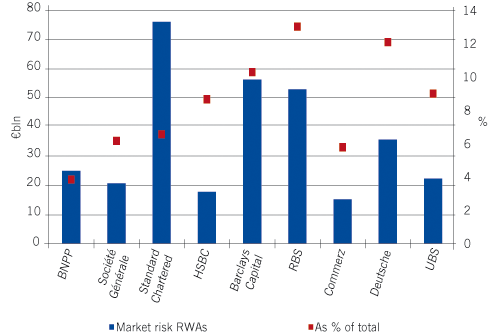
Capital charges could triple for market risk |
|
Market risk risk-weighted assets as a percentage of total (H1 2009) |
 |
|
Source: Company data, Credit Suisse estimates |
Tucker knows full well that just across the City, at the offices of the Financial Services Authority in London’s docklands, Adair Turner has been pressing the case. For his part, Tucker urges delay and suggests that the work on new schemes for resolution of failing banks will inevitably throw up implications for the way banks are structured and organized. Tucker clearly wishes for greater simplification of the myriad legal entities through which banks now operate. As to ring-fenced capital for separate subsidiaries, he says: “I really don’t know what the answer is. I think that question should be addressed when we have new resolution plans for the big firms. International action on resolution schemes has quite a high priority.
“We all need to work through these plans in a rigorous, methodical way, which will take time. When we have done that, we must ask how the prevailing corporate structures of banks fit with viable resolution.”
One could take a reasonable guess right now, though.
|
“If we don’t have a foolproof solution for too-big-to-fail internationally, then we need to think through how a capital-of-last-resort regime would work effectively and without perversely affecting risk-taking incentives” Paul Tucker, Bank of England |
The Bank of England was founded in 1694. It has had an explicit statutory objective to preserve financial stability in the UK since March this year, when the Banking Act 2009 was passed. This also set up a new special resolution regime for dealing with failing banks after the chaotic collapse of Northern Rock revealed deficiencies in the prevailing arrangements between the Bank of England, the UK Treasury and lead regulator the FSA. Partly, that deficiency stemmed from the almost superstitious reluctance of the official sector to lay down procedures for dealing with large bank failures and systemic threats. These things weren’t supposed to happen, so you shouldn’t talk about them. Since Northern Rock and Lehman Brothers people have had little else to talk about. Tucker is trying to lay out a logical view of the responsibilities of the new financial stability committee he chairs that considers bank failures not as unlikely but as inevitable: regulate better so as to make bank failures less likely but stand ready with a workable resolution scheme for when they do happen. Devise resolution schemes in a way that prevents one bank failure blowing up the entire financial system but, so Tucker argues, take the final responsibility of having a back-up plan if that fails and another systemic seizure does threaten.
This final thought takes Tucker into territory where few regulators want to follow even now. If something similar to what followed the bankruptcy of Lehman ever happens again, what plan should governments and regulators have in place then? What has just happened shows how quickly the state must step in to bail out a failing financial system so as to prevent social disorder. Tucker suggests that the world cannot possible pretend that this put to the taxpayer does not exist. Rather, he proposes a new social contract with banks in return for states propping them up as the provider of capital of last resort – just as central banks have always been the lender of last resort.
He wants banks to pay for this, and he wants the knowledge that surviving banks will have to pay the price of any systemic bailout to influence their behaviour in ways that make this capital of last resort less likely to be drawn on.
“What would those policies look like? First of all, there would have to be some form of systemic threshold. Governments should not be allowed to use public capital to prop up failing banks unless there is a clear threat to the stability of the entire system. But, on the idea I aired in Tokyo, taxpayers would only provide this capital as a form of bridge finance that must be paid back, possibly over a long period of time, by the survivors. To the extent that the state suffers any loss, the residual continuing banking system and the shareholders of its members must collectively pick up the tab.”
Self-policing
When Euromoney points out that arguments still continue over how to measure the financial costs or even profits from previous systemic bailouts, such as the Swedish experience of the early 1990s, Tucker holds up his hands and admits he does not have the correct model for this. But he is serious in his intention to redraw the social contract with banks to ensure that, as with pre-funded deposit insurance schemes, the banks themselves ultimately pay for any repeat of the wholesale infusions of taxpayers’ money, which has just saved them.
He says: “I’m not talking about doing this right now, but about over time developing a regime that the banking system can build into its own behaviour. That would incentivize the strongest and best-run banks not to deal with weaker banks that are running excessive risks, so sending a signal to the markets and to the authorities. And I would hope that banks would blow the whistle on each other and go to each other or come to the authorities with their concerns. It is striking the regulators (which don’t include the Bank) are often told: ‘Oh well, of course, everyone really knew such and such a bank was getting into trouble.’ Well go and tell the regulators then… or you might find yourself paying for it. And, for the same reason, the strong, well-run banks might even go to the weaker ones and tell them to sort themselves out.”
It’s self-policing… but not as we’ve known it. It remains to be seen if Tucker has unearthed part of the answer to the most pressing question of the moment for regulators: what to do with banks deemed too big to fail.
Tucker says: “If we are to make progress with reducing the too-big-to-fail problem, pursuing resolution plans or living wills is really important. But if we don’t have a foolproof solution for too-big-to-fail internationally, then we need to think through how a capital-of-last-resort regime would work effectively and without perversely affecting risk-taking incentives.”