Awards for Excellence 2018
|
|

A mature economy and limited room for domestic growth tends to push Canada’s biggest firms into foreign forays. And fortunately for RBC Capital Markets, they often choose to do that supported by Canada’s best investment bank.
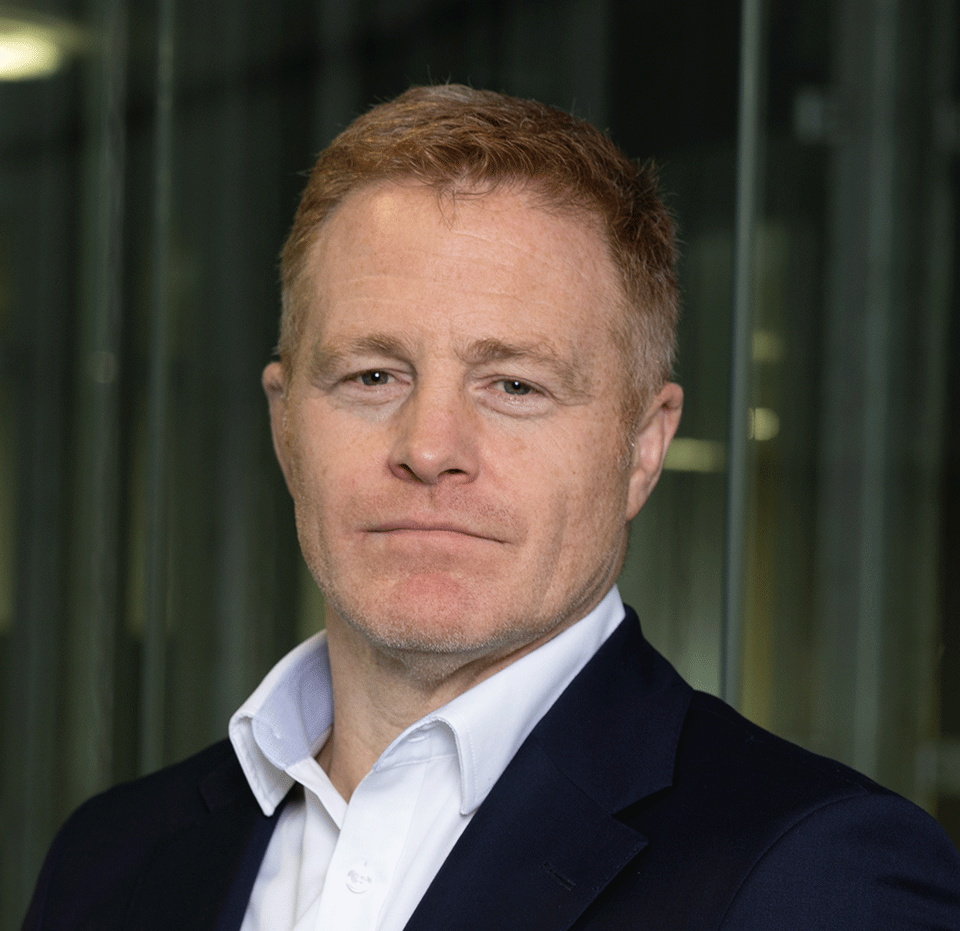
“We sit alone in this space of being a leading Canadian franchise with global distribution and connectivity,” says Derek Neldner, recently promoted to be global head of investment banking.
If one deal summed up the bank’s year, it was probably Permira’s $2.3 billion sale of vitamins business Atrium Innovations to Nestlé, where RBC advised Permira. The story begins in February 2014 when RBC advised on the original take-private, but it ticks all the boxes: financial sponsor work, global connectivity (US-Canada-Switzerland) and a dual-track process, where the bank was positioned to complete either option.
 |
|
Derek Neldner |
The connectivity theme also sat well in the bank’s debt capital markets franchise during the period under review, with cross-border deals providing some of the highlights of the year. The crop of maples (Canadian dollar issues for non-Canadian issuers) included debuts from Apple, McDonalds, Pepsi, Walt Disney and Thames Water – all deals where RBC was a lead. The standouts were Apple’s C$2.5 billion seven-year (the biggest single tranche corporate deal in Canada) and Disney’s C$1.25 billion seven-year.
Where the bank’s claim to be globally capable stacks up best is in its work taking Canadian issuers to other debt markets. It ranks top in leading Canadian bond issues in foreign currencies, ahead of Bank of America Merrill Lynch (BAML) and with almost double the share of the next ranked Canadian firm, BMO Capital Markets.
A deal like Precision Drilling’s $400 million high-yield bond might not be striking at first glance, but it is an example of the bank being moved to lead-left after a series of transactions where it sat on the right, showing how it can be rewarded for making its Canadian clients feel prioritized.
RBC’s equity capital markets business – it finished the awards period top of the Dealogic Canadian ECM league table – is where the years spent cultivating a private equity franchise are really paying off. RBC pounced on bankers leaving global competitors at the time of the financial crisis and was also in the rare position of being able to back that up by supporting clients with balance sheet.
Monetizations and exits were a key theme in last year’s Canadian ECM activity, and RBC’s relationships with sellers outside Canada combined with domestic distribution prowess have continued to put the bank in a good spot.
The IPO of clothing company Canada Goose, where RBC was a joint bookrunner, came just before the period under review. But private equity seller Bain returned later in 2017 for a follow-on offer in the same stock. Both deals were a testament to RBC’s deep relationship with Bain and its Canadian equity distribution power.
The bank’s M&A practice – it posted a top-ranked 20% market share for completed deals with any Canadian involvement – has also helped the firm. RBC sits above all others for completed M&A and only Goldman Sachs ranked above it for announced deals. ECM deal flow has often been M&A-driven, and a bank without cross-border reach and the advisory expertise to match can find it arrives late to the financing party.
When RBC advised SNC-Lavalin on its acquisition of WS Atkins for C$4.2 billion, completed in July 2017, it notched up financing mandates along the way, including a C$1.3 billion subscription receipts offering. It is a measure of how far RBC has come since the financial crisis – it is hard to imagine the bank being on a short list for a company looking to buy a business in the US or the UK a decade ago.
RBC was also sole bookrunner and agent for an extraordinary transaction that saw two first nation entities – Fort McKay and Mikisew Cree – take a 49% stake in an oil storage facility, Suncor’s East Tank Farm Development, for C$503 million. Backing the acquisition was a C$545 million issue of 2041 senior secured notes, sold by a combined joint venture and structured by RBC. The purchase was the biggest first-nation business investment in Canada.
RBC considers itself a global competitor; its challenge is to do this while keeping focus on the mid-market that will supply it with steady revenues and the champions of the future. Neldner recognizes this, noting that entrepreneurs are unlikely to look kindly on banks that only become interested once their company hits the billion-dollar revenue mark. That he sees the contrast in terms that go beyond mere size bodes well for the franchise.
“It’s not small versus big; it’s now versus the future,” he says.