Awards for Excellence 2018
|
|
|
Also shortlisted |
Emirates NBD |
Itaú Unibanco |
| View full 2018 results |

Those who have followed the story of Kotak Mahindra Bank, from its foundation as a broking and leasing business in 1986, through its joint venture with Goldman Sachs in 1995, know it best as an investment bank. But it has gone through a considerable evolution, particularly in the 10 years since the global financial crisis, and today stands as a fully fledged banking and financial services house with a keen eye for opportunity.
“When we got our banking licence in 2003, we were known largely for our investment banking business,” recalls Dipak Gupta, joint managing director of Kotak Mahindra.
“We used to call ourselves a ‘bank plus’, meaning we offer banking services and a whole range of other non-bank financial services. People would jokingly say: ‘I can see the plus, but where is the bank?’
“We realized you cannot run a diversified financial institution purely dependent on an investment banking platform. We started scaling up the liabilities business in 2009, but what gave it the big leg up was the digitization programme.
“Now, when we say we are a bank plus, we can do so proudly: we can see the bank all around.”
Today Kotak Mahindra is very much part of the fabric of Indian full-service banking, operating out of 1,375 branches in 700 locations through four strategic business units – consumer banking, corporate banking, commercial banking and treasury.
But, as Gupta says, it is digitization that has allowed the bank to step up against longer-entrenched competitors with more bricks and mortar. During the review period, the bank launched its 811 instant account, the first downloadable bank account in India, which can be opened anywhere within five minutes using the Aadhaar biometric national ID card.
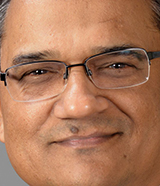 |
| Dipak Gupta |
“In India, if you operate in an isolated vertical like investment banking, the market is very complex and offers you limited scope of making a lot of money or even appropriate returns,” he says. “But when you look at the entire spectrum of diversified financial services, then the opportunity is phenomenal.”
On a consolidated basis, Kotak Mahindra’s profit after tax climbed by 27% in 2017 to Rs58.16 billion ($852 million), with total assets under management and advice up 37% to Rs1.82 trillion and advances up 24% to Rs1.96 trillion.
The group’s capital adequacy ratio is 18.4% (or 18.7% for the bank on a standalone basis) and consolidated return on equity is 13.6%. At the same time, net non-performing assets are just 0.94% on a consolidated basis, 1.09% standalone.
While the numbers are clearly impressive, it is the bank’s ability to find specific opportunities and exploit them ahead of the field that resonates most.
Launches during our review period included numerous digital payment methods, an Aadhaar-based outward forex remittance product, the launch of a consumer durable financing business, the acquisition of a microfinance business and the operational launch of an infrastructure development fund.
In investment banking, we could give a long list of equity and debt capital markets transactions, but it is the sense of manoeuvring ahead of opportunity that stands out. Kotak Mahindra is, for example, the firm most likely to get on the right side of trends in public-sector bank restructuring and new methods of resolving non-performing assets.
“One of the more interesting pieces of the bank is the asset reconstruction business,” says Gupta. “We buy stressed loans from other banks and then we go ahead and resolve them.
“The new stressed asset resolution infrastructure put in place by the government through the Insolvency and Bankruptcy Code has been very timely for someone like us.”
While Kotak Mahindra wins this award for the excellence and professionalism it demonstrates in India – many foreign investors hold it as a play on India, among them Capital – it is also growing internationally on the wholesale side.
The bank has sought to tie up with foreign partners including SMBC in Asia Pacific and ING in Europe, the latter a relationship that was formalized when Kotak Mahindra bought ING’s local Indian bank three years ago. It also has asset management entities in the UK, US, Singapore and the Middle East.
But the top management says the opportunity to be a modern bank in a modern India is so very big that there is plenty to do at home, and so the domestic picture remains the point of focus.
If you ever hear the bank’s founder, Uday Kotak, speak, he is likely to talk about a once-in-a-generation change in banking: in the nature of the customer, the way they wish to be served and the role technology can play.
India is a place where enormous firms like the State Bank of India rub shoulders with Ant Financial and Alibaba-backed payments fintech PayTM, where century-old public- and private-sector lenders are fighting mobile telecom companies with financial services licences. Everything is changing, but Kotak Mahindra convinces as a bank that will come through the upheaval not only intact but energized.