BNP Paribas, partly through tough cost-reduction programmes, has earned its way to a strong capital position, with Basle III common equity tier 1 now at 9.9%. That is ahead even of the big-two Swiss banks, as well as its local rival, Société Générale, and Barclays. Its leverage ratio is down below 20. At the same time, BNP Paribas has strengthened its liquidity buffers to now cover 125% of short-term funding liabilities. Last year, the bank was shrinking its CIB balance sheet. Now, it is in the vanguard of European banks moving past the deleveraging process and looking to grow again. It has managed to improve its capital ratios without damaging client franchises. Indeed, loans increased in every market within its domestic retail networks, leading to an overall increase of almost 2%. The group has continued to demonstrate a stringent risk policy, with one of the lowest cost of risk/gross operating income ratios among its peers, at 37%. Although the bank now looks set to grow more rapidly outside Europe, it still prides itself on being well run in its home region and is highly regarded by analysts for generally delivering on its targets. Like all banks now, it has to be focused on costs, especially in Europe, where the prospects for growth are more limited than elsewhere. Chief executive Jean-Laurent Bonnafé explained the bank’s approach to Euromoney in a recent interview: “There has been an accumulation of rules and regulations, the net effect of which will be to drive the cost of doing business up. The only response is to be more efficient. This is a large bank doing business in nearly 80 countries and one that has been through three successful and major mergers – think back to the combination of BNP and Paribas, the merger with BNL in Italy and then Fortis. Every four or five years a bank needs to look again at all its processes, decision-making and internal communication, as if it were doing a merger. This new programme will look across all geographies and functions for efficiencies and ways to align common platforms, such as, for example, between retail and investment solutions.” Deutsche Bank is Euromoney’s best investment bank in western Europe. In a year when debt capital markets were the key battleground for fee-hungry investment bankers, Deutsche Bank consolidated its number-one position, leading deals worth over $120 billion, with a 7.27% market share, ahead of powerful challengers HSBC, which led deals worth $107 billion and took a 6.5% market share, and Barclays, with deals worth $102 billion and a 6.2% share. Deutsche’s capability beyond the euro and dollar debt markets made it a first choice for frequent issuers. It arranged more inaugural sterling, Swiss franc and Norwegian krone bonds than any other bank, including deals for Heathrow, Allianz, Telia, PepsiCo, Von Roll, Oerlikon and Nestlé. And it took client after client away from its French, Italian, UK and Spanish rivals, winning first-time mandates from Unedic, La Mondiale, Atlantia, Campari, Lottomatica, Ferrovial and Heathrow Airport. It played prominent roles in the growth of the high-yield market in Europe, the hybrid market and, in a shrinking and at times difficult market for bank issuers, was a lead debt arranger for many of its peers. Deutsche has led the industry in helping Irish banks regain market access: sole arranging Bank of Ireland’s first capital bond since 2008 and AIB Mortgage Bank’s first post-crisis issue. Deutsche has done more than any other firm to help ING and Lloyds Bank to stabilize their funding, arranging ING’s inaugural yankee in February 2013 and Lloyds’ vital £13.8 billion ($21.6 billion) and £22 billion tender offers in June and September 2012. Deutsche has been the pre-eminent arranger of liability management transactions for European borrowers over the past 12 months. Standout contingent convertible deals include the first deal to include a permanent write-down (Barclays’ $3 billion CoCo in November) and the first ever CoCo by a peripheral borrower (the €2 billion CoCo for Bank of Ireland, which allowed the Irish government to secure Troika approval for an extension in the maturity of its debt). Deutsche also heads the western Europe equity capital markets league tables for the year, narrowly ahead of Goldman Sachs and Credit Suisse. This year it has been to the fore in reopening the IPO market after a quiet period in the second half of 2012. Standout deals include LEG Immobilien’s €1.3 billion IPO in January 2013, the largest western European real estate IPO ever, which came in at a tight pricing of 3% discount to LEG’s net asset value; and insurer esure’s £695 million IPO in March 2013, which was the largest London IPO of the year, pricing in the top half of the range and at a premium to comparable stocks. Deutsche ranked a respectable fourth place in the quiet M&A markets of the past 12 months behind perennial leaders Goldman Sachs, Morgan Stanley and Rothschild, but ahead of JPMorgan, Lazard and Barclays. Deutsche’s M&A bankers advised América Móvil on its partial offer for KPN, and Carrefour on the sale of some of its Asian subsidiaries. It has made a notable play in peripheral European countries where local banks have scaled down and US firms have backed away because of concerns about political risk. Deutsche Bank has risen markedly in the national M&A advisory league tables for Italy, Greece and Spain. Deutsche also performed very well with private equity houses thanks in part to its outstanding leveraged debt capital markets business, which arranged more high-yield bonds than any other house in 2012/13. Deutsche also retained its leading position in flow, ranking top in the Euromoney survey for FX, as well as maintaining a top-ranking franchise in rates, cash equities and equity derivatives, being second ranked for commodities and third for credit. HSBC made big strides in western European debt capital markets last year, making inroads in corporate hybrid and high yield and FIG capital and cementing its dominant position in SSA and investment grade while bringing deals in more currencies than any other bank. It also demonstrated its ability to reopen markets with the €200 million puttable deal for Spanish region Castilla y Leon and to deliver access to peripheral names with Ireland’s €5 billion 10-year, OTE’s €700 million five-year and AIB’s residential mortgage-backed securitization issue. Given the all-consuming theme of new banking regulation requirements in Europe, the focus of the debt capital markets this year was, unsurprisingly, structural innovation and capital advisory. HSBC was front and centre of the surge in corporate hybrid issuance, being sole structuring adviser on the largest-ever hybrid, Électricité de France’s €6.2 billion multi-tranche deal in January. It also worked on hybrid deals for Eurofins, National Grid, Pennon and Veolia. The bank was also active on the FIG side, with the first contingent write-off structure for Swiss Re and deals for Direct Line and Axa. HSBC now has 8.15% of the market for FIG capital in Europe, and has risen from 10th to second in the league tables for this sector. Another manifestation of the hunt for yield during the awards period was the growth in high-yield bond issuance in Europe. HSBC was successful in capturing market share here, jumping 10 places to number six in the rankings. It led 32 deals, more than twice the number of the previous year. This included a €250 million five-year trade for Spanish technology firm Abengoa, Continental’s $950 million seven-year trade and a €500 million issue for Air France KLM. Currency diversification has always been a strength of HSBC, one it built on last year to lead 152 local-currency issues in western Europe and take an 11.58% market share. It led transactions in 24 currencies, including inaugural Indian rupee deals for BMW (Rs8 billion – $136.2 million), Lafarge (Rs5 billion) and VW (Rs3 billion). It continues to dominate the offshore renminbi market, with a 48% market share, more than six times the volume of business at any other bank. The bank’s own landmark Rmb2 billion ($326 million) three-year deal in April last year was the first dim sum bond to be issued outside greater China and the first such deal to target European investors. HSBC also acted as sole lead on KfW’s inaugural Rmb1 billion deal – the largest offshore renminbi bond from a non-Asian SSA issuer. Tracking yet another central theme of Europe’s debt markets, HSBC was active in both the US and European private placement markets, arranging the landmark $900 million dollar and sterling private placement for Brookfield Utilities, a UK energy distribution operator, earlier this year. It has also been instrumental in the internationalization of the Schuldschein market, with multi-currency transactions for non-German issuers such as Swiss life sciences group Lonza, French kitchen appliance firm Groupe SEB and electrical equipment supplier Sonepar. Last year, the equity capital market in Europe was a story of two halves. The tone in the market was transformed after the Christmas break when many firms rushed to take advantage of the surge in positive sentiment that was ushered in along with the new year. Goldman Sachs demonstrated its unrivalled ability to read the equity markets with a series of trades tapping into this momentum, and is Euromoney’s best western European equity house this year. Although it ranks second to Deutsche Bank by deal volume in the region, it has demonstrated dealmaking skill across geographies and has a solid 10.6% market share for the region. Goldman kicked off the year with the sale of $2.25 billion in mandatory convertible notes and $1.75 billion of shares at $16.75 for integrated steel and mining company Arcelor Mittal. The larger than expected deal enabled the firm to address its over-leverage while protecting its credit rating – a crucial stipulation for Arcelor Mittal, which was cut to sub-investment grade last year. The €1.3 billion LEG Immobilien IPO at the end of the month tapped into the positive sentiment surrounding German residential real estate and was the largest European real estate offering since Russia’s $1.9 billion PIK Group in May 2007. It was sold by Goldman’s Whitehall property funds. Goldman co-managed the deal with Deutsche Bank.
Another successful IPO for Goldman during the first quarter was that of UK estate agency Countrywide Holdings. This was a return to the market for the company, which delisted in 2006, just before the market crashed. In 2009 it agreed a £641 million debt-for-equity swap with lenders Oaktree, Apollo, and Alchemy Partners. The shares priced at the top end of the 260p to 350p range and by early April were trading 14% above their offer price. Goldman was also instrumental in one of the just two UK corporate IPOs in 2012 – the £787 million deal for insurer Direct Line in October. That deal was an important milestone for parent RBS and was the biggest share offering to the general public in the UK since broker Hargreaves Lansdown’s flotation in 2007. The past 12 months have been another frustrating year for Europe’s M&A bankers. By September 2012, banks had generated just $50.1 billion in fees for the year – the slowest quarter for M&A banking fees since the post-Lehman first quarter of 2009. Even after European Central Bank president Mario Draghi’s announcement of outright monetary transactions in August, the longed-for rebirth of the market failed to materialize. The number of M&A deals in January and February this year was down over 30% year on year. Indeed, for the first quarter of 2013 there was just €89.5 billion-worth of deals in Europe, down 27.2% on 2012 and just 28.8% of global deal value. In 2008, the region accounted for 42% of global M&A. The hope is that the improvement in sentiment in the US, where a number of jumbo takeovers reinvigorated the market earlier this year, can spread to Europe. Despite the confidence that deals such as Berkshire Hathaway and 3G Capital’s $28 billion acquisition of HJ Heinz and Liberty Global’s €23.3 billion purchase of Virgin Media suggest, the market still feels a long way from the levels of confidence required for chief executives to start spending their cash piles on new acquisitions rather than share buybacks. As Euromoney went to press, rumours about potential tie-ups between AT&T and Telefónica, and Vodafone and Kabel Deutschland were just that – rumours. But they could be a sign of a more positive environment for the market next year. Despite the subdued environment, Rothschild has spent the past 12 months cementing its dominance of European M&A. In the awards period it inked 222 transactions – 35% more than nearest rival Goldman Sachs, on 145 deals. The firm also advised on four of the 10 largest completed M&A deals in the 12-month period and increased its market share from 16.25% to 18.6%. As a long-term adviser to many of Europe’s top-tier corporates – such as Cairn Energy, Rolls-Royce, GDF Suez, Eni, Casino and Royal Dutch Shell – it is no surprise to see the firm involved with the landmark deals in the region this year. These include GDF Suez’s acquisition of the remaining 30% stake in International Power, Cinven’s €3.3 billion disposal of the aero-engine division of Avio to General Electric and Volkswagen’s acquisition of the remaining 50.1% stake in Porsche. GDF Suez appointed eight advisers for its initial purchase of a 70% stake in International Power in 2010, but used just two in the 2012 deal – one of which was Rothschild, the other Ondra Partners. Falling margins, sluggish trading volumes and regulatory constraints on dealing have all created an extremely tough environment for flow businesses in the past 12 months. For those firms that command top positions across rates, credit, foreign exchange, equities and commodities, it was a year when they all tried to make money where they could, protect market share and ultimately make the best of a pretty bad situation. One firm in particular not only managed to do just that – largely maintaining its leading market position across the main flow businesses – but managed to do so in the aftermath of the damaging Libor scandal and internal upheaval that ensued at the top. Indeed, if there was a threat that Barclays’ clients might start walking away because of this, the reality is that many if not all of them stuck with the UK investment bank, and particularly in two markets where most of the action was: interest rates and credit. Barclays was not only ranked number one overall globally in Euromoney’s annual 2013 rates survey, including for cash and derivative trades, but also ranked number one in euro cash and derivatives, dollar cash and derivatives, and sterling derivatives. For the big firms, rates remains a good business, with margins not yet as compressed as in foreign exchange and volumes supported by the vast increases in government debt issued in recent years. And as fringe players withdraw, volumes have remained good for the survivors. As the top-ranked player, Barclays is therefore a big beneficiary. In credit too Barclays has maintained its commanding market position across asset classes despite some fierce competition from rivals; in foreign exchange it remains one of the top-three banks. Barclays was ranked number one in three of the five overall product segments – investment-grade corporate CDS and financial institution CDS, as well as CDS index trading – in Euromoney’s 2013 credit trading survey, and was ranked second to Deutsche Bank in investment-grade corporate and financial institutions cash trading. Barclays, for the second consecutive year, was ranked third overall in Euromoney’s annual FX survey 2013, behind Deutsche Bank in first and Citi in second. Commodities and equities trading were not as strong for Barclays as rates, credit and FX, but that was almost universally true for investment banks. Taken together, however, Barclays’ flow trading, sales and research platform remains potent. Given the external and internal issues it has simultaneously faced, that’s no mean feat. The financial institutions sector faces complex risk management problems, and in the past year Deutsche Bank has been prominent in providing some of the best and most innovative risk solutions to banking, insurance and institutional investment clients across Europe. In the banking sector, Deutsche has led the way in both advising banks such as Lloyds Bank in de-levering by selling illiquid non-core assets, and advising others on distressed assets that need hardcore restructuring, including those held by FMW Wertmanagement, the German government institution that assumed control of Hypo Real Estate Holding following its nationalization, and Ireland’s National Asset Management Agency. Deutsche also advised European banking clients on rebalancing portfolios of FX hedges to enable them to match on the capital side the currency mix on their global risk-weighted assets, mark-to-market volatility on their pension fund liabilities, and funding over-the-counter derivative transactions via collateral. For insurance and pension fund managers, Deutsche was a key adviser on hedging complex risks such as longevity, inflation and credit, as well as resolving issues around duration mismatch and boosting portfolio returns. Deutsche was quick off the mark in advising French and German insurers on a solution that enabled them to fix duration mismatch to liabilities, and both at attractive yields and in line with regulatory and accounting constraints. The solution involved insurers buying bonds on a forward basis from Deutsche at an agreed and fixed price-yield level, a transaction made possible via a collateral matching programme where the insurers lent Deutsche short-dated bonds and received as collateral long-dated bonds that Deutsche had to hold anyway for regulatory purposes. Deutsche helped a pension fund manager enhance returns on its equity portfolio through what it says is the “first multi-stock dynamic overwriting strategy completed via a single swap”. The manager had considered selling call options on the stocks it owned, a technique known as overwriting, but the operational and time costs to the manager were too high. So Deutsche developed a solution in which the manager tells Deutsche which stocks it wants to overwrite each month, then Deutsche pays the manager the premium earned on the option less any losses if the options end up in the money, and all via a single swap agreement. The manager expects to earn a 2% pick-up a year in returns through this strategy. Deutsche also continued to provide expert bespoke hedging and financial solutions to the European corporate sector, particularly in the volatile natural resource sector. For example, when coal prices plummeted in the second half of 2012 on weak demand from US power producers, Deutsche Bank stepped in and structured solutions that enabled coal producers and trading houses to reduce their inventories and/or obtain a minimum price for future sales. Competition among big global and regional banks in cash management is growing as senior management continue to see the business for what it is: capital-light, highly revenue generative and one of the best ways to win new clients and lock in existing ones. In western Europe competition is most intense because of the sheer number of European and US banks that are aiming to strengthen their regional cash management franchises across corporate and financial institution clients. One bank, however, remains the strongest – Deutsche Bank. The German bank has once again cemented its leading cash management position in the region for corporate and financial institution clients, which ranked it number one in Euromoney’s annual 2012 cash management survey. In the past year, Deutsche has benefited from a continued flight to quality as clients seek stable and reliable banks, a trend that in 2012 helped increase its corporate deposits by 20% on a year earlier. The bank has also maintained its leadership in euro clearing, with a 20.6% market share, well ahead of its nearest competitor in value and volume, according to Target/European Banking Association. Foreign exchange is a core strength of Deutsche’s banking proposition, and there it leveraged its powerful global cross-currency payments platform, FX4Cash, which now boasts over 400 banking clients. Innovation also played a key role in the business’s performance in the past year, notably in the cross-divisional development of its Autobahn App Market. This app-based electronic service provides companies with integrated access to Deutsche Bank’s wide range of financial products. Deutsche has harnessed this new technology to deliver liquidity management and fund administration services as well as other solutions to its clients. Deutsche has also led the way in investing resources in advising clients on pressing and wide-ranging regulatory issues such as the Foreign Account Tax Compliance Act, Basle III, the Single Euro Payments Area (Sepa) initiative, and the Dodd-Frank Act. On Sepa specifically, Deutsche has developed and launched a new Sepa processing engine and connected its eurozone, UK, Switzerland, Poland, Czech Republic and Hungary branches, enabling clients to initiate and receive Sepa transactions from existing accounts. It was also the first bank to announce domestic pricing for all bulk cross-border transactions within Sepa. It is this investment in resources and technology combined with service delivery that continues to enable Deutsche to win new corporate and financial institution mandates, a selection of which include those from Bayer, Électricité de France and Gaz de France, Roche, Linde, Inditex, Zurich Insurance Group, Intesa Sanpaolo, Svenska Handelsbanken, Capita and KBC Group in the past year. Project finance is an extremely important source of credit for the European economy, but there are some systemic problems facing the market, not least acute regulatory pressures on bank balance sheets that have caused a sharp contraction in lending in the past year. Project finance volumes in western Europe fell 34.5% in 2012 to $37.3 billion on 2011, forming part of a broader 22.8% slide in volumes to $70 billion across Europe, the Middle East and Africa during the same period, according to Dealogic. But of those banks still providing the financing and advisory expertise to projects across industry sectors in Europe, it is BNP Paribas that stands out for the breadth and scale of projects and financings that it helped arrange and execute in the past year. Top among them was a consortium’s €3.2 billion acquisition and financing of Open Grid Europe, Germany’s largest gas transmission network, from E.On. The deal, recognized as one of Euromoney’s Deals of the Year 2012, was driven by a Macquarie-led consortium, comprising Infinity Investments (Abu Dhabi Investment Authority), British Columbia Investment Management Corporation and MEAG (Munich Ergo Asset Management), and stood out because it was the largest European infrastructure investment last year by some margin.
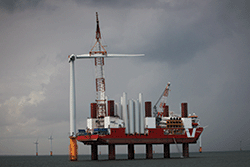
BNP Paribas was also involved in large financings in the renewable energy sector, and particularly on landmark offshore wind projects in the UK and Belgium. BNP Paribas was part of the financing group on the £1 billion financing – the largest offshore wind financing in Europe – for the Lincs Offshore Wind Farm located eight kilometres off the coast of Skegness, UK. The transaction finances the construction of a 75-turbine facility with a total capacity of 270MW, and was not only the first UK offshore wind farm financing to have construction risk but also the largest nonrecourse UK renewables project in the past year. Off the coast of Belgium, BNP Paribas was also one of the lead financing and advisory banks on the €595 million Northwind offshore wind project, a transaction that could set a template for other multi-sourced financings in the offshore wind sector. |