French hotel group Accor has recently opened a perfectly formed, modern Novotel near the airport in Banjarmasin, the capital of South Kalimantan on the island of Borneo. The hotel adds a little bit of European-style luxury to the developing city, boasting a restaurant that serves international cuisine, a fully stocked, modern bar and an outdoor swimming pool.
Still a new addition to the various offerings in Banjarmasin, the Novotel hasn’t yet filled its 198 rooms, but it’s getting there. The hotel is busy in the evenings, with a variety of customers from families to businessmen enjoying the facilities.
“As people in Indonesia become wealthier they are also beginning to look for quality,” says Gérard Guillouet, senior vice-president of Accor in Indonesia, Malaysia and Singapore, from his office in Jakarta. “And the opportunities for us are not just focused on Jakarta anymore.”
When Guillouet moved to Indonesia in 1993 from stints with Accor in Thailand and Malaysia, the hotel group had only just opened its representative office in Jakarta. In three years, Accor had built just three hotels in the country, in Jakarta; Balikpapan, a sea-port city in East Kalimantan; and Surabaya, Indonesia’s second-largest city, in East Java. Each had 200 rooms. Today, Accor boasts 70 hotels in Indonesia, with a total capacity of 13,000 rooms.
Guillouet has an aggressive expansion plan for Indonesia, arranging to open 20 hotels each year. By 2015, Accor will have at least 100 hotels in Indonesia, with big businesses in the growing second-tier cities, such as Bandung, the capital of West Java province; Bandar Lampung, the capital of north Sumatra; Pekanbaru also in Sumatra; Balikpapan and Pontianak both in Kalimantan; and Sulawesi’s provincial capital, Makassar.
Wealth has become much more widely distributed in the period since Accor set up shop in Indonesia. According to Boston Consulting Group (BCG), the country has the world’s fourth-largest population, while the number of middle class and affluent consumers is set to double by 2020. The country has 25 locations where middle-class and affluent consumers exceed 500,000. This will rise to 54 locations in 2020, says BCG. Attractive demographics and an appealing investment climate have attracted investment from big multinationals.
“Indonesia is central to our development in Asia Pacific,” says Guillouet. “Asia Pacific accounts for 15% of Accor’s total profit, but if you look at our development programme, the region represents 50%. This is where the potential is, and Indonesia is central to this.”
Top-tier cities, usually regional capitals and well-established economic hubs including Jakarta, Surabaya and Denpasar, have grown rapidly over the past 30 years on the back of increased foreign direct investment, growing domestic demand and government spending focused in these areas under president Suharto’s centralized government structure.
But over the past 10 years, important economic development outside Java-Bali has led to wider urbanization and economic growth, echoing the development of China and India. In a country rich in natural resources, coal mining, agriculture, palm-oil production and nickel-smelting businesses have sprung up. Indonesian multinationals including Sinar Mas, Golden Agri-Resources and Wilmar (in the palm-oil business) as well as Bumi Resources and Adaro Energy (coal mining) are thriving. And big business is creating an increased need for services, including hotels, health care, housing, tourism and banking services.
Adaro Energy’s coal mines, for example, are based in South Kalimantan, but the group has expanded its presence throughout the country, acquiring stakes in coal companies and mines around Indonesia. Adaro Energy now owns 61% of Bukit Enim Energi based in South Sumatra, 75% of the Balangan Project in South Kalimantan, and 10.22% – with an option to increase to 90% – of Bhakti Energi Persada in East Kalimantan. “Not only is the company diversifying its revenue base, but we are also helping to develop the areas we enter,” says Alastair Grant, senior adviser at Adaro. Investment in these cities is booming.
Guillouet says: “Although most investment is local and from Asia, we are definitely seeing a lot more European companies coming into Indonesia to take advantage of the developments in second-tier cities, especially the French.” Companies such as L’Oréal, Carrefour, Danone and Total have already increased their presence in Indonesia, hoping to tap consumption by the growing middle classes.
The catalyst for change was the regional autonomy law introduced in 2001, part of the surge of democratic development that followed the 1998 resignation of Suharto, Indonesia’s authoritarian president, and his military-dominated government. “The military, families close to Suharto, huge conglomerates – they were the ones that had the monopoly in Indonesia for a long time,” says Guillouet. “But now many of them have divested out of business, and more opportunities lie with private companies. When power was decentralized, there was a complete change in business mentality.”
Combined with rising prices in Jakarta, second-tier cities have become even more attractive. Although office rents slipped this year in some key Asia Pacific cities, including in China and Australia, Jakarta experienced some of the strongest rental growth, with prime rents increasing by 12.4% in the second quarter of 2013, according to Knight Frank, a London-based global real estate consultancy. And according to commercial and real estate brokers Cushman & Wakefield, monthly rents are due to jump to Rp356,028 ($31.44) a square metre by the fourth quarter of 2014, from Rp198,680 in the fourth quarter of 2011.
“Cities outside Java have been outpacing the GDP growth of Jakarta for some time now, with some seeing growth close to 9% and 10%,” says Tigor M Siahaan, Citi country officer Indonesia. “There is a lot of new wealth being created outside of Java.”
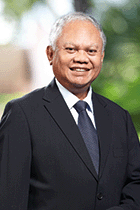 |
| Ketut Budi Wijaya, president director of Lippo Karawaci |
Lippo Karawaci, Indonesia’s largest publicly traded real estate developer, is following this growth into the second-tier cities. “Our most strategic locations are still in Jakarta and Greater Jakarta because these areas are the most developed market for Indonesia in terms of size and sophistication of customers,” says Ketut Budi Wijaya, president director of Lippo Karawaci. “But we are starting to realize that markets in the secondary cities are picking up the pace.” Lippo’s strategy in Makassar has developed in tandem with economic growth in the city. In the mid-1990s, Lippo began developing a residential and commercial district there that has grown into a sizable township.
“Currently, the township has a population of 9,500 with almost 4,000 houses and has created 12,000 jobs,” says Wijaya. “But two years ago the governor of South Sulawesi gave us the right to reclaim the swamp beach area [near the township] of 650 hectares. This will enable us to enlarge and enhance the township.” GDP growth in Makassar has been relatively high: in 2007, 2008 and 2009, it was 8.1%, 10.5% and 9.2%, respectively.
It is not all easy growth for second-tier cities. The need for infrastructure is one of their main obstacles, and it is vital for Indonesia to improve inter-island connectivity and strengthen transportation links between urban areas.
“The lack of efficient and good-quality infrastructure in Indonesia causes supply-driven inflation, uneven income distribution and manpower immobility,” says Wijaya. Logistics costs in Indonesia come out higher than the international average of 10% of the total cost of production, making the economy one of the most expensive in the world to run and lowering business competitiveness.
One of the main obstacles to infrastructure development is legal disputes around land clearance. In December 2011 – the same time that Indonesia gained investment-grade status from Fitch – the central government introduced an updated land-clearance law that would facilitate land acquisition for public infrastructure projects including toll roads, bridges, airports, roads and railways. Combined with access to cheaper funding, infrastructure projects should have taken off.
“But nearly two years on and Jakarta still hasn’t made any progress in building an intercity railway service,” says Enrico Tanuwidjaja, southeast Asia economist at RBS. “Land ownership in Indonesia remains ill defined and is a hurdle to infrastructure development. If the capital – with higher levels of committed investment – is running into problems, cities outside of the capital will also face significant challenges.”
The opening of Kuala Namu International Airport in Medan, the capital of North Sumatra, due in July this year, has been stalled because of land-acquisition difficulties. Although the airport – which will be Indonesia’s second largest – is ready to go, toll roads and highways from the city to the airport are not finished. Not all residents affected by the construction have yet surrendered their land to the provincial administration, even though the government has already paid them compensation. This problem and others like it also highlight the tension between regional and central government.
“Even with the regional autonomy law, there can often be confusion of which government body you need to go through to start building or mining – regional or central,” says David Tendian, CFO of Adaro Energy. “There are a lot of hurdles to jump over and not everything is completely clear as yet.”
Finding skilled workers in some of these cities can also hinder development. “Labour productivity growth in Indonesia is slow and based on natural resources,” says an economist based in southeast Asia.
“This is not good for developing a skilled workforce as skill and knowledge transfer is low in these types of industries. Not only are we lacking in skilled workers, the current focus doesn’t allow for much individual development. In the run-up to the general election this year the government needs to focus on such issues. A bigger emphasis on manufacturing – a sort of quasi-China model – might help to level out some the issue.”