Industrial and Commercial Bank of China’s European headquarters dominate a picture-postcard location in the heart of Luxembourg City, the sleepy, tree-enveloped capital of the tiny yet financially powerful country.
The towering building of the world’s largest bank looks out over the Adolphe Bridge, a national symbol that spans the Pétrusse valley, connecting Boulevard Royal, in the area of Ville Haute, to Avenue de la Liberté, in Gare.
It is a prime piece of real estate once owned by HSBC that says as much about ICBC’s remarkable rise on the world banking stage as it does about the importance ICBC associates with its banking presence in Luxembourg.
ICBC is not alone. The European headquarters of Bank of China, which first opened a branch in Luxembourg in 1979, are located just around the corner from ICBC on Boulevard Prince Henri. And China Construction Bank will soon open its doors for business in Luxembourg after receiving its banking licence.
With China’s three largest banks basing their European operations there, and more sure to follow, Luxembourg is swiftly evolving into the preferred outpost for Chinese investment and banking expansion across the European continent.
Hand in hand with this is Luxembourg’s quiet yet equally rapid emergence as a leading western financial hub for all things renminbi, a development that suggests it is stealing a march on such rivals as London, Paris and Frankfurt – all of which have trumpeted their ambitions in the currency.
 |
The internationalization of China’s currency is one of the most important developments in global finance since the introduction of the euro, which is why cities are jostling for market share. But Luxembourg seems, so far, to be astutely positioning itself best to capture much of the trading flows related to the currency coming online.
At the end of the second quarter, professional services and accountancy firm PwC says, Luxembourg had the largest pool of renminbi deposits in Europe at about Rmb40 billion ($6.5 billion); the largest renminbi loan portfolio at Rmb62 billion; and the largest trade-finance volume at Rmb52 billion. Luxembourg is also the largest renminbi investment fund centre in Europe, with some Rmb214 billion of assets – including debt, equity and other instruments – held in Luxembourg-domiciled investment funds, according to Banque Centrale du Luxembourg.
There are also 40 renminbi-denominated bonds listed on the Luxembourg stock exchange – the highest number of any European bourse and the highest number outside Asia. In securities settlement during the first half of the year, Luxembourg was the leading European centre, having settled Rmb353 billion of securities – up from Rmb271 billion in full-year 2012, according to Clearstream.
In renminbi-denominated payments, Luxembourg is making impressive gains too. According to Swift, the bank-owned global provider of secure financial-messaging, Luxembourg is ranked eighth in the world for renminbi payments value, and second in the eurozone to France. It recorded an 86% rise in renminbi payments value in the 12 months to the end of July this year.
Patrick de Courcy, Swift’s deputy chief executive and head of markets and initiatives, Asia Pacific, says no one should be surprised at Luxembourg’s gains in renminbi payments given the number of renminbi-denominated bonds listed in Luxembourg and the strong presence of Chinese banks there. “It will be interesting to watch future developments as Luxembourg builds on its position as a leading international renminbi centre in the euro area,” he adds.
Watching closely will be the governments and authorities of the UK, France, Germany and Switzerland, which have all been banging their tanggu championing the unique strengths of their financial centres to fully support the internationalization of the renminbi.
George Osborne, the UK’s chancellor of the exchequer, said last year that his government “isn’t prepared to let anyone steal the march” on London becoming the main renminbi trading centre outside of Chinese territory, and that the renminbi market was the “next step in a 400-year-old road” for London. He has been quite quiet since, although the Bank of England signed a Rmb200 billion swap line with the People’s Bank of China in June.
The German and French governments haven’t quite matched Osborne’s defiant tone, but German chancellor Angela Merkel and French president François Hollande have come out fighting on behalf of Frankfurt and Paris. For Zurich, the Swiss Banking Association says the Swiss government is right behind it in its ambitions to make the city an international renminbi trading hub.
And yet amid all this posturing, Luxembourg is just quietly getting on with doing it. How?
Luxembourg and China have a long cooperative history. But the air routes between the Duchy and Beijing have been particularly busy of late.
In May last year China’s top legislator, Wu Bangguo, chairman of the standing committee of China’s National People’s Congress, met Grand Duke Henri of Luxembourg as part of a state visit to mark the 40th anniversary of diplomatic ties between the two countries.
In banking, the relationship goes back almost as far. In 1979 Bank of China opened its Luxembourg branch – the first overseas Chinese bank branch since the founding of the People’s Republic of China in 1949.
Since 2008, however, Luxembourg has been particularly successful in mounting a charm offensive to drum up new business from China, as well as other emerging market and core European countries.
It’s an offensive that is being led by Luxembourg for Finance, a partnership between the government and the Luxembourg Financial Industry Federation set up to promote the interests of Luxembourg as an international financial centre. Luc Friedman, minister of finance, is chairman of its board. And Nicolas Mackel, formerly Luxembourg’s consul general in China, is chief executive.
“It just happens that because of my previous posting in China I know a thing or two about the RMB business, which is just one aspect of what we do here,” says Mackel. One aspect, but an important one. “China is high on our priority list,” he adds.
Mackel says there are several compelling reasons why Luxembourg is making strong gains as a renminbi hub, not least the fact that it is the largest investment fund centre in Europe and second only to the US in the world. He adds that Luxembourg is attractive to Chinese banks and companies because the authorities have a canny ability to respond quickly and get things done.
“We make it a point and take great pride in the efficiency our bureaucracy. A decision on an issue is usually just a phone call away,” Mackel says.
 |
| Janet Ming, head of China desk, Europe, Middle East and Africa, at RBS International Banking in London |
Bureaucratic expediency on issues such as work permits and visas is certainly one of Luxembourg’s trump cards. Its advantageous or “efficient” tax and legal system are of course others, according to Janet Ming, head of China desk, Europe, Middle East and Africa, at RBS International Banking in London. “It’s also about Luxembourg’s political stability as well as its professionalism, and multilingual and multicultural status,” says Ming Gao, chairman of the board of ICBC (Europe) and general manager of ICBC Luxembourg Branch.
“The taxation here is also beneficial for investors,” Gao adds.
These factors and others were things that ICBC had to contemplate when embarking on its European expansion in 2010.
“At that time there was a feasibility study on which location would be best for the ICBC Europe subsidiary or headquarters,” says Gao. “All our thinking then centred on Luxembourg due to our history there, geographical location, currency, and that it was part of the Schengen Area, giving us a platform to expand throughout Europe. We needed a favourable single-passport policy so that we could take advantage of and complete our aim of expanding.”
Gao says ICBC’s European headquarters in Luxembourg now have 80 staff and in total ICBC has around 300 staff across branches in Paris, Amsterdam, Brussels, Milan, Madrid, Barcelona, Warsaw and Lisbon.
Gao expects that by the end of this year the Luxembourg office will have around 100 staff, primarily because ICBC is consolidating most if not all of its middle-office and back-office operations there. “We are consolidating other operations, such as IT and financial accounting, in Luxembourg too,” she says.
Bank of China has not expanded as far as ICBC in Europe nor has it quite as many staff, but staffing levels are on the rise, according to Zhou Lihong, deputy general manager of Bank of China (Luxembourg).
“At the moment we have a total of only 115 staff in Luxembourg and across our five branches in Belgium, Portugal, the Netherlands, Sweden and Poland,” says Zhou. She adds: “The way we are looking at the European business, we expect to expand our business and will hire more people in Luxembourg. By the end of this year we may have 140 to 150 staff.”
The seriousness of ICBC and Bank of China’s intent in Europe, and in Luxembourg particularly, is further underlined by the rapid growth in their renminbi business.
For example, Gao says that ICBC Europe transacted Rmb24.5 billion in trade-finance volume to the end of August – a 186% increase on the same period a year ago. In the same period, she says, ICBC settled Rmb33 billion of trades – a staggering 283% increase on the previous year. ICBC is also the first European-registered Chinese bank to get approval from the People’s Bank of China to enter into China’s domestic interbank bond market, further expanding the bank’s renminbi products.
Gao says that as a result of this, renminbi products in total contribute about 25% of ICBC (Europe)’s annual revenues. That will surely grow.
If the biggest Chinese banks are all seemingly using Luxembourg as the de facto financial centre for renminbi trading and settlement, and an ever increasing value of renminbi business is being transacted there, what does this mean for Europe’s other financial centres?
The renminbi’s rise as a global currency first needs to be to be put into context.
 |
“China started to push for the internationalization of the renminbi in 2003. In the last couple of years the whole process has accelerated towards the key goal of the Chinese government, which is to make the renminbi as important as the US dollar and euro in global markets,” says Ming at RBS. However, although China accounted for more than 10% of the world’s total trade in 2012, the renminbi accounted for only 0.25% of all trade settled. This has risen sharply this year but the renminbi still accounted for only 0.87% of all trade settled, as of July. “So there is still a long way to go,” says Ming.
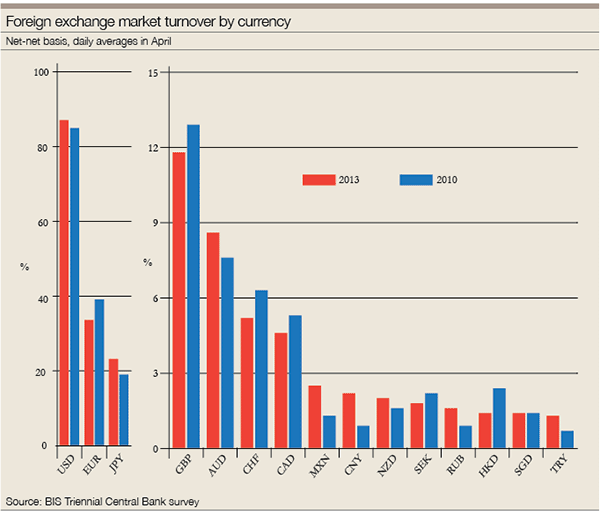
That the renminbi has become a top-10 world currency for the first time, according to the latest Bank for International Settlements foreign exchange report, shows that it is certainly on its way.
 |
| Alexandra Gropp, regional head of RMB solutions, Europe, at Standard Chartered |
Alexandra Gropp, regional head of RMB solutions, Europe, at Standard Chartered in London, is bullish on how far it can grow from here. “If you look at the numbers and in particular the trade-driven numbers, you have only 14% of China’s total trade today settled in renminbis. We expect China’s overall trade will double in size between now and 2020,” she says. “Combined with the steps China is taking to open up its capital account, the volume of renminbi business that is going to come through eventually is going to be significant.” Mike Rees, chief executive of wholesale banking at Standard Chartered, says the tipping point is closer than many realize: “You’re starting to be able to do cross-border cash management in renminbis. The day one of the big oil companies first invoices China for oil in renminbis and receives payment in Chinese government bonds as a result is what will really open people’s eyes.”
As those eyes open wider, the race among the European financial centres to capture what renminbi business there is already is intensifying.
London is well placed to play a central role in the development of this market in Europe, and has been doing so. The Bank of England’s three-year swap agreement with the PBoC in June – the first between China and a member of the Group of Seven largest developed economies – should help London enhance its status as a big offshore renminbi trading hub.
Bank of China’s Zhou says agreements such as the BoE’s with the PBoC are a “very important step for any city that wants to become an offshore financial centre for renminbi,” primarily because of the liquidity it provides in times of stress.
The Hungarian and Albanian central banks have since followed the BoE’s lead, while the Banque du France, Bundesbank and European Central Bank, among others, are all understood to be still in discussions with the PBoC over this.
But bankers in London worry that the UK’s challenge has lost momentum. In April 2012, it launched the City of London Initiative to promote and develop London as a centre for renminbi business, which coincided with HSBC’s ground-breaking sale of Rmb2 billion of dim sum bonds – the first to be issued outside Chinese sovereign territories. China Construction Bank followed in December, becoming the first Chinese bank to issue renminbi bonds in London.
London has developed since as a centre for international renminbi business, boasting a growing customer, institutional and interbank deposit base and a growing share of the FX market. However, a low natural demand for the renminbi and a deposit base of around Rmb35 billion forces London to play to its location and strength in the FX market, where it commands 40% of global turnover – the equivalent of New York and Tokyo combined.
“In renminbi-related FX conversion/hedging – and outside of China and Hong Kong – London has 59% of the market in spot, 37% in forwards, 34% in swaps, and 49% in options,” says Ming at RBS. “So for any renminbi-related hedging product, London has the dominant position outside of China. This position is almost unshakeable in the near term. This is what makes London outstanding compared with the competition.”
But there’s an elephant in London’s renminbi trading room. It needs an officially mandated clearing bank for renminbis – and on that front, efforts appear to be stalling.
ICBC in Singapore became the latest officially mandated clearing and settlement bank for renminbi earlier this year, following mandates for Bank of China in Taipei, Hong Kong and Macau late last year.
As yet, no country outside Asia has received Chinese approval for a clearing bank. Luxembourg, however, could be the closest to securing that. Bank of China became the first renminbi clearing bank officially recognized by the Luxembourg government in July this year. Bankers say this could precede a full-blown mandate from the PBoC.
 |
| Mike Rees, chief executive of wholesale banking at Standard Chartered |
Rees at Standard Chartered says London needs a clearing bank for renminbi trading because without it, it lacks settlement and, crucially, liquidity. “You need both sides of the balance sheet to build liquidity, including deposits and assets as well as liabilities, and that’s lacking at the moment,” he says. As a consequence, “all the liquidity in London just flows back to Hong Kong”. Standard Chartered is just one bank that would love to secure the mandate as an official clearing bank for renminbi in London. It would be a huge coup for HSBC to see off the challenge of the big Chinese banks for the role. But few at either bank hold out much hope that will be the case. What they all agree on is the need for a decision to be made soon. But there are many factors at play.
“There is obviously a systemic exercise associated with introducing a new piece of clearing and settlement infrastructure to the UK banking system and a whole bunch of questions to answer too,” says a senior investment banker. “Does the government sponsor it? Does the private sector sponsor it? Will it be managed by domestic or foreign banks? Are those banks big enough to handle it? And can they provide the renminbi liquidity to actually front-up between the time difference between here in the UK and China? This is not straightforward by any means.”
Standard Chartered’s Gropp highlights another important element – regulatory supervision. “Having the clearing infrastructure in place and functioning is one element, but then you also need to have to have it well regulated going forward, so the roles of HM Treasury and the Bank of England are very important in all of this,” she says.
Some London-based bankers worry that the Bank of England has not been active enough in working with the Chinese authorities on establishing a clearing bank. They say London is currently stuck between the rock of the BoE’s desire for market solutions and the hard place of China’s preference for the firm hand of the state in all matters financial.
The issue of clearing and settlement is frequently discussed between the government, HMT, the BoE and the steering committee of the City of London Initiative, which includes Bank of China, Barclays, Deutsche Bank, HSBC and Standard Chartered. Chancellor Osborne is also likely to discuss it with the Chinese authorities during his visit to China in the coming weeks.
But there are those that do not think it should be a priority at all.
Mark Boleat, chairman of the policy and resources committee at the City of London, gives it short shrift. “The clearing and settlement issue gets rather more attention than it deserves. It is a means to an end,” he says.
Boleat contends that the City of London is “very comfortable with where London is in its development as an offshore centre for renminbi business”, adding that it “is the predominant western hub for this market”.
He adds: “The swap line between the Bank of England and PBoC signifies sufficient support from the Bank of England in developing this market in London.”
Boleat might have a point on priorities. By end of this year at the earliest, the Chinese could have already introduced a solution, according to RBS’s Ming.
“The Chinese government is developing a so-called China International Payments System (CIPS) that will serve as the international renminbi clearing system,” she says. “This system is expected to be available at the end of this year or beginning of next year.”
Once this system is in place it will replace with a new unified global renminbi clearing system the existing China National Advanced Payment System (CNAPS), the onshore renminbi clearing system, and offshore clearing arrangements operated by Chinese banks in Hong Kong, Singapore and Taiwan.
Following the introduction of CIPS, international banks will have a direct route to a renminbi clearing system operated by the PBoC and supported by its sovereign credit.
“As a result of this, it is really not that important to have a mandated clearing bank in London,” says Ming at RBS.
Contrast that uncertainty with the pace of development in Luxembourg, driven by a collective activism from the government, ministry of finance, central bank and financial regulator, the Commission de Surveillance du Sector Financier.
 |
| Ming Gao, chairman of the board of ICBC (Europe) and general manager of ICBC Luxembourg Branch |
Take the latest initiative from ICBC. “We will integrate a new system called the RMB Cross-Border System in October this year, making us the first Chinese bank to adopt a unified IT system for renminbi cross-border business across our overseas network,” says ICBC’s Gao. “It will be adopted by all of ICBC’s overseas branches and will give us a competitive advantage to accomplish our future clearer role. We have discussed this with the financial regulator and the ministry of finance here in Luxembourg, and they are supportive and see that our clearing function will be strengthened after we adopt this cross-border renminbi system.”
Critics say this is not so much a proactive approach as a light-touch regime from a small country that is worried about losing its relevance in the globalization of financial markets. Not so, says Gao. “The Luxembourg regulator definitely follows the same EU directives as others and I don’t see that there is any difference in their strictness to other regulators in other jurisdictions,” she says. “Regulatory supervision in Luxembourg is the same as elsewhere in Europe, but the benefit of being here is that we can get a very quick response from the regulator, the central bank and the ministry of finance. They do not create grey areas for us: communication is easy and open.”
That Luxembourg has made such gains without having anything of the size of trade programme that France, Germany and, to a lesser extent, the UK has with China is also striking.
For Luxembourg for Finance’s Mackel however, Luxembourg is not disadvantaged by its lack of trade relative to other countries.
“If you look at the evolution of a currency that is on its way to become a reserve currency or on its way to true internationalization, trade is one stage in that process,” he says. “Beyond that it is financial services and investments. Investment funds denominated in renminbi have taken off. In the last couple of years bonds denominated in renminbi have taken off too. So it’s not only about trade.”
That might be true, but generating a natural demand for renminbi through the exporting of hundreds of billions of euros-worth of goods and services to China is still a powerful basis from which to build an offshore trading hub. This is one area where the rest of Europe is at a disadvantage to Germany in particular.
“Due to a strong Germany-China trade corridor and the presence of the ECB, Frankfurt has a good chance of developing into an offshore renminbi hub,” says Gropp.
In a speech to the International Financial Centres Global Series last month, Sajid Javid MP, economic secretary to the Treasury and a former managing director at Deutsche Bank, said that London and the UK government mustn’t become “complacent” about the city’s leading status as an international financial centre.
“We know that we have to keep adapting to global trends, social changes and international developments to maintain that top spot,” he said.
It’s doubtful that Javid had Luxembourg in mind when he contemplated the challengers to London.
But a quick stroll around the centre of the Grand Duchy would soon put him right. Its designer stores are teeming with Chinese shoppers. Luxembourg has designs on much more lucrative trade with the People’s Republic.