
|
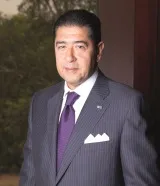
Hisham Ezz Al Arab, chairman, Commercial International Bank
Hisham Ezz Al Arab is a man committed to Egyptian banking. That is where he began his career in the late 1970s, and that is where he is now, towards the end of his career, heading Commercial International Bank, widely considered to be the country’s best private-sector bank.
But it was in London, where he spent 13 years working for Merrill Lynch, JPMorgan and finally Deutsche Bank, that he learned the essential skills for his daily work – there that, in his own words, he “formulated [his] perspective on banking”.
“You go through the ups and the downs, the crises,” he clarifies. During the late 1980s and 1990s, his London years, there were certainly plenty of those to work through. “I saw the crash of 1987 and how we dealt with it, the Gulf War and how we dealt with it. I saw the British break from the ERM [European Exchange Rate Mechanism]; I saw the tech crash.”
Exposure to these events and to boardrooms’ responses to them, hardened Al Arab to crisis. And they prepared him, as much as one can ever be prepared for such things, to carry on banking through the biggest crisis of his career: the Egyptian revolution of 2011.
“Those experiences were useful when the revolution happened, to deal with it calmly,” he tells Euromoney. “It was not the end of the world,” he says. Al Arab steered CIB through those years and made it the dominant bank it is today, winner of the Euromoney award for best bank in Egypt since 2013.

|
|
Hisham Ezz Al Arab, |
Hisham Ezz Al Arab was born in Cairo, into a family that had never produced a banker. His father served in the army, other members of his family practised law and worked in politics. The decision to go into banking was “the consensus at home”, Al Arab says: his grades were strong and finance seemed to offer good prospects. He studied accounting and finance at Cairo University, “when it was still a good university”, and graduated in 1977. Al Arab did not stray from the course he and his family had set. He spent his summer breaks in banking, and immediately after graduation took up a job at Arab African Bank, now known as Arab African International Bank.
Al Arab remembers the institution as the only one in Egypt that was, at the time, working with modern banking products. “We were doing project finance, syndicated loans, convertible bonds. People are talking about all of this tens of years later. We were ahead of everyone else.”
But that is also why he left the bank and the country. He was frustrated with modern banking being the exception rather than the rule in Egypt. He left for New York, where he spent a little under a year, still working for Arab African Bank, then worked for a couple of years in Bahrain at Saudi Arabia’s National Commercial Bank.
Eventually he settled in London. It is there, after Cairo, that he spent the longest period of his life. It is easy to see why he stayed so long. His distinguished career in the City brought him roles as managing director in a number of leading international banks.
His international experience put him in good stead to return to Egypt in a senior position. And that is exactly what he did. In 1999, he left London to become CIB’s deputy managing director in Cairo.
From there, he quickly ascended the corporate ladder. In 2001, he became a member of the bank’s board. In 2002, the bank appointed him chairman and managing director, a role he has held ever since.
His early years at CIB were spent simplifying the bank’s complex shareholding structure and improving its governance. He launched a company share option plan to increase staff loyalty and align employee interests with those of the bank’s shareholders. He also strove to improve the bank’s non-performing loan ratio and to work through challenges in the FX business, he says.
But all that was business as usual compared with the events of 2011. Twelve years after his return to Egypt, he looked on as every bank in the country closed down for several days during the revolution that overthrew president Hosni Mubarak and brought into question the country’s political and economic future.
At that point staff safety became Al Arab’s primary concern. But even through this hard time, with all bank branches closed, he remembers proudly how CIB continued to provide basic services to its customers. “All the banks closed. But we paid salaries, certain secure ATMs functioned, treasury operations were functioning,” he says.
The key, he says, is that the bank was ready for this eventuality. “If the headquarters became unsafe, staff knew where to go. There were plans.”
The damage to Egypt’s economy was still enormous. “We needed to start from underground, not even from scratch,” Al Arab says.
In the years that followed, even as other bankers played it safe, fearing what would become of Egypt’s economy in the wake of the Arab Spring, Al Arab pressed on and had CIB invest in new hires and new bank branches. It was a strategy that many deemed foolish at the time, but that has since paid off, delivering impressive year-on-year growth – last year, CIB’s net profit grew 26%, to E£4.7 billion ($530 million).
Al Arab is a man who displays little emotion, a man who is hard to faze. As Euromoney recounted in a piece last year about Al Arab’s CIB, in the early days of the Egyptian revolution he was enlisted into a neighbourhood watch and found himself on the streets with a rifle that had been intended for recreational duck shooting. Fortunately he had no cause to fire it at anyone.
But it is not hard to imagine him in that scene. The man has a heavy build and a hard resolve. It is clear that he does not waver if he believes himself to be in the right – that is, if the numbers add up. Asked if he has made friends among his collaborators, he says: “In business there is no like or dislike, only performance indicators.” He says people tell him he can be kind but also brutal. What matters to him, clearly, is bank performance first and foremost. “Friendships lie outside the boundaries of the bank.”
He is confident enough to speak his mind. Where many businessmen would shirk from talking politics, Al Arab readily answers questions about the revolution and its aftermath. He still defends Mubarak, saying that he was legitimately elected. As for the Muslim Brotherhood, the Islamist party that held power in 2012/13 as Egypt’s first elected government since the revolution, he says: “They have a certain ideology, that’s great. But don’t try and impose it. Democracy is different views.”
After the June 2013 protests that toppled president Mohamed Morsi, of the Muslim Brotherhood, Al Arab was quoted as saying the army had acted as the country’s “underwriter for democracy”. (Even when he discusses politics, his vocabulary is still resolutely that of a banker.) Asked about these comments three years on, he says that he meant western media were wrong to brand those events a military coup. He finds that insulting to the millions of ordinary Egyptians who took to the streets and says the army in fact resisted the urge to take power.
Of Egypt’s current leadership, he says: “Sisi [president Abdel Fattah el-Sisi] and the government need to work not nine-hour days but 18-hour days.” He cites terrorism as one of the many threats that the country’s leadership has to work through.
Al Arab is clearly revered by his peers. Even rival bankers in Egypt call him “an icon” and “a legend”. They respect his long experience and his successes with CIB. They also recognize his status beyond the bank he leads. For the past three years, Al Arab has been the chairman of the Federation of Egyptian Banks, a consultancy body for the Central Bank of Egypt. And, since 2010, the American University in Cairo has had a partial scholarship named after him.
Also in 2010, Al Arab established the CIB Foundation, a non-profit organization devoted to enhancing the health of underprivileged children in Egypt. He says of the foundation that it is “very close to [his] heart”, and adds that he personally makes a contribution to it, as do many of his employees. CIB donates between 1% and 1.5% of its net annual profit to the foundation. For that reason, Al Arab tells his staff: “When you work hard, you not only make money, you also increase your balance with God.” Even his theology has a corporate ring to it.
So where to now for Al Arab? He says he does not know. The two things than make him “nervous” are lies and silly mistakes. Otherwise, he says, “I live my life easy.”



