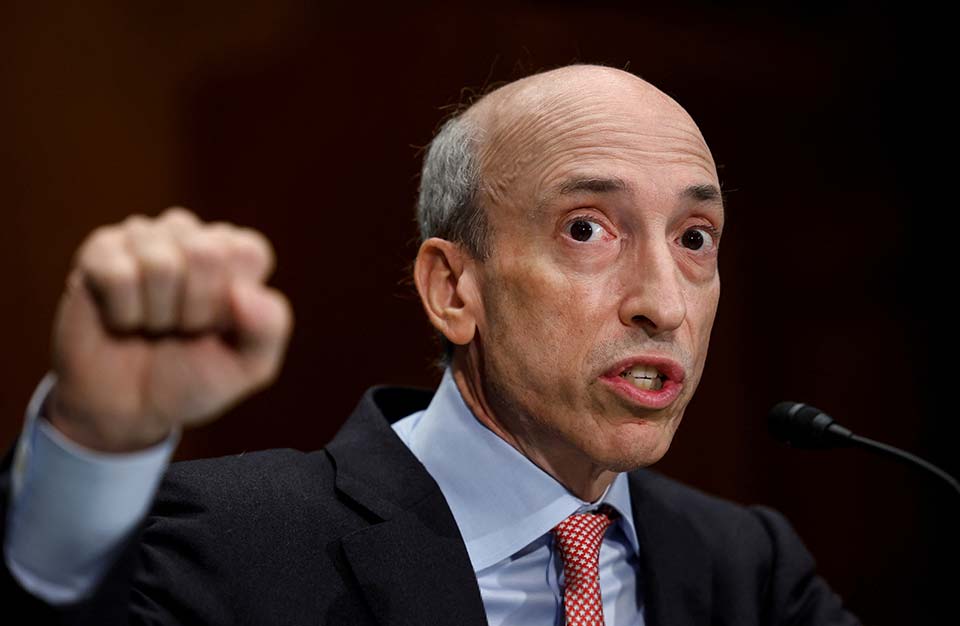
Don’t let it be said that the SEC is not down with the zoomers. Not only is chair Gary Gensler seemingly gunning for anything crypto-related, but he is also all too happy to spread his regulatory wings over the world of celebrity influencers.
And Gensler is certainly going after the big names. His latest target is none other than uber-influencer Kim Kardashian, whom the SEC charged with having touted crypto asset securities on her Instagram account without telling followers that she had been paid to do so.
According to an October 3 SEC statement, Kardashian published a post about Emax tokens, which were being offered by EthereumMax, and included a link to a website where readers could find instructions on how to buy the tokens. As such, she was touting crypto asset securities, the SEC said, and doing so without disclosing that she had been paid $250,000.
Kardashian agreed the settlement without admitting or denying the SEC’s findings.
The Kardashian case is a high-profile example of a current obsession of the SEC – that crypto assets frequently constitute securities and therefore should be treated as such under relevant legislation
Emax, which is built on the Ethereum network but has no business connection with it, hasn’t been the best crypto investment for anyone who was tempted to pile in at around the time of Kardashian’s mid-June 2021 post. According to CoinMarketCap, it is trading at $0.000000004292, compared to a peak of about $0.000000863 in late May 2021.
“Ms. Kardashian’s case … serves as a reminder to celebrities and others that the law requires them to disclose to the public when and how much they are paid to promote investing in securities,” said Gensler.
In a move intended to make his point even clearer but which instead looks to be an embarrassing attempt at humour, Gensler stars in a bizarre – albeit jaunty – tie-in video posted on YouTube in which a succession of odd characters posing as influencers make peculiar gestures, some involving wads of cash, while others posing as unsuspecting members of the public look variously as if they are being sucked into a trend or else are dutifully researching the credibility of any claims made.
In the video – part of Gensler’s ‘Office hours’ series, in which he tells the world at large about the wonderful work of the SEC – Gensler says that while we may all enjoy watching our favourite stars doing what they do best, “we shouldn’t confuse those skills with the very different skills needed to offer appropriate investment advice”.
Duly noted, Gary.
Audience reach
Such was the profile of the Kardashian case that it had previously attracted the attention of other regulators with similar concerns to Gensler. In a speech in September 2021, Charles Randell, then-chair of the UK’s Financial Conduct Authority (FCA), said that “when [Kardashian] was recently paid to ask her 250 million Instagram followers to speculate on crypto tokens by ‘joining the Ethereum Max Community’, it may have been the financial promotion with the single biggest audience reach in history.”
Kardashian said in her original post that it was “not financial advice”. Randell said that while Kardashian complied with Instagram’s own rules by labelling the post as an advertisement – “#AD” – she did not have to disclose that Ethereum Max was “a speculative digital token created a month before by unknown developers”.

She is also one of the defendants in a class action in the California US District Court relating to the same post, in which investors blame her, various EthereumMax executives, former basketballer Paul Pierce and boxer Floyd Mayweather Jr for losses relating to Emax tokens.
Kardashian’s settlement with the SEC saw her pay a $1 million penalty plus a further penalty of $260,000 reflecting a disgorgement of the payment that she had received plus pre-judgement interest on it. She has also agreed not to promote crypto asset securities for three years.
Recent movements in interest rates mean a step-up in what the SEC can earn from levying pre-judgement interest. The agency has not specified what rate it used in the Kardashian case, but it typically uses an underpayment rate charged by the Internal Revenue Service (IRS), which is set at the start of each calendar quarter.
As of October 1, the IRS underpayment rate for corporates and non-corporates rose from 5% to 6%, marking a return to the level seen in the first half of 2019 after having dropped to as low as 3% during the coronavirus pandemic. The rate has risen by one percentage point in each of the last three quarters, broadly mirroring the movement in the federal funds rate over that time.
The Kardashian case is a high-profile example of a current obsession of the SEC – that crypto assets frequently constitute securities and therefore should be treated as such under relevant legislation. At this year’s annual ‘The SEC speaks’ briefing hosted by the Practising Law Institute in September, Gensler said that he believed the majority of the nearly 10,000 crypto tokens in existence were securities.
“These are not laundromat tokens,” he warned his audience, and he cited his distant predecessor, Joseph Kennedy, the first chairman of the SEC, appointed in 1934, who once stated that “no honest business need fear the SEC”.
Kennedy would later ridicule the earlier prophecies of critics of the SEC and the 1933 Securities Act who had argued that they would lead to US markets drying up within months. Gensler argues that, on the contrary, such moves set the US apart and helped spark the economic growth it would then see for the next 90 years.