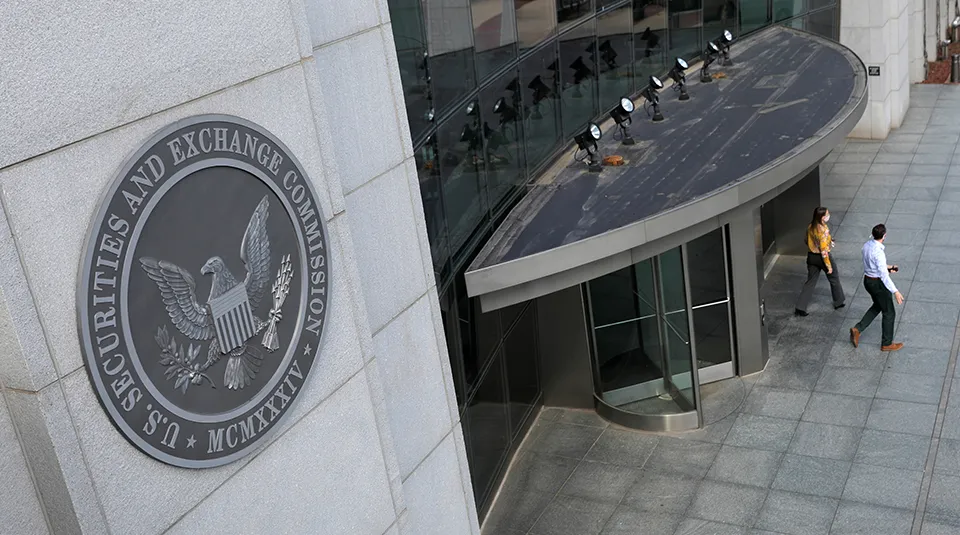
When Allison Lee asked Kristina Wyatt to join her team at the Securities and Exchange Commission (SEC) last year as a senior counsel on environmental, social and governance (ESG) matters, it took Wyatt all of three seconds to say yes. She had been director of sustainability at law firm Latham & Watkins and was inspired by commissioner Lee and her desire to bring climate change into the spotlight in the corporate world. She spent the next 13 months hashing out a set of proposals to help put a stop to listed companies’ greenwashing.
Jump to
Her contract ended in February and instead of moving back to a major law firm, she jumped into the climate tech sector. She joined Persefoni – a young software company that measures, among other things, the greenhouse gas (GHG) emissions of investment companies and their assets – as its deputy general counsel. “We do a fair amount of engagement with regulators and that feeds into our product development,” she tells Euromoney.
Persefoni works with corporates, fund managers and private equity groups to help them shoulder the burden of red tape that government bodies are starting to load onto green finance. Every day is different, but Wyatt is often on back-to-back calls speaking to regulators, the media and potential clients. She wants to deliver the kind of data that corporates and asset managers with well-publicized sustainability goals can use to prove to investors, and her former employer, that they aren’t lying.
During her time at the SEC, trillions of dollars were allocated to funds that claim to focus on ESG issues. Bloomberg Intelligence reported in February that global ESG assets might surpass $41 trillion by 2022, and could total $50 trillion by 2025, one-third of all assets under management.
For banks, asset managers or corporates, it is a real challenge to keep abreast of this tsunami of ESG regulation coming their way at pace globally so regulatory fragmentation is a real concern
Sonali Siriwardena, Simmons & Simmons
Now, regulators have started to question how green those funds really are. The SEC published two form and rule amendments on May 25 to enhance and standardize funds’ disclosures on climate. In theory, the proposals would provide investors with “consistent, comparable and reliable information” on the credentials of funds that claim to focus on ESG initiatives. Those amendments would force significant upheaval among investment firms offering mutual funds, exchange-traded funds (ETFs), or any other investment type geared towards ESG factors.
The SEC’s proposal – ‘Enhanced disclosures by certain investment advisers and investment companies about environmental, social, and governance investment practices’ – requires environmentally focused funds to publish comprehensive data on greenhouse gas emissions across the entire value chain of their assets, from the carbon they produce themselves to that produced by suppliers and even by employees’ commutes.
Some emissions are notoriously difficult to track and requiring institutions to disclose them has sparked fierce debate across the investment sector. At an event in Washington DC in May, Eric Pan, chief executive of the Investment Company Institute (ICI), branded the rules as “unworkable”.

Even before the new proposals were published, the SEC had already been cracking down on greenwashing in financial markets. Days earlier, Bank of New York Mellon agreed to pay a $1.5 million fine levied by the SEC over allegations that several investments held in its mutual funds did not have ESG quality review scores despite the bank claiming that they did. In Germany, police raided the offices of Deutsche Bank and its asset management unit, DWS, in Frankfurt days later over allegations of greenwashing. It was the first time the bank’s asset management arm had been raided over its ESG credentials.
“There is an enormous amount of fear right now in the industry,” says Aniket Shah, managing director and global head of ESG and sustainability strategy at Jefferies and an adjunct professor at Columbia University’s School of International and Public Affairs.
Persefoni raised $101 million of series B funding last October, the largest sum yet raised by a software-as-a-service company in the climate sector. Investment companies and corporations focused on decarbonizing will need to prove they are actually making a difference. A cottage industry is waiting in the wings to help them.
Much-needed sanity
Sustainable finance has existed in some form for centuries, but until fairly recently ESG was a term rarely used in the investment sector. New Haven-headquartered Pax World, founded by two Methodist ministers, established the world’s first sustainable mutual fund in 1971 in a bid to move church finances away from the Vietnam War. Over time more investors created funds with the goal of avoiding funding war, apartheid and oil spills, as governments worldwide paid closer attention to global warming.
But the ESG moniker took another three decades to arrive. It was first mentioned in the launch of the United Nations’ Principles for Responsible Investment initiative in October 2006.
Marian Macindoe, who became head of ESG stewardship at sustainable investment group Parnassus this spring, was an early adopter. At the start of her 18-year career, ESG investment seemed a lot like Milton Waddams – the often-forgotten Initech employee in the 1999 film ‘Office Space’, working in the basement out of sight.
But Macindoe says she subsequently witnessed a shift of “intense interest” in ESG, which surged during the global pandemic. Investment in global ESG assets surpassed $35 trillion in 2020, according to Bloomberg, up from $30.6 trillion two years before. Now, Macindoe says: “The slide decks have changed from ‘Why you should care about ESG’ to ‘How you should care about ESG.’”
If interest in ESG is just reaching maturity, attempts to qualify and quantify it are generations behind. The Greenhouse Gas Protocol was launched in 1998 with a mission to develop internationally accepted reporting standards specifically for GHG emissions, but the Sustainability Accounting Board, established to set specific standards for corporate reporting on broader ESG issues, was not formed until 2011.
ESG can mean any number of “good” things in investment. It could mean investing in so-called pure-play sustainable projects like building wind farms. It could mean holding stakes in oil and gas companies to put pressure on their executives to decarbonize through shareholder votes. It could simply mean not investing in tobacco firms or a carbon-intensive industry (negative-screening). It has in many ways become shorthand for investors’ ambition to do well by doing good.
Many self-described ESG funds, however, do neither. Between 2010 and 2018, a “comprehensive sample” of self-labelled ESG mutual funds based in the US held portfolio firms with “significantly” worse records for violating labour and environmental laws compared with non-ESG funds managed by the same groups, according to a study published in Social Science Research Network last year.
ESG is sometimes simply treated as a marketing tool, says Shivaram Rajgopal, a professor of accounting and auditing at Columbia Business School and one of the authors of the study. The world of sustainable finance, he says, is “crying out for some kind of sanity and structure”.
Pressure for clarity came to a head in the US this spring when the SEC rounded on two of the world’s largest financial institutions, fining BNY Mellon in May and then launching an investigation into mutual funds held by Goldman Sachs with a total value of $725 million just days later. In a statement in June, Goldman Sachs said it was cooperating with the SEC.
BNY Mellon’s fine may be just the start of a wave across the market, says Rajgopal. If the regulator were to launch just one or two high profile cases, it could “scare people quite a bit and it will excite the class action lawyers,” he adds.
Those lawyers will have even more to work with if the SEC’s new proposals are adopted. One involves extending an existing ‘Name Rule’, so that any fund that uses the terms ‘ESG’, ‘Sustainable’ or similar must invest 80% of its worth according to one or more ESG factors.
With its second proposal, the SEC is hoping to build the sanity and structure that Rajgopal is calling for. It divides funds into three categories: ESG-integrated – funds that simply consider one or more ESG factors alongside others when making investment decisions but don’t prioritize them; ESG-focused – those that claim to actively seek investment opportunities using those factors as a guiding light; and impact investments – an offshoot of ESG-focused funds that have a specific target, such as removing carbon from the atmosphere.
Under the proposal, funds would need to give an overview of how ESG fits into their strategy and how they engage with firms or vote their proxies on ESG matters.
The proposals would require funds that focus on the ‘E’ to publish the aggregate emissions of their entire portfolios, something Rajgopal says has been vanishingly rare until now. The theory is that the more information funds provide on their assets, the less room there is for exaggeration.
Scoping out the challenge
Carbon emissions are arguably one of the easier parts of an investor’s sustainability credentials to scrutinize. The GHG Protocol published its first corporate standard in 2001, which gave birth to the idea of Scope 1, 2 and 3 emissions, created for businesses to have a set standard for their carbon accounting.
But one aspect of the SEC’s rule has divided opinion. As well as compelling funds to publish their annual carbon footprint and carbon intensity, using Scope 1 and 2 emissions, the regulator wants some funds to list their assets’ Scope 3 emissions.

Scope 1 and 2 refer, respectively, to the emissions a company produces itself and those that result from the energy that it buys. Scope 3 emissions are produced by everything else across the value chain, such as the petrol an employee uses to get to work, pollution from business travel or from waste disposal. They are “in essence, someone else’s Scope 1 and 2 emissions,” says Toby Green, co-founder of UK-based climate accounting startup MyCarbon.
Some experts believe they account for more than 80% of a company’s overall carbon output. Others think that is a conservative guess. A study from the Rocky Mountain Institute found that the GHG emissions from a company’s supply chain may be more than five times its own direct emissions.
Because of their weight, discovering the worst offending links in a supply chain can help fund managers to significantly lower their portfolio’s footprint. Last year 54 US companies in the S&P 500 voluntarily disclosed their Scope 3 emissions in their annual statements – a threefold increase on the previous year, according to research by Bloomberg Law, but still just 11% of the whole index.
Reliable Scope 3 data is hard to find, according to experts. Companies that do report their carbon use have rarely needed to record Scope 3 emissions before. Today, at least 85% of companies reporting to the Carbon Disclosure Project use the GHG Protocol’s corporate standard, but those organizations are only expected to quantify Scope 1 and 2 emissions.
The data – or the lack of it – is the elephant in the room, according to Sonali Siriwardena at law firm Simmons & Simmons. Just as Wyatt moved from her public sector role at the SEC to a carbon accounting startup, Siriwardena saw an opportunity to offer up her legal expertise to an investment market she believes is caught in a “turning tide” of regulatory crackdowns. In April she left a role leading sustainability, policy and regulation at Morgan Stanley to become Simmons & Simmons’ first head of ESG.
There is a growing recognition in the industry that sustainability disclosure without looking at the whole supply chain is “half-baked” at best, she says. “But then we also need to be aware that if you can’t access the data, there’s not much you can do.”
Everything everywhere all at once
The SEC issued another proposal on climate and greenhouse gas emissions disclosures this year, targeting listed companies and including Scope 3 emissions. Asset managers’ ability to meet the regulator’s demands “will depend entirely” on that other proposal’s success, says Fionna Ross, senior sustainable investment analyst at abrdn. If it is approved, carbon data will be “much easier” to gather and to disclose.
But its success is far from guaranteed, with opposition coming from both the political and corporate world. A conservative majority in the Supreme Court voted to curb the Environmental Protection Agency’s power to cap state greenhouse gas emissions on June 30 and the SEC’s proposals are the party’s next target.
West Virginia attorney general Patrick Morrisey told media that Republican senators will be scrutinizing a number of new initiatives under the Biden administration, “particularly, the SEC’s.” The SEC said on July 28 that it had received 14,500 comments on the company proposal. A group of 24 states, led by West Virginia and Arizona, issued a comment opposing the rule, arguing that it went above and beyond the commission’s purpose.
It’s hard to see fund managers having to disclose greenhouse gas information for their portfolios and that not impacting what goes into their portfolio
Aniket Shah, Jefferies
Companies also expressed concerns over quantifying their Scope 3 emissions when they work with hundreds of different suppliers across state and national borders, each of whom file their own emissions data at different times. Lawyers warned of increased liability if corporations are expected to make more information public. Some companies said they had already applied a disclosure schedule according to the GHG Protocol, arguably the world’s most widely adopted regime. Meeting the SEC’s demands would mean creating two separate sets of data, raising their cost burden.
Fund managers will face very similar challenges, says Macindoe at Parnassus. The success of one set of proposals, she says, “is dependent on the other.”
The SEC’s moves come three years after the European Union started implementing its Sustainable Finance Disclosure Regulation, which also demands emissions disclosures across the entire value chain. But there is “limited convergence and alignment between regions and even within regions such as Europe,” says Siriwardena. “For banks, asset managers or corporates, it is a real challenge to keep abreast of this tsunami of ESG regulation coming their way at pace globally so regulatory fragmentation is a real concern,” she adds.
For entities that don’t file with the SEC, fund managers would need to look at whatever emissions they voluntarily disclose or “cobble data together as best [they] can,” SEC commissioner Hester Peirce, a Republican, wrote in the Harvard Law School Forum on Corporate Governance soon after the proposal was made public. A disclosure regime including Scope 3 emissions, Peirce said, would be inconsistent, incomparable and “does not survive close inspection”.
The ICI sent a feedback letter to the SEC in June suggesting it should axe the Scope 3 emissions disclosure requirement, at least for now, as there were still “significant data gaps”.
Future strategies
Many large asset managers have already committed to reaching net-zero across their portfolios, placing pressure on issuers to decarbonize. Will that shift actually lower carbon levels overall? Shah at Jefferies is not convinced. Few oil and gas companies issue new equity, being largely financed through their own earnings. Transportation and electricity grids still rely on fossil fuels, and “as long as that demand stays high, there will be supply,” he says.
But the weight of emissions in a portfolio may affect its future value. The European Central Bank said on July 4 that it would start decarbonizing its corporate bond holdings from October. The fact that a major central bank will consider emissions in deciding what to buy and sell could affect asset prices “more and more going forward”, says George Raine, partner at law firm Ropes & Gray.
Asking funds to disclose emissions could usher in a wave of divestment from carbon-intensive assets and industries, says Shah. “It’s hard to see fund managers having to disclose greenhouse gas information for their portfolios and that not impacting what goes into their portfolio.”
It could also force environmentally focused funds with large carbon footprints to justify their investments with more nuanced reports or change their strategies. Getting ExxonMobil to reduce its carbon footprint by 5% “will have much more of an impact on the environment than investing in 25 small wind farm companies,” adds Shah. “But if you’re using emissions as your metric for how good you are for the environment, that’s going to be completely lost.”
Where fund managers focused on growth may invest in small wind farms, a value-focused manager would rather help an oil company pivot to renewables. Raine says that establishing a disclosure regime based on aggregate emissions may have a “chilling effect” on the latter, despite its positive effects over time.
But that is where the added nuance comes in. The EU’s disclosure requirement has often been misused by market participants as a move to discourage certain investments, says Siriwardena at Simmons & Simmons. But regulators are “not aiming to dictate how portfolios should be managed,” she says. Breaking up investment vehicles into integrated, focused and impact fund categories is an attempt to help the industry articulate what’s being done in practice.
“Unfortunately, it has sometimes been used as a labelling regime in Europe when it shouldn’t be,” she says. “I think we need to learn from that.”
Closing the data gap
New startups have emerged that are attempting to close the Scope 3 emissions data gap. Persefoni, founded in 2020, recently launched an additional service aimed at private companies that are planning to gather emissions data for the first time.
Consultancies have also launched their own products. Bain & Company invested in Persefoni’s Series B round last October, allowing it to draw on the tech company’s products for its own services. Boston Consulting Group partnered with the non-profit Carbon Disclosure Project to develop its own climate accounting service last February that touts accurate Scope 3 emission assessment.
“There’s a whole ecosystem of data providers out there,” says Marian Macindoe, head of ESG stewardship at sustainable investment group Parnassus.
Competition between consultancies, accountants and startups could lead to more reliable data, says George Raine, partner at law firm Ropes & Gray. “Even if it’s somewhat ham-handed, it’s going to have a positive effect on creating incentives for service providers to deliver more and better nuanced data,” he says.

Under SEC rules, only certified public accountancy (CPA) firms can audit company financial statements, but that requirement does not extend to climate risk or emissions disclosures set out in the regulator’s more recent proposals. As the market starts to heat up, audit and advisory firms can’t seem to agree on who should be allowed to check the numbers. In their comments on the proposals for listed companies, EY, PwC, Deloitte and KPMG wondered whether assurers that provide carbon disclosure services should meet certain standards – such as those of a CPA – and recommended narrower guidelines for which companies could be allowed to provide disclosure audits.
Some also question who should be responsible for collecting estimations on emissions data: issuers or their investors. Eric Pan, chief executive of the Investment Company Institute, asked SEC chairman Gary Gensler during an event on May 25 whether he believed it was fair for fund managers to be expected to disclose data or advisers to be liable, when the companies they invested in had no legal obligation to collect it. Gensler declined to comment, suggesting that Pan could be setting up for litigation further down the line.
“I do think that there will continue to be debate about who ought to be responsible for estimating anything about companies,” says Debra McCoy, senior partner at Bain & Company.
The SEC estimates that companies could spend an extra $10.2 billion getting in shape to meet disclosure requirements, according to a report in Politico. A shortage of experienced advisers in sustainability has also driven salaries higher. The average annual income for a sustainability officer in the US sits at just shy of $280,000, according to data from Salary.com.
Some funds are worried about the cost burden they will face, but initial expenditures to get it right outweigh the costs of getting it wrong, according to a report from Deloitte. Failure to curb greenhouse gas emissions could cost the US economy $14.7 trillion over the next 50 years, equivalent to 4% of GDP.
McCoy says her clients broadly welcome the opportunity to bring not just greater transparency on emissions but a more nuanced understanding of what environmental, social and governance (ESG) actually means. “There’s an embrace of the idea that there would be clear categories to describe what an investor is seeking to do with ESG”, whether that means supporting companies that prioritize employee wellbeing or using different tactics to further a transition towards clean energy.


