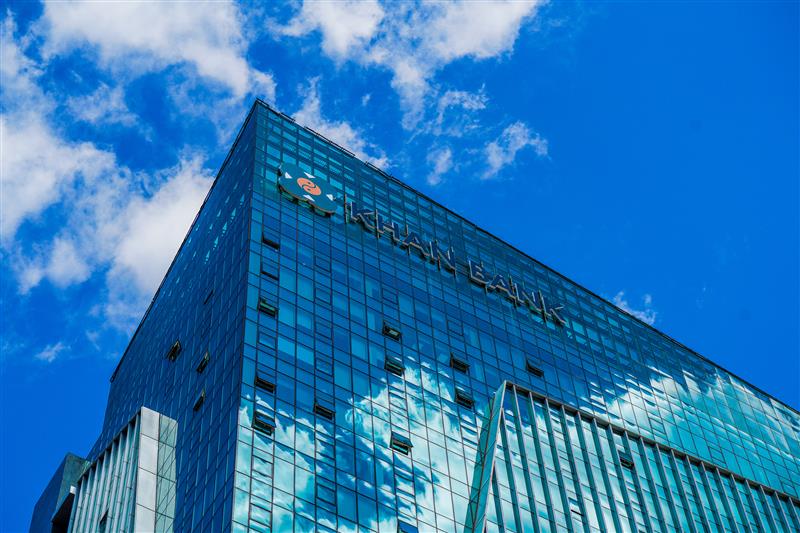
Khan Bank has taken its core value of “Sustainability is the future” from aspiration into practice, now commanding more than half of the country’s commercial green loan market. In addition, the bank mobilised 22% of its total loan portfolio in field of green, gender, and social.
As Mongolia’s largest commercial bank, Khan Bank has been a pioneer in integrating sustainability into the financial sector. In 2011, the Bank marked a major shift in how credit risk and capital allocation were evaluated in Mongolia, introducing environmental and social criteria into lending decisions, a move that has since influenced billions of tugrik in annual financing. Building on this foundation, Khan Bank adopted its first comprehensive sustainability policy in 2020, formally embedding sustainability principles in every aspect of its operations.
The bank’s commitment extends beyond policy statements, contributing to its win in as Mongolia’s best bank in Euromoney’s Awards for Excellence earlier this year. As of 2025, Khan Bank accounts for 52.6% of Mongolia’s entire commercial banking sector’s green loan portfolio – a position that reflects the institution’s scale and its systematic approach to environmental and social risk assessment.
This market leadership stems from Khan Bank’s role as a driving force of the Mongolian Bankers Association’s Mongolian Sustainable Finance Program. By joining the Partnership for Carbon Accounting Financials (PCAF) initiative, the bank also demonstrates its commitment to international standards, measuring financed greenhouse gas emissions with the same rigour applied to traditional credit metrics.
Sustainability strategy 2030
In 2025, Khan Bank’s Board of Directors approved the bank’s sustainability strategy 2030, establishing a comprehensive framework built upon four key pillars: Environmental, Social, Governance, and Responsible Banking. Through this strategy, the Bank has identified 14 priorities areas and 20 measurable targets to be achieved by 2030. The strategy serves as a clear roadmap to deepen Khan Bank’s sustainability commitments whilst alignment with evolving international standards and Mongolia’s national priorities.
Khan Bank is committed to protecting the environment and advancing climate action. In line with the goals of Paris Agreement and Mongolia’s Nationally Determined Contributions, the bank actively works to maintain ecological balance and reduce greenhouse gas emissions through both its operations and financing activities.
The bank’s headquarters operate smart, energy-efficient systems, and integrated waste management solutions. 27 regional service centres now feature Building Applied Photovoltaic (BAPV) solar panel systems, generating renewable electricity that prevents 49.29 tonnes of CO₂ emissions annually – equivalent to planting 3,420 trees. Beyond its internal operations, the bank also committed to planting five million trees by 2030, a major initiative that will contribute significantly to restoring natural ecosystems and enhancing biodiversity and supporting Mongolia’s ecological resilience. Through continuous learning and capacity-building, Khan Bank strengthens its expertise in environmental management and climate action, reinforcing its role as a leader in sustainability.
At the heart of Khan Bank’s sustainability vision is a strong commitment to employee wellbeing, customer protection and community engagement. Khan Bank champions equality and diversity in the workplace, empowering employees through professional development, fair opportunities, and a safe, supportive environment. The bank actively invests in community development through corporate social responsibility programmes spanning education, healthcare, environmental protection, and social wellbeing – recognising that sustainable development extends beyond environmental considerations to encompass broader societal impact.
Strong governance is the foundation of Khan Bank’s long-term success and sustainability. The bank upholds the highest standards of ethics, integrity, and accountability in every aspect of its operations. Through robust internal controls, risk management frameworks, and transparent reporting, Khan Bank ensures responsible business conduct and compliance with international standards. Dedicated sustainability governance structures ensure that environmental, social, and governance (ESG) principles are embedded into decision-making at every level. With a zero-tolerance policy towards corruption and a commitment to fairness and transparency, Khan Bank continues to strengthen trust among its customers, employees, and stakeholders — demonstrating that sound governance is essential to sustainable growth.
Through its responsible banking pillar, the bank integrates sustainability principles across all products, services, and financing decisions, applying comprehensive environmental and social risk assessments to all lending and financing decisions, screening businesses for environmental responsibility, energy efficiency and green operations.
This systematic approach has not only grown the bank’s green portfolio but has also mobilised international funding sources to expand green financing across Mongolia’s economy. The bank issued Mongolia’s first international social bond to fund vital projects in health and education. Through partnerships with international financial institutions and development organisations, it helps shaping a resilient and inclusive future for Mongolia.
Financing women empowerment
As part of its commitment to sustainability, Khan Bank actively supports women entrepreneurs. Although women own two-thirds of Mongolia’s small and medium-sized enterprises, they continue to face barriers in accessing finance – many lack collateral due to property deeds being in men’s names, and those who do obtain loans often receive smaller amounts or face higher interest rates. Through a $130 million syndicated loan from IFC, Khan Bank has expanded its support for women-owned businesses. Half of this funding was dedicated to women entrepreneurs under IFC’s Banking on Women program, supported by We-Fi and the Women Entrepreneurs Opportunity Facility.
Munkhtuya.R., CEO of Khan Bank, stated that “If men and women receive the same level of resources, it will greatly contribute to Mongolia’s economy. Our support goes beyond financing – we empower women through soft skills training at the SME Academy.“ In 2025, Khan Bank further strengthened its commitment by issuing Mongolia’s first-ever Gender Bond, promoting gender-inclusive finance across the country.
For a bank operating in a country where mining and traditional industries dominate the economy, Khan Bank’s sustainability leadership represents a significant shift in capital allocation and risk management.
Khan Bank’s sustainability infrastructure – from solar panels on regional branches to environmental screening in credit decisions – demonstrates that environmental responsibility and commercial banking are not competing priorities but complementary elements of modern financial services. As Mongolia’s banking sector evolves, Khan Bank’s four-pillar approach to sustainability provides a realistic yet ambitious blueprint for the industry.