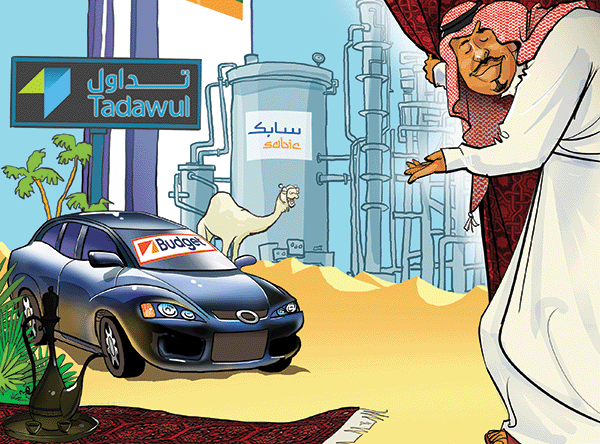
Saudi Arabian institutions dominate Euromoney’s best managed companies in the Middle East survey this year. Jeddah’s NCB Capital is the best research house, and monopolizes individual categories; Tadawul, the Saudi Stock Exchange, is the best exchange; Al Marai has the best treasury; and seven of our sector winners are listed in the country.
Perhaps this should not be a surprise, because Saudi Arabian investment – today and, in particular, for the future – is the subject on everyone’s lips in the region.
Early next year, selected foreign investors will be able to invest directly for the first time into a newly opened Saudi Arabian stock market. It’s a big moment. At the time of writing, the market capitalization of Tadawul, the Saudi Stock Exchange (tellingly, its executives now prefer the latter, more international-sounding description), stood at $590 billion, bigger than Malaysia, Mexico or Moscow.
| Further reading |
 |
| • Best Managed Companies in the Middle East 2014: Results by sector • Ambitious Al-Ghamdi manages expectations |
The Saudi Stock Exchange already constitutes half the Gulf’s total capitalization, dwarfs any neighbour, and accounts for 45% of the entire Mena region. After several years of a cumbersome middle ground, through which foreigners have had to use a form of total return swap to gain their exposure or go through a local exchange-traded fund or mutual fund, foreigners will finally be able to buy directly into the one market that matters in the Middle East: the biggest, the most liquid, the most diversified.
The Saudi Capital Markets Authority (CMA)’s review period for proposals and the ideas and restrictions put forward in its consultation paper will close before the end of the year. Bankers in the region expect a gradual form of opening reminiscent of the one that has taken place in Chinese A-shares, in which initially access is restricted to a group of qualified foreign financial institutions (QFIs, in Saudi’s abbreviation, like China’s QFIIs).
These QFIs, who will need to be licensed, can be banks, brokerages, securities houses, fund managers or insurers, but they must have at least $5 billion under management and a five-year track record. Some restrictions will apply – the headline one is an overall QFI ownership cap of 10% of the overall market – but since that represents about $59 billion of capital, there is considerable scope for increased foreign involvement.
That’s the how. But what about the why? What will foreign investors find when they have unfettered access to the Saudi markets? Why should they consider investing there? And how will their own presence affect the behaviour of the market itself?
There’s no question that the Saudi Arabian market represents a great deal of potential for foreign investors. It’s not just a question of the market’s scale. It is considerably more diversified and liquid than anything else on offer in the Middle East.
The contrast is still more stark than that: while Dubai’s markets are dominated by Emaar companies and Qatar’s by a handful of state-backed behemoths, there are 40 companies in Saudi Arabia with a market capitalization of more than SR1 billion ($267 million) – sufficient liquidity to be interesting to foreign institutional investors. The $6 billion IPO of National Commercial Bank that concluded in November – the second biggest IPO in the world this year, despite being open only to local, or at least GCC, money – brought the total number of listed companies in Saudi to 168, in comparison to about 70 apiece in Abu Dhabi and Dubai and just 43 in Qatar.
Better still, these stocks trade with far greater liquidity than is commonplace in smaller neighbouring markets. Al Rajhi Bank says there has been an average of more than $1.5 billion of trading volumes a day since 2008, more than all other GCC markets combined, while Deutsche Bank puts average daily turnover volume today at $2.5 billion, which represents 65% of all regional liquidity. “There’s no denying that within the regional context, Saudi Arabia is the elephant in the room,” says Aleksandar Stojanovski, analyst at Deutsche Bank.
Additionally, investors will find a diversity of sectors that might at first glance appear surprising. Materials (35%) and financials (34%) dominate the market – petrochemicals fitting within the materials definition – with telecoms accounting for 11% of market cap and smaller sectors such as consumer staples, consumer discretionary, industrials, utilities, energy and healthcare also represented. Compare this to the UAE, where 68% of the market is financials, and 53% in Qatar.
“We believe investor interest initially is likely to be more on the established sectors such as petrochemicals, banking and telecoms,” says Jitesh Gopi, head of research at Al Rajhi. Passive funds, he says, will track free-float market capitalization, and so will favour those stocks with a higher weighting in indices; logically that makes Sabic, Al Rajhi and Etihad Etisalat the most likely beneficiaries.
“Active investors are more likely to prefer strong domestic-driven sectors such as retail, food and construction, due to their strong growth potential supported by favourable government policies and demographics,” Gopi says, provided valuations remain reasonable. “High dividend-paying sectors such as cement might attract investors looking for regular income.”
Clues as to investor interest are in the selections of foreign investors through swap structures to date. “The investors who are in the market today will be a proxy for what investors will buy when the market is open,” says Stojanovski. “The investor base has been very keen to play domestic themes. So anything that has exposure towards the consumer space and the demographics of the region has been attractive, and that will probably be a central theme as the markets open.”
Sabic will be a natural first port of call for investors, through its sheer size. The petrochemical company accounts for more than 13% of the market and has a market cap almost three times the size of Saudi Telecom, which follows it, although in terms of free-float market cap it is less dominant (Al Rajhi, with 9.88% of the market, follows on that metric, and then Etihad Etisalat).
“The investor base will probably divide into two tiers,” says Stojanovski. “Those who are already knowledgeable in the market will be looking for second- and third-tier stocks. Newcomers who now have access to the market will initially spend more of their investor dollars in large caps: Sabic will feature prominently and some of the financial institutions.”
Others see opportunity in less well-trodden sectors. The Kuwaiti group Markaz, for example, recently put out a report on the Saudi insurance industry. Raghu Mandagolathur, the report author, notes that the industry generated a compound annual growth rate of 18.2% between 2008 and 2013, compared to a global figure of 4%, and notes that while $6.7 billion in insurance premium volumes is tiny on a world scale, the potential is considerable. Saudi already constitutes 51% of the global takaful market, the Islamic equivalent of insurance, and is steadily growing since the government made health insurance mandatory for all nationals. “The opportunities for both local and international insurers are enormous,” says Raghu.
Indeed, the one area that’s hard to find exposure to is oil. “Investors have a limited ability to invest in hydrocarbons in the Gulf,” says Asha Mehta, lead portfolio manager for fund manager Acadian’s frontier market strategies.
Buyers shouldn’t necessarily expect low prices. “Despite the absence of foreign investments, the Saudi market does not offer any obvious bargains in terms of valuations,” says Stojanovski. At the time of the CMA’s announcement, the Saudi market was trading at a 2015 price/earnings ratio of 13.2 times, just above Mena’s 13.1 times. Price/book (2.5 times) and return on equity (19%) were both modestly above the Mena region, and dividend yield, at 4.1%, slightly below.
“While the opening of Saudi Arabia should be positive on many fronts, we expect Mena investment to remain a stock-picking game,” says Stojanovski.
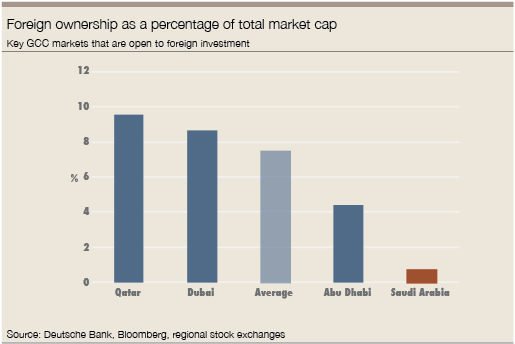
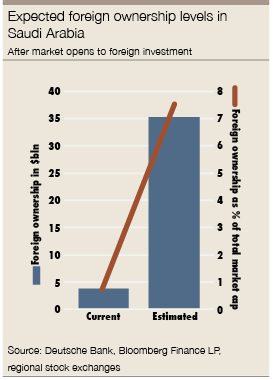
Then there’s the question of how the arrival of foreigners will impact on the market itself. Deutsche estimates that foreigners own less than 1% of the market, compared to 7.5% on average in Abu Dhabi, Dubai and Qatar. If foreign buyers follow that pattern, Deutsche says, there could be $35 billion of incremental foreign inflow, in comparison to the $4 billion that has accumulated since indirect ownership was first permitted in 2009.
 |
HSBC, for one, has been conducting roadshows in Europe and the US to showcase the idea of international investment into Saudi. People attending the roadshows say there has been exceptional attendance and interest at the events.
The hope is that foreigners improve market behaviour – in the sense that they are likely to bring down volatility and increase governance – and so create a virtuous circle through which the market becomes more attractive for foreign and local capital alike.
“We see the opening up… as a significant step in the evolution of the Kingdom’s capital market,” says Gopi at Al Rajhi. “The move will lead to more institutional participation, an improvement in transparency and disclosure practices, an increased focus on fundamental themes and drivers, and better access to long-term capital, while reducing the overall volatility in the market over the long-term.”
That, in turn, should encourage more private companies to list, says Gopi, increasing still further the depth of the market.
This raises a question: will market openness, in itself, lead to a bigger pipeline of new IPOs? This splits opinion. Some bankers say there’s plenty coming to the markets anyway, even after NCB’s jumbo arrival.
The general consensus is that there will be 20 to 30 new or follow-on capital raisings in the first year or two after the markets open – a big fee-generating opportunity for banks involved in the deals and with Saudi expertise and global distribution.
Much is written about the dominance of retail investors in Saudi Arabia – though Saudi Stock Exchange CEO Adel Saleh Al-Ghamdi offers a different perspective on this. Nevertheless, the way that foreign institutions and local retail investors mix in the market will be crucial to its behaviour and development.
Locally, brokers are keen to stress the positives of the way the market works. “Higher retail participation provides much needed liquidity for the market, which is a major criteria for institutional investors,” says Gopi at Al Rajhi. He, like others, cites CMA data showing the curiosity of the Saudi market: retail constitutes 85% of the trading turnover yet only one third of market ownership. “We believe that with higher foreign institutional participation in the future, we might see increased focus on market fundamentals rather than on short-to-medium term factors, resulting in lower volatility in the long run.”
Foreign involvement will be particularly important if it leads to inclusion in the MSCI Emerging Markets index. Nobody expects this to take place before 2017, since the approach of MSCI is normally to watch the country for three years before including it; the May 2017 review would therefore be the first likely date for an upgrade, and even then, that might be a year or two early.
Still, it is now being widely talked about as a possibility for the first time. Deutsche estimates the weight of Saudi in the EM index would be 1.86%, bringing the combined weight of the Mena region to close to 3% from 1.05% today.
“We estimate the incremental fund inflows due to eventual MSCI EM promotion could reach up to $10 billion, including $1.5 billion from passive EM funds and $8.5 billion from active EM funds,” says Stojanovski.
Al Rajhi believes that Saudi would represent more like 4% in the EM index. “We believe the Kingdom could enter international indices sooner than later,” says Gopi.
Then there’s an important structural issue to consider.
Because of the dominance of local retail in domestic turnover, the market structure has been geared towards them, most obviously with a T+0 settlement structure. “For them, the current settlement structure works wonderfully,” says Arindam Das, head of HSBC security services for Mena. “It’s very efficient, and everything gets settled immediately, within the day. But when the same cycle is extended to foreign investors, it doesn’t quite work.”
That’s for a number of reasons. One, foreign investors typically appoint a broker to execute the trade and a custodian to settle it. These are two different entities undertaking two different processes. Ordinarily, it takes time – typically two days, sometimes three – to put the necessary funds in place and match the custodian instruction with the execution of the local broker, and this is why in most markets the model is T+2 or +3.
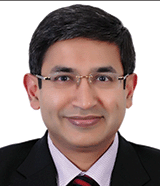 |
| T+0 is very efficient, and everything gets settled immediately, within the day. But when the same cycle is extended to foreign investors, it doesn’t quite work Arindam Das |
“Saudi, with T+0, makes this extremely challenging,” says Das. “A trade, once done, will immediately settle and the sub-custodian may not be able get the instruction from the global custodian to match with the allegement from the local broker the same day.”
Two, this raises a question about pre-funding. Trades normally go through only if there is an adequate cash balance in the account, meaning investors will need to keep Saudi riyal balances in their accounts in expectation of trading, whether they end up buying or not.
Three, under the T+0 model, once shares are sold, it will be impossible to reverse a trade even if the investor believes that this was an unauthorized or erroneous trade. “Those shares will go out irrespective of whether the custodian approves the trade or not,” says Das.
What can be done? There is a proposed new independent custody model, in which the sub-custodian becomes the clearing member and hence receives the sale proceeds, reducing counterparty risk considerably, which might help.
“I’m not sure that all the other changes, like extending the settlement cycle, can be made before the market opens to foreign capital in early 2015,” says Das. “Not necessarily because it’s technically difficult to change, but because it is subject to acceptance by the market and local authorities.”
Much as the CMA and Saudi exchange want to accommodate foreign investors, it would be unreasonable to expect them to change everything about market practice in order to do so. “They would have to be very clear that this change is beneficial for everyone in the market rather than just one investor segment,” says Das. “You can’t change the whole system for the benefit of 10% of the investor base.”
In the meantime, brokers and custodians will need to persuade foreign investors to pre-fund, or to make credit facilities available to them to allow a swift purchase and settlement of trades.
Be that as it may, custodians like HSBC – a powerful presence locally in Saudi Arabia as well as internationally – perceive a clear chance in Saudi’s opening.
“It’s a huge opportunity,” says Das. “In Saudi we have most international global custodians and broker-dealers signed up with us, but because foreign investors can’t yet invest in the stock market, assets so far through that route have been negligible compared to the size of the market. Now, the market opportunity pretty much doubles. We have effectively been playing in a field where half that field was closed for everybody.”
HSBC and other global custodians will not only gain an opportunity with Saudi but will be expected to help it take shape. Under draft regulations, the CMA has created a category of intermediaries called AAPs (assessing authorised persons), through which authority is delegated to assess applications of foreign investors who want to come in. There is already a list of APs, or authorised persons, including both custodians and brokers; any of these will be able to apply to become an AAP, and HSBC is one that will definitely do so.
This delegation “is an extremely progressive step,” says Das. “It took 20 years before India came up with its FPI [foreign portfolio investor] system, where custodians have the authority to decide the eligibility of applicants wanting to become FPIs. Going to that stage straightaway in a market that is opening up for the first time is very significant.”
Moreover, the CMA has then imposed upon itself a very short timeframe to decide if investor documentation is in order, and gives itself just three days to overrule any custodian’s decision on an appropriate investor. The effect is that custodians are not just a first line of defence putting recommendations in, but a real authority.
Most market participants have taken part in the CMA’s three-month review and consultation period. They say they feel they have been listened to, even if their advice is not ultimately taken.
Above all, there is a clear sense that Saudi’s regulators are trying something new here: the consultative approach is unusual in this often insular country, and the determination to see the changes through are self-evident, despite still-born previous attempts.
Is the Saudi market ready for the onslaught? Locals are confident, noting that several steps in recent years – such as aligning working days with other GCC markets and gradually improving corporate governance – have led towards this. “We believe the Kingdom’s regulatory environment is ready for foreign investors, and the regulators are well-prepared to address any specific needs as we move forward,” says Gopi.
Some caution that there needs to be a ceiling to expectations. “To be a financial centre, you need to create an environment where market participants are happy to live and work: bankers, sponsors, investors, the whole range of participants that make a financial centre tick,” says Paul Harter, Dubai head of law firm Gibson Dunn & Crutcher, which among other things is a leader in Middle East M&A. “Saudi is never going to be a place that is going to attract that kind of talent in any significant numbers. Dubai is just an hour away and is an extremely open society, even by western standards.
“Saudi Arabian regulation is not at all suited to international commerce,” he continues. “The insolvency law dates from the 1930s. It still provides for mandatory incarceration of categories of bankrupt persons and, by inference, for directors of bankrupt companies. I believe the Saudis are going to be forever unwilling to implement not only the legal structures but the physical environment it would need.”
Still, being a financial centre is not really what Saudi is aspiring to; more a gradual opening to develop its capital markets and create greater efficiency in capital raising for its companies, and a more sophisticated and rigorous market for its own pension institutions to invest in when the moment arrives for them to develop.
In that respect, living norms in Riyadh aren’t really the point, so much as a market environment that international capital finds acceptable. It appears that the last remaining closed market of real size is on its way into the global fold.