Differing levels of efficiency
 |
|
Turning and turning in the widening gyre |
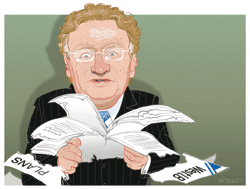
THOMAS FISCHER DID not have the immediate future of his own bank in mind when he began throwing impromptu snippets from The Second Coming into an interview with Euromoney in 2005. But the former CEO of WestLB, as much an aficionado of WB Yeats and Dylan Thomas as of extravagant pinstripe suits and large cigars, could scarcely have chosen a more appropriate way of foretelling his own demise. For Europe’s largest economy, the recent upheavals at WestLB and a handful of other German banks might turn out to be precisely what was needed to accelerate change in the country’s hopelessly outdated and inefficient banking industry. But for WestLB, as well as for Fischer and a number of his erstwhile colleagues, things have indeed fallen apart spectacularly in recent months. Nobody imagined it was going to be easy for one of Germany’s most colourful bankers when he was appointed chairman of WestLB’s management board in October 2003, or for the bank’s new chief risk officer, Matthijs van den Adel, whose appointment was announced on the same day. Fischer arrived in Düsseldorf having famously fallen out in 2002 with Josef Ackermann in his previous post at Deutsche Bank, where he was board member in charge of risk management. Van den Adel had previously been responsible for central balance sheet and risk management at Fortis.
For both, it was a brave move, given that WestLB had been a disaster area for years, with its catastrophic dalliance with principal finance, led by the bank’s femme fatale, Robin Saunders, contributing to the €2 billion loss it had sustained in 2002. As was to be expected from a one-time amateur boxer not short of self-belief, Fischer immediately made pugnacious noises about restoring WestLB’s profitability. But the truth was that he and van den Adel had signed up for a bank with a business model that had the solidity of wet cardboard and a reputation that was wobbling like blancmange.
Fitch Ratings, for one, said as much at the start of 2006, when its senior director, Thomas von Lüpke, told a state parliament hearing on the future of the region’s savings banks that WestLB’s business model was unsustainable. WestLB responded furiously, with Fischer himself somewhat indecorously describing Fitch’s comments as flapsig – which is best translated as boorish or loutish. That, says one local observer, was counterproductive because it succeeded only in exciting the attention of journalists and other analysts who otherwise would probably have ignored WestLB. And intensified public scrutiny was one of the last things WestLB needed at the time.
Nevertheless, Fischer harboured a number of ambitions, most notably to steer WestLB into a position from which it could lead consolidation in the German banking sector. For a while, he seemed to be delivering on at least some of his promises, and by March 2005 WestLB was making the outspoken prediction that “together with the Sparkassen we will become the leading German universal bank”.
Those lofty ambitions were dealt a shuddering, terminal blow when it came to light earlier this year that some rogue traders on WestLB’s prop desk had punted the wrong way on the common and preference shares of German automakers. The general consensus is that Fischer would have been entirely ignorant of any shenanigans being committed by the traders in question, who were promptly dismissed. But that did not satisfy regulator BaFin – or its boss, Jochen Sanio – which allegedly found that management had failed to report the trading irregularities promptly. The result was that, at the end of July, Fischer and van den Adel were shown the same door that had been shown to two key protagonists on the prop trading desk, Friedhelm Breuers (in April) and Robert Stein (in July).
From bad to worse
Since then, things have stumbled from bad to worse at WestLB. At the end of August, it announced a worse than expected net first-half loss of €170 million, with the gains it had made in such areas as fee and commission income insufficient to offset the €604 million lost by its proprietary trading desk. Barely a fortnight later, WestLB’s old adversary, Fitch, downgraded the bank’s individual rating from D to D/E and placed it on Rating Watch Negative (RWN). The downgrade, said Fitch, reflected “the expected impact of the current capital market development on WestLB’s off-balance-sheet funding vehicles and potential losses in connection with off-balance-sheet risks, particularly the bank’s two structured investment vehicles…” Fitch’s disconcerting update about WestLB added that it was also concerned about the bank’s “continued poor underlying profitability”, “uncertainty about management and strategy”, and the “hit” on its reputation.
Some analysts say that the WestLB story is quite different from those that unfolded soon afterwards at IKB and Landesbank Sachsen, both of which were casualties of the US sub-prime crisis, because the WestLB debacle that brought Fischer and van den Adel down had nothing to do with what was happening in the US mortgage market. WestLB, though, has said that it has €1.25 billion of exposure to sub-prime (most of which is highly rated), which it has described as a “relatively limited” exposure – certainly not big enough to lead to heads rolling at board level.
The underlying drivers of the difficulties at WestLB, SachsenLB and IKB were, however, the same – which is that it in the overpopulated German banking market it is murderously difficult to earn a decent crust. Those that have tried to earn more by abandoning traditional Teutonic caution have generally fallen flat on their faces, and WestLB has had an uncanny knack in recent years of backing the wrong horses. “After its well-documented problems with BoxClever it seems that WestLB was pressured into chasing ROEs that were comparable with other international houses,” says one banker.
That being so, it seems probable that for all Fischer’s ebullient talk about spearheading consolidation in the industry, WestLB’s days as one of the survivors of the much-needed shake-out in German banking would have been numbered with or without the untimely interference of its hapless prop desk. “The trading losses have clearly highlighted WestLB’s vulnerability,” says Katharina Barten, analyst at Moody’s. “But we had previously outlined that its investment banking-focused business model made the bank vulnerable because a major portion of its revenues was unreliable. Trading revenue has been very volatile in the last three years and it was evident that the bank’s risk-return profile was unsound.”
In some ways, Fischer’s early demise was what his beloved WB Yeats might have called a pity beyond all telling, because given his relatively short tenure in the Herzogstrasse hot seat he achieved a great deal. “Fischer was a very strong manager in many ways,” says Barten at Moody’s. “He did a number of things that from the perspective of a ratings agency we viewed positively. He and van den Adel led a concerted effort to reduce the bank’s book of bad and doubtful assets, and he was not easily inclined to support projects that were politically motivated. However, he failed to establish an appropriate risk culture or a strategy capable of supporting a broader, more predictable and sustainable income mix.”
|
Alexander Stuhlmann took over as CEO of WestLB in July, making it clear that he was doing so on a strictly temporary basis |
 |
Others agree. “In the first few years of his tenure, I think Fischer stabilized the bank, de-risked it to a large extent and gave it new impetus towards a strategy that he never had the time to implement,” says Ian Centis, credit research analyst at Commerzbank Corporates and Markets (CBCM). “He also correctly identified that WestLB could no longer act as a large-scale corporate and investment bank as it had in the past. And, maybe most importantly, he put a great deal of effort into securing improved relationships with the region’s savings banks in order to make sure that WestLB had access to the funding it needed.” That funding came in the form of a €1.5 billion injection of fresh capital from WestLB’s two savings banks associations in September 2004 that replenished the group’s capital adequacy ratios and offset the €1.4 billion repayment of the so-called unfair subsidy granted to the bank by the German state of Nordrhein-Westfalen.
That achievement, say bankers, ought not to be underestimated, given how fractious relationships between WestLB and the savings banks were when Fischer took up his position. But German bankers say that even with those relationships patched up, Fischer was always operating with one hand tied behind his back. “You can’t change things dramatically at a bank the size of WestLB in the time he had,” says one. “You can’t rewrite and implement a new business model in less than four years at such a political organization. To do that, you need flexibility, which is something Fischer’s bosses never gave him enough of.”
It was not just at the savings banks associations that Fischer was able to cultivate new friendships. His conviviality meant that he was broadly liked – and not just by his own staff who, in the words of one analyst, were collectively given a “new spirit” when Fischer stepped through the door at Herzogstrasse. True, some say that Fischer was a showman who talked the talk better than he walked the walk, with one banker describing him somewhat unkindly as a “peacock”. Others say he was an individual of formidable intellect who was misunderstood by those around him – literally, in one instance, when he started quoting Latin to a group of bemused analysts during a results presentation. And most agree that his temperament and abilities were probably much better suited to the private than to the public sector, where he was frequently frustrated at being bogged down in the bureaucratic and political quagmire that continues to characterize German banking.
Nevertheless, it appears to be beyond dispute that Fischer had to fall on his sword. “As I understand it, his demise came about not because he sanctioned a risky trading strategy but because a risky trading strategy was being implemented without his knowledge,” says a banker. “By the time he found out about it, apparently he wasn’t altogether decisive about stamping it out and informing the supervisory board. So his main failing seems to be that he took his eye off the ball.”
The choice of Fischer’s immediate successor appears to confirm – if confirmation were needed – that WestLB has now thrown in the towel when it comes to ambitions to lead the much-needed process of consolidation in German banking. Described by the local Manager Magazine as der Fusions-Pionier (the merger pioneer), the 59-year-old Alexander Stuhlmann took over as CEO of WestLB in July, making it clear that he was doing so on a strictly temporary basis. To some local observers, even that arrangement represented an unlikely comeback, given that Stuhlmann stood down at the end of 2006 from his position as chairman of the managing board at HSH Nordbank. Others say that Stuhlmann has been appointed as a safe and dependable pair of hands whose experience of negotiating Landesbank mergers is second to none.
Certainly, there appears to be broad agreement that, with Fischer out of the picture, the path has been cleared for a rapid takeover of WestLB. “I understand that the two board members who were really driving policy were Fischer and Stein, both of whom are very strong characters,” says a banker. “The fact that both are now history will speed up the process of WestLB being taken over.”
As to the likeliest acquirer, all the usual suspects have been mentioned, with US private equity houses such as Ripplewood and Cerberus – as well as JC Flowers – all reported to have an interest. Closer to home, Bayerische Landesbank (BayLa) and Commerzbank are also understood to be in the frame. But most of the smart money appears to be on Stuttgart-based LBBW, which has made no secret of the fact that it fancies its chances of spearheading an acceleration in Landesbank consolidation.
Although the Westfalen-Lippe and Rheinland savings banks associations – which between them hold a more than 50% stake in WestLB – have openly expressed their support for a “merger” with LBBW, the government of Nordrhein-Westfalen, which holds 38% and has appointed Citi to advise on its options, has been less ready to accept a union with LBBW. That apparent intransigence, say bankers, is little more than a canard aimed – quite reasonably – at maximizing the purchase price any acquirer pays for WestLB.
Certainly, LBBW is regarded as the strongest of the local players to have harboured realistic ambitions of absorbing WestLB. It has also not been shy of using its balance sheet to expand its presence inside its Baden-Württemberg backyard and beyond, with analysts saying that the track record it has developed of managing its acquisitions has been close to flawless.
At first blush, however, LBBW’s most recent expansion looks more like a bail-out than a strategic acquisition. But the speed with which LBBW was able to step in and resolve the crisis at SachsenLB speaks volumes about its ambitions and its preparedness to move speedily and decisively to realize them. “LBBW said in the spring that it was looking at buying SachsenLB, and everybody laughed because at the time WestLB had an option to acquire at least 25% of the bank,” explains Alexander Plenk, banking analyst at UniCredit in Munich. “By August, WestLB was clearly out of the picture and although NordLB and Bayerische Landesbank were also interested, LBBW was stronger and quicker than the other candidates.”
 |
|
Will WestLB be an asset that will enable LBBW to build on its credentials as the so-called national champion that German banking needs, and to enhance the reputation of its boss, Siegfried Jaschinski, as one of the Wunderkinder of German banking? |
Strong enough, believe other analysts, to make relatively light work of straightening out SachsenLB. “I think LBBW is definitely the strongest of the Landesbanks – and on an individual ratings basis it is also among the strongest of all German banks,” says Thomas von Lüpke, head of German banking at Fitch Ratings in Frankfurt. “We are pretty convinced that LBBW will be able to do in Leipzig exactly what it has announced, which is to sort out the problems at SachsenLB.” Assuming LBBW does push ahead with the acquisition of WestLB, the most intriguing question it raises is about the outlook for LBBW itself. Specifically, will WestLB be an asset that will enable LBBW to build on its credentials as the so-called national champion that German banking needs, and to enhance the reputation of its boss, Siegfried Jaschinski, as one of the Wunderkinder of German banking? Or will it turn out to be a liability that diverts the attention of LBBW’s management from its core business and drags it into endless political wrangles about job preservation?
Opinion on this subject appears to be mixed. “Over the long term, WestLB will be an asset, but in the short term it is clearly a liability,” says UniCredit’s Plenk. “If you look at WestLB’s recent track record of bad investments and poor risk management that revolved around doing business for its own sake rather than for the benefit of its P&L or its balance sheet ratios, clearly there would be a lot for a buyer like LBBW to clean up. But if you look at the big picture, an opportunity is clearly emerging for LBBW to create a kind of super-Landesbank that will be a top-three player in German banking. But I think everybody at LBBW understands very clearly that cleaning up the mess at WestLB will take time.”
On paper at least, WestLB has plenty going for it. For one thing, its location in Düsseldorf means that it has an important foothold in a large, strong and recovering region in Germany that is home to 130 savings banks with 11.5 million clients. Beyond that, bankers say that would-be buyers of WestLB will be attracted by its capital market franchise which, according to Fitch, “has been, and is likely to remain, the main contributor to operating profit”, and by the beginnings of a retail-cum-private banking presence. There, as one analyst points out, Fischer should be credited for expanding WestLB’s presence with the acquisitions of Weberbank in 2005 and ABC Bank (which has been rechristened readybank) in 2006.
In off-the-record asides, however, some observers express concerns about LBBW’s capacity to take on an enfant terrible like WestLB, especially at a time when it is also sidetracked by sorting out the mess it has shouldered at the Leipzig-based SachsenLB. Fitch’s von Lüpke says it is important to distinguish between the challenges associated with tackling the problems that LBBW has taken on in Leipzig with those it would have to address in Düsseldorf. SachsenLB is, after all, a relative minnow in the grander scheme of German banking.
To some observers, the principal concern arising from SachsenLB’s acquisition by LBBW is the signals that it sends out about the Stuttgart bank’s expansionary ambitions. Moody’s, for one, responded to the announcement by changing its outlook on a number of LBBW’s ratings to negative, commenting that “LBBW will be merging with a weaker, albeit smaller, institution” and that SachsenLB continues to face challenges with its exposure to structured products and ABCP conduits. More significant, however, was the warning that “the transaction may also signal LBBW’s willingness to consider taking on additional risks as part of its broader strategy to act as a consolidator in the Landesbank sector.”
The political hot potato will be the assurance that any purchaser of WestLB has sufficient leeway to make reasonable cost savings – which is shorthand for allowing any acquirer to tackle the issue of WestLB’s bloated payroll. “At the moment WestLB has 6,000 employees and costs of a little over €1 billion,” says a banker. “LBBW has more than 12,000 employees and costs of about €970 million, which suggests that WestLB is paying its people more than twice as much as LBBW is. So there is certainly room for improvement in terms of costs.”
Another important box that Jaschinksi will certainly try to ensure is ticked before any deal is finalized will be that the acquisition of WestLB gives LBBW access to at least some of the savings banks in Nordrhein-Westfalen. “We have said all along that a Landesbank plus a number of savings banks is normally going to be a more stable credit than a Landesbank on its own,” explains von Lüpke.
Note of thanks
If the buyer of WestLB can build constructively on relationships between the Düsseldorf-based Landesbank and the savings banks in its Nordrhein-Westfalen backyard, perhaps it should send a note of thanks to Fischer, who had the foresight, energy and charm needed to lay the appropriate groundwork. That, say bankers, was precisely what German banking needed – suggesting that the industry will be poorer without Fischer than it was with him. “This market desperately needs more free-market champions and less political influence,” says a senior figure at a non-German bank in Frankfurt. “The question is: do we have the strong visionaries we need to help the Sparkassen and the Landesbanks to become stronger and more unified? This is serious, because if German banks don’t do something to address these weaknesses the danger is that a small bank from a neighbouring country such as Austria or Poland is going to walk in and steal market share from under their noses.”
Pressed on whether the German public sector has any of these visionaries, this banker is hesitant, saying that they can probably be counted on the fingers of one hand – with LBBW’s Jaschinski and SaarLB’s Thomas Buchbinder probably among the few that have the necessary vision to strengthen the industry.
Whether the name of Fischer could have been added to that shortlist will probably never be known. For the time being he is expected to continue to serve as head of the supervisory board of Essen-based utility RWE. And given his boundless energy and self-belief, some say they wouldn’t rule out the possibility of his making a reappearance on – perhaps – the board of a private equity fund. But as far as the German banking industry is concerned, it seems unlikely that for Thomas Fischer there will be a Second Coming.