Trade is no longer delegated solely to procurement or treasury functions; it is increasingly viewed as a strategic lever, shaping liquidity, resilience and growth.
According to Vivek Ramachandran, head of Global Trade Solutions at HSBC, “2025 was a year which was unprecedented in the scale of change.” HSBC’s Trade Pulse Survey, based on 6,750 business leaders across 17 markets, suggests corporates are adapting to this new normal. Sixty-seven per cent of respondents report greater certainty about the effects of trade policy on their business compared with six months earlier, while expectations of potential negative revenue impact from supply-chain disruption over the next two years fell from 37% in May 2025 to 22% in October 2025.
“Companies have been incredibly proactive about thinking about levers they can pull,” Ramachandran explains. “Consistent feedback from the market is that companies are rethinking business models and their supply chains.”
Cutting through complexity
Trade finance has been part of HSBC’s DNA for more than 160 years, with operations in more than 50 countries and connectivity into around 85% of global trade flows. But client feedback suggests scale alone is not enough. Corporates value global reach insofar as it simplifies execution and reduces coordination burden across markets.

2025 was a year which was unprecedented in the scale of change.
Vivek Ramachandran, head of Global Trade Solutions, HSBC
Respondents frame HSBC’s global presence as a way to streamline trade activity rather than fragment it. One manufacturing corporate highlights HSBC’s “excellent digital trade finance services, quick processing times and reliable document handling.” Another notes HSBC’s platforms are “intuitive and secure,” paired with “knowledgeable and responsive” trade staff – reinforcing that technology matters most when it shortens cycles and accelerates resolution.
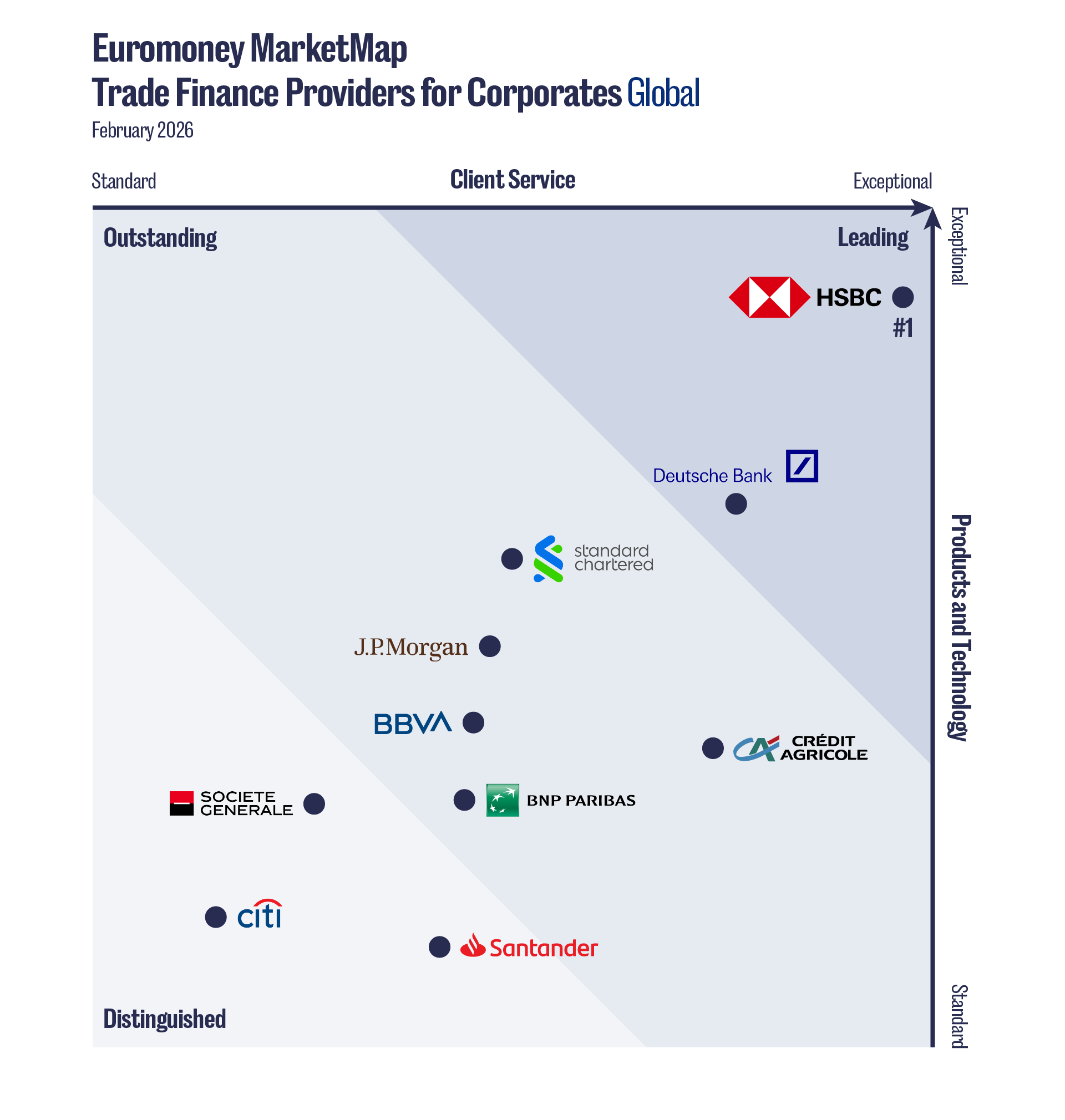
Ranked by corporates as the #1 trade finance provider globally for the 9th consecutive year by either service or scale, HSBC is also ranked #1 among large corporates. In this segment, feedback centres on facilitating complex cross-border flows efficiently and with specialist expertise. One respondent notes: “HSBC team consistently provides clear, proactive guidance on complex documentation and market requirements […] The quality of relationship management, particularly their responsiveness and understanding of international trade timelines, really stands out.” Another adds: “HSBC’s combination of personal engagement and international expertise truly differentiates it from other banks.”
Sector-based strategy
A sector-based approach has become central to how HSBC supports its clients. “We reorganised the trade global team, focused on industry groups,” Ramachandran explains. As trade becomes a board-level lever, he adds, “beyond working capital, CEOs and CFOs are looking at trade as a sales enablement tool, as a risk mitigation tool and as a supply chain resilience tool.”
The quality of relationship management, particularly their responsiveness and understanding of international trade timelines, really stands out.
Euromoney Trade Finance Survey respondent
That shift is also driving demand for bespoke solutions, particularly where corporates need structures aligned to sector dynamics, counterparties and route-level risks. Ramachandran points to increased demand for bespoke solutions, with the industry-led structure acting as an enabler.
Industries with the highest satisfaction across HSBC’s portfolio in 2025 included consumer staples, communication services, retail and wholesale trade, construction and manufacturing.
As one corporate puts it, the value is in tailoring the wider HSBC proposition, beyond trade: “HSBC provides a comprehensive suite of financial products and services, including global cash management, trade finance, foreign exchange solutions, and investment products […] Their digital banking platforms and efficient cross-border transaction capabilities make them a preferred choice for managing complex treasury operations and international business activities.”
Technology as an enabler
HSBC’s response has been to modernise its trade infrastructure. Central to that effort is HSBC Trade Solutions (HTS), the bank’s front-to-back trade platform supporting letters of credit, guarantees, trade loans and supply chain finance from a single digital core.
Deployed across 25 markets, HTS enables straight-through processing and supports multiple connectivity options, including API and host-to-host, within a unified data architecture.
For Ramachandran, the strategic value is flexibility. “Clients expect banks to talk to them on their terms, not the other way around,” he says. HTS allows greater flexibility in pricing and in how credit limits are deployed across product constructs and geographies, while also providing “a platform through which we can innovate,” as needs evolve.
Client satisfaction with HSBC’s technology capabilities improved year on year, with one of the strongest positive deltas versus the industry.
Working capital built into the trade flow
Demand for working-capital solutions has intensified as corporates adjust to operating in persistent uncertainty. Corporates ranked HSBC as #1 globally for letters of credit, structured trade, working capital solutions and documentary collections.
Agility has become a real mantra for companies we are talking to.
Vivek Ramachandran, head of Global Trade Solutions, HSBC
“Historically, trade finance has been split between very paper-based trade and highly structured receivables products, leaving a big white space in between,” Ramachandran explains. Companies often filled that gap through overdrafts or short-term facilities. TradePay was designed to address it through a different construct: “a fully digital trade loan, where suppliers are paid directly and the buyer repays the bank. It is self-liquidating, linked to your working capital cycle and fully digital.”
Looking ahead to 2026, HSBC sees scope to extend TradePay with additional digital features and to support not only buyers but also sellers. Enabled by HTS, Ramachandran describes it as “the right product at the right time.”
What comes next
Ramachandran highlights three themes shaping the next phase. The first is “genuine change in automating traditional trade”. Despite progress, too much paper still moves through the global system.
The second is the rise of more structured working-capital and industry-specific solutions as trade becomes a strategic agenda point at board level.
The third is embedded finance, which he sees as the next wave of innovation. But embedded finance requires a different operating model. Serving millions of smaller suppliers through platforms cannot rely on journeys designed for large corporates; it requires rethinking automation, credit processes and risk management at scale. “You have to keep tweaking the product to get it market fit and ensure that the entire journey is fully embedded,” he adds.
The global trade environment remains volatile, shaped by geopolitics, technology investment and shifting alliances. What has changed is how corporates respond. “Agility has become a real mantra for companies we are talking to,” Ramachandran concludes.