 |
| A billboard in Mexico City depicting Donald Trump |
It was a gloomy time for Mexican M&A advisers. Donald Trump had just been elected president of the US on the back of repeated threats about how he was going to scrap the North America Free Trade Agreement and slap hefty import tariffs on Mexican goods. The peso was plummeting and dealmakers were fretting that acquisitions might come unstuck.
Mars’ purchase of Mexican chocolate maker Turin, for instance, had almost collapsed because of the impact of the peso’s decline months before Trump had even been elected, according to a person familiar with the deal.
The prognosis was grim.
“It was like if you are driving a car and you suddenly pull up the handbrake, that’s exactly what we felt here,” says Martin Plettner, a partner at Mexico City-based M&A advisory Rion. “Many of the deals that we were managing at the time either slowed down or came to a complete halt. The reason for that was because it was such an unexpected win, all the premises a buyer was basing acquisitions on became invalid overnight.”
Yet while domestic activity stalled to its lowest point since 2009 and inbound interest remained relatively subdued throughout the opening months of the year, Mexican companies were shrugging off concerns about Trump and busy shopping for assets in the US.
In February, just a few weeks after Trump’s inauguration, Mexican drinks company Arca Continental entered into a deal with Coca-Cola to acquire Coke’s southwest US bottling unit in exchange for a 20% stake in Arca’s Latin American beverage business – a transaction worth $2.7 billion, the largest deal involving a Mexican company in the US since Cemex bought Southdown 17 years ago, according to Dealogic data. And then in March, Mexican mining company Grupo Mexico announced plans to buy Florida East Coast Railway Corp for $2.1 billion, the fifth-largest Mexican deal in the US on record.
 |
|
| Jordi Tasias, BBVA Bancomer |
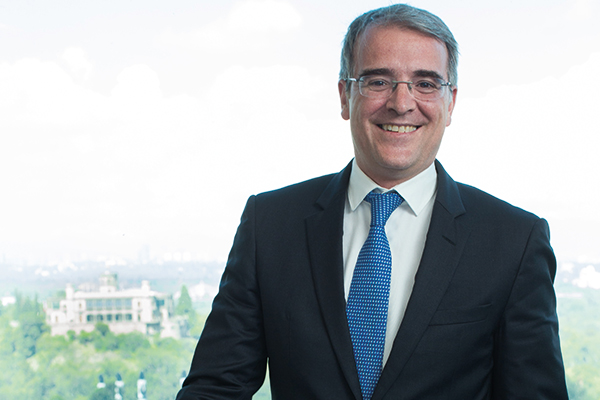
“This is a trend we’re seeing more of: Mexican large corporates expanding into the US, even given the currency situation,” says Jordi Tasias, head of corporate finance for Mexico at BBVA Bancomer in Mexico City. “Mexican multinationals are in a very good financial position to expand their businesses, and geographically it makes more sense expanding into the US.”
That US-targeted activity also played a role in restoring market confidence and signalling that, despite all the uncertainty, it was business as usual, spurring companies to reboot transactions that had faltered.
“Those deals proved to investors that the threats from Trump were just threats and showed that large investors were really willing to continue with acquisition plans,” says Fernando Carreno, a partner at Mexican law firm Von Wobeser y Sierra.
Since then, M&A activity has picked up rapidly. By mid-August, Mexican companies had announced $9.25 billion of acquisitions outside Mexico – the most at this stage of the year on record, again according to Dealogic. And while domestic activity remains at its lowest in eight years, inbound deals have crept up to $2.2 billion, 22% more than a year ago.
What seemed almost certain to be a miserable year for Mexican-focused M&A bankers has now turned into one of their best. Dealogic data show that revenue from Mexican-related M&A deals grew to $84 million by mid-August, the highest in four years and the third best at this point in the calendar on record.
“The real turning point was Trump being unsuccessful in passing his healthcare bill [in March]; people began realizing he was probably a lot more hot air than an actual threat, and so deals that were cancelled were calling us back wanting to take a look again,” says Plettner.
One deal Plettner’s firm was working on at the time of the election was advising a European company on buying a Mexican entity as a platform for the US market.
“When Trump won and with all the threats around the killing of Nafta, they effectively pulled out,” he says. “They called us back sometime around late April or early May wanting to revisit the deal, so that is a specific example of a deal being completely dead and then being revived.”
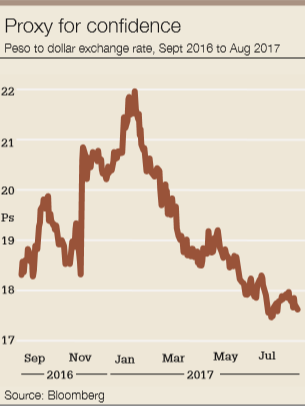
That shift in sentiment has mirrored the peso’s rebound. One dollar bought Ps17.5 in July, compared with almost Ps22 in the days before Trump took office.
“If I had some scientific index of Mexican business leaders’ confidence, in the past year or so it would probably look a lot like the Mexican peso chart, which means confidence has recovered significantly over the last several months as the rhetoric around Nafta has become a little clearer,” says Jim Allen, head of Latin America M&A at Morgan Stanley in New York.
“The Mexican business community now is starting to conclude that the sky isn’t falling and the paralysis where nobody knows what to do or is afraid to do anything is not the same as it was in January or February.”
 |
| Martin Plettner, Rion |
Yet while the overall mood has improved and some buyers are refocusing their attention on Mexico, not everybody is willing to sell.
“We worked on a number of significant potential buy-sides of Mexican assets late last year, and early this year that did not ultimately result in transactions,” says Allen. “But the reason they didn’t happen was not because the buyers faded away, it was because sellers were not panicked and did not like the valuations presented, so chose not to sell.”
Felipe Garcia-Moreno, head of banking for Mexico at JPMorgan in Mexico City, says he noted a similar reluctance among some business owners to proceed with potential sales in the first half of the year after Mexican share prices fell sharply in the wake of the US election, denting valuations.
“While on the international side acquirers might be taking some time and analyzing the perspectives of investing in Mexico, sellers have also been sitting and waiting because right after the US election, the Bolsa was down 20%, so they have been holding off for valuations to recover,” he says. “But as the situation has normalized, the foreign exchange has come back to levels even lower than before the election and people are more confident that there will be a favourable outcome with regard to the Nafta negotiations, so we expect to see more inbound transactions in the second half of the year.”
Corporate buyers
M&A bankers say that while much of that inbound interest will be driven by corporate buyers looking for strategic opportunities, private equity firms are increasingly sniffing out potential acquisitions in Mexico.
Luis Solórzano, a managing director at Advent International, says his buyout firm had a busy first half of the year in Mexico as business owners became anxious about the risks from Nafta and the peso’s devaluation, and while other investors shied away.
“For many US dollar investors and Mexican business owners, who often think in dollars regardless of the underlying currency of their businesses, that devaluation and the uncertainty around where the currency was heading helped create this cloud in the environment that slowed activity,” he says.
“That allowed us to take advantage and develop dialogues with these companies. We’re long-term investors in Mexico, so when these things happen, of course we remain cautious but we also believe that it’s an interesting time to look for opportunities, so we have a bit of a contrarian view with respect to how markets in general react to this kind of situation.”
One transaction is already in the bag. In July, Advent agreed to buy Mexico City-based Grupo Farmaceutico Somar from Endo International for around $124 million as part of the buyout firm’s regional healthcare strategy.
But finding deals is not easy.
“Private equity penetration is low in Mexico, so the number of investments above $75 million of equity is very limited,” says Solórzano. “You see more deals starting to happen in the lower end of the spectrum, say $20 million to $25 million of equity, but that’s not where we’re operating. Driven by the size of our fund, we’re chasing opportunities between $50 million and $250 million.”
 |
|
Jim Allen, Morgan Stanley |
That low penetration is partly because larger private equity firms are put off by a dearth of big buyout opportunities in Mexico.
“The problem with private equity work here in Mexico for some of these funds is the size of the ticket,” says Pablo Mijares, founding partner at Mexican law firm Mijares, Angoitia, Cortes y Fuentes.
“It’s difficult to find real large transactions that are worth their while; for them it’s just as expensive in terms of financial and human resources to do something that is an investment of $500 million as it would be $100 million, so they would probably prefer do the $500 million in the US rather than the $100 million in Mexico. That’s not always the case, but it does constrain activity.”
That reflects a wider challenge with the Mexican M&A market.
“There’s not a huge supply of companies for sale in Mexico, and when there are companies for sale there tends to be a lot of competition,” says Martin Sanchez, co-head of Latin America M&A at Bank of America Merrill Lynch in New York. “In many instances, transactions that happen in the Mexican market are not necessarily driven by formal sale processes, quite often what ends up happening is one-on-one transactions that lead to structured deals and combined larger platforms and therefore stronger players.”
Owners may often simply look to relinquish a minority share of their assets. For example, Mexican billionaire Carlos Slim’s infrastructure firm Ideal last year sold a 49% stake in one of Mexico’s largest toll roads to two Canadian pension funds for around $1 billion.
“Mexico has consistently punched below its weight in terms of M&A transactions of assets or companies in Mexico,” says Morgan Stanley’s Allen.
“If you look at the percentage of deals and deal value involving Mexican targets in the overall Latin America M&A market versus Mexico’s share of Latin America GDP, it’s almost always lower. That’s because Mexico is a highly concentrated market where a handful of very large corporations are the bulk of the value; and these are the guys that are buying stuff elsewhere but they’re generally not selling anything in Mexico.”
Energy sector
Against that backdrop, M&A advisers are hopeful that the government’s efforts to reform the country’s energy sector might become a greater source of deal activity in the future.
Pablo Ferrante, a partner at law firm Mayer Brown, says: “This is at a very early stage, so we’re not seeing much typical M&A activity at the moment; it is more at a stage where companies are partnering and bidding for these oil and gas production and exploration opportunities.
“Once these players are more established and the market matures you will then see much more M&A activity among them.”
Plettner says those reforms are likely to generate increased M&A interest in support services for the oil and gas industry.
Encouragingly, bankers say the energy sector is one of the areas that was least affected by the uncertainty surrounding Trump and the Nafta renegotiations, boosting potential deal activity. “The energy industry is where we’re seeing most of the transactions in our pipeline for the coming months,” says Tasias.
 |
The wider infrastructure market is also likely to attract foreign interest, bankers say.
In July Australian private equity firm IFM took a roughly 28% stake in Spanish construction company OHL’s Mexican toll road operator OHL Mexico.
Meanwhile, foreign bidders are lining up with offers for renewable energy assets that Enel Green Power is currently seeking to offload in Mexico. And private investors are also watching for any further Pemex divestments.
“Inbound activity tends to relate to growth capital for new projects,” says Sanchez, “there is significant interest in the energy and infrastructure sectors given there is still a lot to be done in those fields in Mexico, so you see several infrastructure funds and private equity sponsors looking at those sectors.”
Dealmakers say the pipeline in Mexico is looking promising for the remainder of the year, in part because buyers and sellers are seeking to get transactions out of the way ahead of the country’s presidential elections next July.
Outbound activity is also likely to remain robust as Mexican companies continue their expansion plans abroad. For example, Jorge del Castillo, head of corporate and investment banking for Mexico at MUFG, says his bank is arranging a $1 billion financing package for an outbound deal that is close to being signed off.
And outbound deals are not just focused on the US. In August, chemicals and plastics producer Mexichem agreed to buy an 80% stake in Israeli irrigation firm Netafim for $1.5 billion, while dairy giant Lala announced plans to buy Brazilian counterpart Vigor Alimentos for $1.8 billion.
“Given the Nafta situation,” says Tasias, “Mexican corporates are starting to look at other geographies just in case the situation gets worse, so they can balance their exposure.”
Mexican baking company Grupo Bimbo, for instance, has this year purchased bakery assets in Colombia and Morocco, as well as two businesses in North America. Of the top 20 outbound Mexican deals this year, just over half were outside the US or Canada, with roughly two-thirds of those in other parts of Latin America, according to Dealogic.
“We are seeing more and more Mexican companies looking at the rest of Latin America because it’s cheaper than buying in the US,” says Mijares. “If you look at commerce between Mexico and the rest of Latin America, trade is relatively small, so there is tremendous opportunity for growth. Mexican companies have tended to look northwards, but south American countries are growing a lot and Mexican companies should be there.”
Mexican cinema chain Cinepolis, for example, continued its push into the wider Latin American market with the acquisition in June of a shopping centre in Panama. And the tussle between Arca Continental and Coca-Cola Femsa for the Latin American bottling companies they do not already own is also likely to generate more deals in the region, M&A bankers say.
“If I look at outbound M&A, Mexico is clearly not punching below its weight,” says Allen. “The largest players in Mexico are actually among the most aggressive outbound acquirers from Latin America. They’ve got cash and they’re trying to buy things and expand their businesses, and they’re finding very little available in Mexico either, so they go abroad.”