 |
|
|
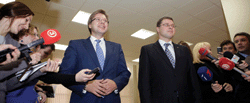
Riga mayor Nils Usakovs (left) and Latvia’s prime minister, Valdis Dombrovskis of the Unity bloc: election reduces political risk |
Latvia’s prime minister, Valdis Dombrovskis, and his coalition partners scored a stunning victory in October’s general election, securing 63 out of the 100 seats in parliament and transforming the incumbent minority administration into one with a good working majority. The election result paves the way for the Latvian economy to continue its recovery from a biting recession, during which GDP has plunged by almost a third in the past three years.
But one of the sharpest downturns in modern economic history looks set to be over by the end of the year. The so-called internal devaluation policy pushed through by Dombrovskis after he took the helm of a fragile coalition of parties in March 2009 is beginning to deliver results in economic competitiveness – exports are up 40% this year, for example – and in persuading international investors that the country is not an economic basket case.
James Oates, chief executive of Baltic fund manager Cicero Capital, says: “In some ways the fact that Dombrovskis now has his own, personal, mandate is a just reward for the sensible approach he adopted to the management of the coalition as much as for his economic policy. The trick now is to maintain the same direction without being tempted into less-productive approaches.” A new government headed by Dombrovskis will be sworn in this month, with its key task the trimming of €500 million from state finances in the 2011 budget if the country is to meet the terms of the €7.5 billion bailout package it received from a coalition of lenders led by the IMF and European Union.
Having shrunk by 18% in 2009, the Latvian economy is still in recession but the contraction this year is set to be as low as 1.5%. Growth forecasts for 2011 range from 2% to 3.5%.
Economic analyst Lars Christensen at Danske Bank in Copenhagen says the election result is strongly positive from a market perspective and should reduce the political risk in Latvia and secure the continuation of the IMF/EU-sponsored reform programme.
Christensen adds that if the new government passes yet another austerity budget for 2011 there is the chance of positive actions by the rating agencies and he says that the pro-reform outcome of the elections will be supportive of Latvian markets. Already this year the Latvian stock market has been among the world’s best performers, posting a 42% gain in the first 10 months of the year.
Zigurds Vaikulis, head of research at Citadele Asset Management in Riga, points out that the risk premium attached to Latvian debt has fallen dramatically since Dombrovskis came to power. Five-year credit default swap spreads on euro-denominated Latvian debt have plummeted from more than 1,200 basis points in March 2009 to about 350bp at present, paving the way for the Latvian government to return to the international bond markets should it so wish.