UniCredit’s headquarters – Italy’s tallest building – tower over the Milan skyline in a blunt celebration of growth. Given that the bank’s share price has tripled in the two years to June 2024, the 32-story building could be seen as a reflection of the ambitions of its chief executive, Andrea Orcel.
Orcel, who was head of UBS’s investment bank for most of the 2010s, now presides over a refocused and balance sheet-light approach at UniCredit. Thanks in part to this and to higher interest rates, UniCredit’s return on tangible equity was 16.6% last year, compared with 7.3% when Orcel arrived in 2021, albeit on a slightly lower capital ratio. This has been a remarkable turnaround and Orcel is Euromoney’s banker of the year.
Before his time at UBS, Orcel was an investment banker at Merrill Lynch in London, advising on a wave of bank M&A deals that culminated in the ill-fated Royal Bank of Scotland-led takeover of ABN Amro in 2007.
That was the era when the UniCredit tower was conceived, under then-chief executive Alessandro Profumo. Orcel and his team advised Profumo on some of UniCredit’s transformational deals, including the 2005 purchase of HVB, Germany’s third-largest private-sector bank.
In the post-2008 world of banking, however, banks can be too big and, at UniCredit, change is afoot, both strategically and architecturally.
In addition:
The lease on the UniCredit skyscraper expires at the end of this decade and the bank announced plans late last year for a new headquarters in a campus-style arrangement of low-story buildings to be built on disused railway yards in the north of Milan.
The project is close to Orcel’s heart, even though he may not still be chief executive when it is finished in seven years’ time.
“People get together a lot more in campuses, rather than towers,” he says. “Because they are lateral, people walk around. It gets people to see each other and to interact and integrate a lot more.”
Model example
One campus-style bank headquarters that Orcel knows well is that of Banco Santander. Orcel publicly fell out with Santander’s executive chairman Ana Botín after his aborted appointment as Santander’s chief executive in 2018. At Merrill, however, Orcel was a regular M&A adviser to her father Emilio, who opened the Spanish bank’s sprawling campus 20 years ago, in countryside outside Madrid.
Another such campus is Crédit Agricole’s leafy Parisian headquarters, which is in a semi-suburban area similar to the new site UniCredit has acquired. The French bank’s structure – a central entity helps 39 French regional banks harness group-wide synergies – is also remarkably close to how Orcel now seeks to grow UniCredit’s banks in its 13 countries.
Financial performance bolsters Orcel’s supporters
As one of the M&A bankers most closely associated with big bank deals before 2008, UniCredit’s chief executive, Andrea Orcel, has long attracted divergent opinions. Once referred to publicly by a British member of parliament as a “deal junkie”, some colleagues appear to like working with him so much that they have followed him as he has moved institutions.
Meanwhile, both within the industry and society at large, there has been a debate about his pay, which was the reason Santander gave for rowing back on his chief executive appointment.
In 2008, Orcel’s pay at Merrill Lynch – amounting to more than $30 million – attracted widespread press attention. UniCredit has not directly compensated him for up to €50 million in deferred pay from UBS, as Santander initially proposed. The Italian bank has, nevertheless, made him one of Europe’s best paid bank chief executives, potentially receiving up to €10.8 million for 2024, despite opposition from proxy adviser Glass Lewis.
UniCredit’s recent financial performance has gone some way towards quelling dissent. “They have unlocked a lot of capital in an intelligent way,” says Sebastiano Pirro, chief investment officer at Algebris Investments. “The management has been more proactive on the costs front. Yes, they got lucky on rates, but they optimized the bank even further, which is why the share price reacted so aggressively.”
Similar praise comes from equity analysts. Berenberg says the bank “is doing all the right things, from focusing on improving its fee-based revenues to maintaining a strong focus on risk and costs”.
As a universal bank, UniCredit is much more pan-European than Crédit Agricole, mainly due to Germany, Bank Austria and the central and eastern European (CEE) network that came with HVB. Moreover, Orcel has prioritized capital efficiency and subsequently shareholder returns at UniCredit much more than any mutual group would need to do.
Nevertheless, Crédit Agricole is today perhaps the most prominent example of how to realize pan-European scale via in-house product factories. It is the majority owner of Amundi, Europe’s largest asset manager. It also owns a large in-house insurance company and runs some of Europe’s largest businesses in consumer finance and custody.
Partly as an attempt to realize greater cross-border synergies, Orcel has moved to reinternalize some asset management products. He has cut the number of the group’s insurance partners and has recently sought to leverage international scale in payments, including through a new pan-European agreement with Mastercard. At the same time, UniCredit has sought to bring its group-wide technology closer together.
A deal with Alpha Bank announced in October highlights the potential of UniCredit’s group product capabilities to foster growth even in European states where it does not own a bank.
The deal sees UniCredit bulk up its Romanian operation by adding the Greek group’s local unit, making it Romania’s third-largest bank. It also involves an arrangement for Alpha to distribute UniCredit asset management and unit-linked life insurance in Greece. As part of the deal, UniCredit agreed to buy all the Hellenic Financial Stability Fund’s 9% stake in Alpha – securing its return to private ownership – and to buy 51% of Alpha’s life insurance business, AlphaLife.
Although bank-to-bank referral agreements are not always easy, Orcel and Alpha’s chief executive, Vassilios Psaltis, have gone out of their way to demonstrate their amicable relationship. The partnership is unusually wide-ranging, covering asset management and insurance, as well as corporate and investment banking.
Orcel says the two banks’ expectations for how much business they can do together has only increased since October, notably in trade finance.
“We both recognize the vast potential in our economic bloc,” he says, referring to Europe. “Our partnership provides an alternative model for banking integration in order to unlock this potential.”
I am Italian. I have an Italian passport, I speak the language and I’m from Rome, but I left when I was 21 and only came back when I was 58, so I have an international outlook
Andrea Orcel, UniCredit
As was the case when Crédit Agricole bought a 9.18% stake in Italian mid-tier lender Banco BPM in 2022, adding insurance to an existing consumer finance partnership, UniCredit’s Alpha stake has sparked speculation about whether a purchase of the whole bank will follow.
UniCredit does not own a bank in Greece through which it could reap domestic cost synergies by buying Alpha, however. Another concern for UniCredit or any other bank wishing to buy in Greece would be whether the national government would be amenable to such a deal given the country’s experience of international banks exiting when the economy was sinking.
Even so, post-crisis restructuring has left Greek banks much reduced, and they sometimes struggle to attract investor attention. Euromoney wonders whether the chance to deploy common product factories couldn’t justify a full purchase of Alpha – the way CaixaBank has largely justified buying BPI in Portugal via its deployment of asset management and insurance businesses scaled in Spain.
“That was not in the plan and is not in the plan,” Orcel responds. “For now, and in the foreseeable future, the answer is no.”
Regional strengths
More generally, government attitudes to foreign ownership are a concern for UniCredit. For example, UniCredit sold Poland’s second-largest bank, Pekao, to local state investors in 2016 when the ruling Law and Justice party was seeking to bolster Polish ownership. Now, after the installation of a more liberal and pro-EU government in Poland last year, there are questions about whether UniCredit might come back.
“The easiest M&A deals to justify are bolt-on acquisitions in the markets where we are already present,” Orcel says. “The next best is contiguous markets where we have synergies because of our factories and payment flows, trade-finance flows and export-import business by companies that are present in our existing market.”
The UBS playbook
After Andrea Orcel took over as head of UBS’s investment bank in the early 2010s, he embarked on a new capital-light model, in which the firm refocused on some segments and got out of others. Ten years later, core elements of that model appear intact, including in the way UBS is integrating Credit Suisse’s investment bank.
At UniCredit too, there are parallels with how Orcel sought to boost profitability at UBS – largely by focusing on the use of capital.
UniCredit’s return on equity in its corporate business in Italy was around 4% when he arrived, one of the lowest in the country. Today, he says, it is about 25%, one of the highest.
“We don’t go for volume; we go for value,” he explains. “We want to be supportive, but we need to reward our capital, net of risk. If it’s a subsidy, you might do it once, but we’re not going to do it for ever.
“I have been very impressed by the pace at which people at UniCredit have adapted and run their businesses differently,” he adds.
Client-facing focus
Even while paying more attention to risk-adjusted returns, UniCredit under Orcel has also given more power to client-facing staff over credit decisions. One Italy-focused investment banker at an international firm says that has helped UniCredit win deals that previously it would have missed.
Sam Kendall, an equities banker at UBS under Orcel, is now UniCredit’s head of advisory and financing. He describes an approach of increasing balance-sheet velocity and of making more use of knowledge about industries and clients, for example providing more stapled financing (providing financing to a bidder while advising the seller).
In the race to buy Vodafone Italia this year, rather than merely being part of a syndicate, it offered to underwrite 100% of the financing to Swisscom, which it recognized relatively early on as the most likely winner, increasing its fees haul. It also scored a prized global coordinator mandate in Germany on the IPO of CVC-owned Douglas after financing an associated margin loan.
“Clients are sometimes surprised as they bucket us as a lending and debt capital markets bank,” Kendall says. “When we’re asked to provide equity capital markets and M&A advice, a 30-minute meeting can turn into four hours when the client realizes the value we can add.”
Poland, therefore, would fall into the second category rather like Greece or perhaps the Baltic countries.
UniCredit has recently been rumoured to be bidding alongside OTP for Blackstone’s Luminor Bank – a combination of former DNB and Nordea Baltic businesses, previously led by Peter Bosek, now Erste Bank chief executive.
In Poland, banks face huge litigation costs over Swiss-franc mortgages, as well as the legacy and possible return of the Law and Justice party and its populist banking policies. Still Poland would clearly fit into UniCredit’s regional strengths.
“Poland is a critical country in the central and eastern European framework,” says Orcel. “Secondly, the flows between Poland and Czech, Poland and Germany, or Poland and Italy and the rest of CEE, are high.”
Commerzbank, ING and Santander own top-five banks in Poland, with BNP Paribas and Portugal’s Millennium BCP owning smaller Polish lenders. None of these banks’ wider CEE networks are anywhere near as extensive as UniCredit’s.
UniCredit’s name has also been attached to takeover rumours involving Polish banking-as-a-service company Vodeno.
But in terms of a truly transformational deal outside Italy, the biggest question remains Commerzbank.
Commerz has long been subject to takeover speculation, including that involving UniCredit, given the potential synergies with HVB. Here too the key question is the national government, not least as the federal finance ministry is Commerzbank’s largest shareholder, with more than 15%.
The Commerz debate played a role in the 2020 exit of Orcel’s predecessor, Jean Pierre Mustier. Some thought Mustier’s 2019 plan for a sub-holding for international operations – just as Commerz’s merger talks with Deutsche broke down – was ultimately designed to win Berlin’s backing for a Commerzbank takeover. The fear in Italy was that the holdco would eventually make the group more German, including in its governance, particularly as Mustier’s critics thought he was disregarding growth opportunities in Italy.
While the sub-holding plan was dead and buried even before Orcel arrived, politicians in Berlin could still be a barrier to a Commerzbank bid.
Catch-22
Orcel once wrote a university thesis on hostile M&A, and BBVA has recently revived the debate about the feasibility of hostile acquisitions in European banking by going directly to shareholders after Banco Sabadell’s board rejected its takeover offer this year. In Intesa Sanpaolo’s 2020 takeover of UBI Banca, the last big bank M&A deal in Italy, the target’s management was also opposed to it.
In domestic deals, however, acquirers can normally get more comfortable with the risks than in international deals. European banking remains heavily fragmented along national lines, and the eurozone lacks a common deposit insurance scheme.
“I have never believed in the idea that it’s a friendly or a hostile deal because the question always becomes: to who?” Orcel says. “If you have overwhelming shareholder support, in my opinion, it’s friendly. Now, it is quite different if you go to a country, especially if it is not your own, and the government either has a very strong opinion on banking or is a bank shareholder, and you cannot make a move without their blessing.”
Can local power coexist with group synergies?
While Andrea Orcel’s strategy of developing European product factories has something in common with Crédit Agricole’s approach, his managerial philosophy also appears to draw on the French mutual group’s political structures. That includes an aim to empower local country managers, notably on topics such as credit decisions.
“We went from a very centralized group to the extent that almost every decision was coming to Milan, to decentralized execution for the day-to-day decisions,” says Orcel.
HVB is the main question here, as the German bank remained relatively independent after its 2005 acquisition by UniCredit. After the exit of HVB chief executive Michael Diederich in 2022 and the transfer of more traders to Milan, some saw a shift in the German subsidiary’s legal structure last year as another sign of UniCredit imposing its authority. But when Euromoney sits down with Diederich’s successor Marion Höllinger, she denies she has less independence than her predecessors.
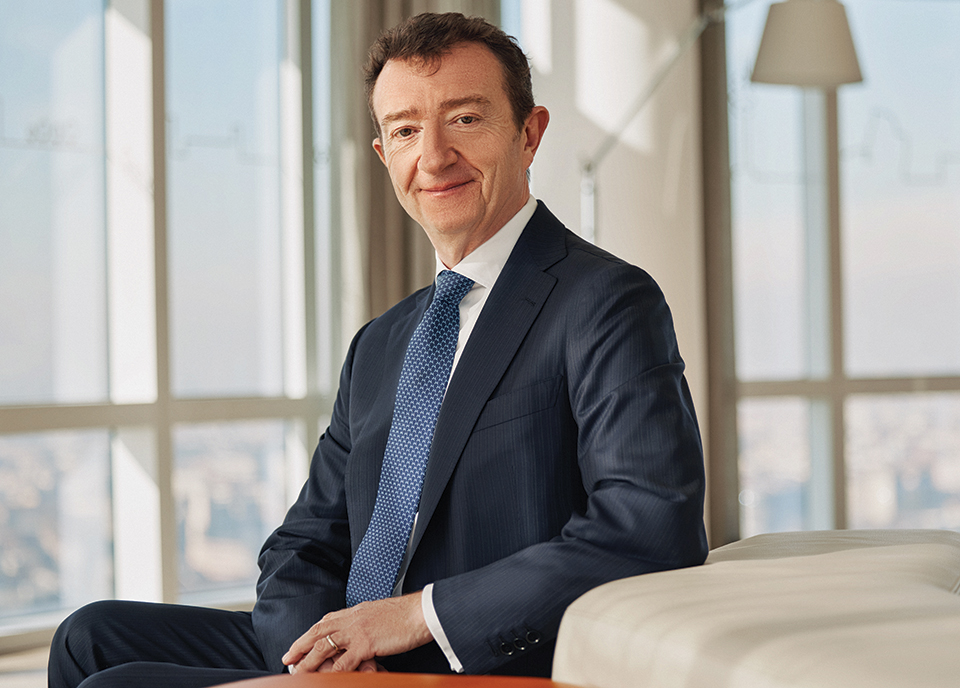
Being able to attract the best partners is part of the scale effect
Richard Burton, UniCredit
Hollinger points to better progress towards realizing group benefits in areas such as IT. Like any chief executive, Orcel attends some client meetings in Germany, but, she says, German client-specific decisions are her purview.
“Now the country-level bank can benefit from a group structure that has really come into practice,” says Hollinger. “On the other hand, we are fully empowered with regards to supporting clients in our local market. This balance makes us successful and is a great foundation for the group – and the good thing is that there’s a lot more we can do in the same direction.”
Richard Burton, previously head of corporate and investment banking, oversees UniCredit’s product factories as head of client solutions, a role Orcel created in 2021. He too says that the approach has been to decentralize client coverage, while centralizing sector and product expertise.
“Any single country might be able not on its own to justify investing in best-in-class industry advisory,” Burton explains. “By having 13 countries, we can afford to invest in best-in-class advisory, best-in-class products. A local competitor can’t compete with that, and because we’re deep in the country, we can reach mid-corporate clients that international banks miss.”
Burton says the principles are the same in insurance and asset management, where it can negotiate regional agreements with large global asset managers.
“Being able to attract the best partners is part of the scale effect,” he says.
The 2007 takeover of ABN Amro was a hostile deal. Today, in large part because the aftermath of that deal was so bad for RBS and Fortis, the extent to which investors are supportive of bank M&A remains questionable. BBVA’s shares fell sharply after it announced its initial bid for Sabadell.
Yet another problem for Orcel and other would-be consolidators is that potential bank acquirers and targets are so widely known and discussed in the press, especially in leak-happy Italy.
This creates a Catch-22 situation in which M&A becomes harder as soon as the market environment appears more receptive because the acquirers’ shares become relatively less valuable as acquisition currencies.
“There is an uncertain economic and geopolitical environment, which could obviously have an impact on banking franchises and their profitability,” says Orcel. “Secondly, because everyone knows the targets and the most likely buyers, all the speculators have taken a position. All the targets are out of alignment with their core values because there’s a merger premium. The buyers aren’t risking it. They’re waiting for valuations to align to where fundamentals dictate.”
Profitability at European banks, especially UniCredit, has risen sharply over the past two years, partly as the European Central Bank has ended its negative rates policy. This has increased the relevance for investors of price-to-earnings ratios, which remain relatively low (at eight times earnings for the European sector in mid June, according to research from Citi).
But, says Orcel, if the share price is fixed as part of an M&A deal, the price-to-earnings ratios would be higher if earnings fall next year after interest rate cuts.
“If you buy today, the integration happens in most cases by the first or second quarter of 2025. Acquiring banks are trying to guess: ‘What am I buying in 2025 and beyond?’ Because of the adjustment that’s expected as rates come down, you may be buying at seven times 2024 earnings, but it will be more like nine times 2025 earnings, with a premium on top.”
Even as price-to-earnings ratios have fallen, however, valuations are higher on a price-to-book basis. Shares in UniCredit and the sector have risen to about par. Previously, the prevailing discounts to book made deploying capital on share buybacks, rather than M&A, more convincing.
Orcel still gives plenty of arguments in favour of buybacks.
“If you’re confident with your earnings and capital generation trajectory and believe your shares are undervalued, people who love buybacks will ask what is better: do you buy your own shares, with no execution risk, bringing in an increase in earnings, and no premium? Or do you go out there and buy another bank, at a premium, when you don’t fully know what you’re buying?”
Nevertheless, there is a balance to be struck.
“Pushed to the extreme, doing buybacks all the time will push you to eventually go ex-growth. You’re buying, buying, buying, but your franchise remains the same and at some point, it is optimized as much as it can be.”
Before 2008, Lloyds TSB came close to this situation. It was highly profitable and had a high dividend yield, but its share price ended up trading like a bond, with no growth premium attached. Banks such as Santander and UniCredit, under Profumo, were at the opposite extreme – growing all the time, especially through M&A.
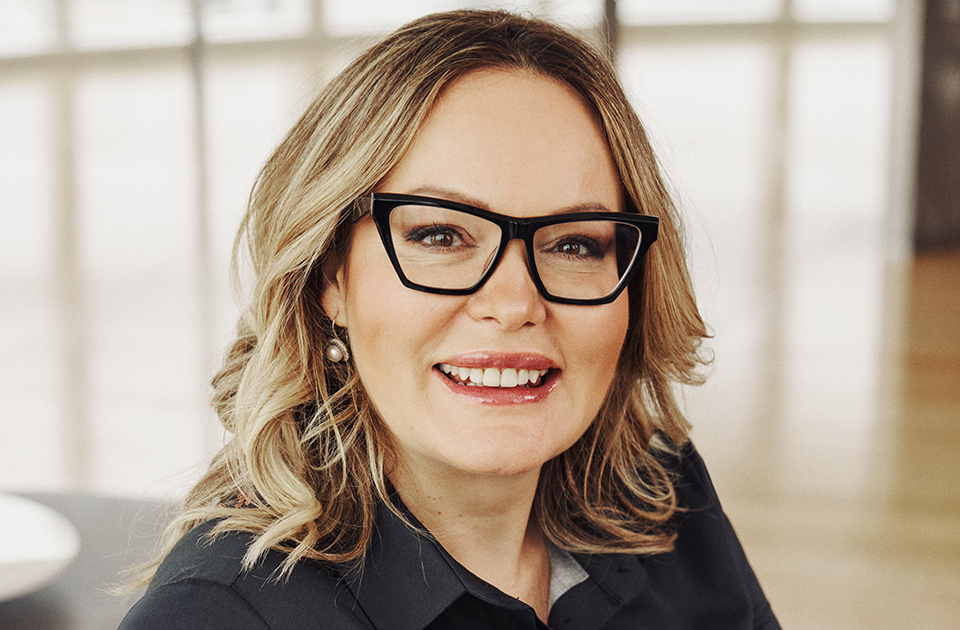
For us Romania was not an isolated case… In fact, more generally speaking, all the markets where we are present in CEE are undergoing some form of consolidation
Teodora Petkova, UniCredit
UniCredit seemed to be at risk of coming close to Lloyds under Mustier, who got so fed up with responding to questions about acquisitions (principally Commerzbank and Banca Monte dei Paschi di Siena) that he took up a “No M&A” mantra. That was another reason why the board pushed him out, after markets welcomed Intesa’s successful swoop on UBI.
“In my opinion, before you consider M&A, you need to look at what you have and ask yourself: ‘What can we do to make our business the best it can be?’ Because there is always a potential to make it better,” says Orcel. “In parallel, you need to look at whether, in your key markets and in some key segments, products or factories, there are things that you could buy that would enhance your value creation and allow you to grow further.”
Up to now, despite higher capital distributions, Orcel has kept the excess capital he found when he arrived at the bank, thanks to higher profits and by reworking its balance sheet – deploying risk-weighted assets differently and by using things like synthetic securitization.
“In our case, because we had a very inefficient deployment of capital, we can return 100% of net profit and still increase our CET1 [common equity tier-1] ratio,” he says.
But in the first-quarter results, Orcel underlined that the bank’s excess capital (€6.5 billion and growing, at the end of March) would be returned to shareholders via extraordinary capital distributions between now and 2027, unless he can find appropriate targets for M&A at the right terms.
Euromoney asks him where such deals are most likely.
Although he caveats that things always change, he says: “At the moment, the most likely are traditional banks in our key markets. It’s not one deal. The most likely is that we do several, let’s say, mid-sized deals.”
Italian roots
More deals in CEE are one possibility, particularly if it allows the bank to rebalance its regional business more towards retail. To that extent the Alpha Bank Romania deal could turn out to be a test case, allowing future deals to go faster, whether in Romania, Poland or elsewhere.
“For us, Romania was not an isolated case,” says Teodora Petkova, UniCredit’s head of central and eastern Europe. “In fact, more generally speaking, all the markets where we are present in CEE are undergoing some form of consolidation.”
Orcel hits back at short-term criticism
UniCredit’s share price dramatically outperformed arch-rival Intesa Sanpaolo in 2023 and continued to do so in the first half of 2024. Although Intesa still traded at a 25% premium to UniCredit in mid 2024, this has caused a degree of discomfort at Intesa, whose profitability and stock price performance vastly outperformed that of UniCredit for most of the post-2008 period.
Given this, it is unsurprising to hear some Intesa insiders cast doubt on UniCredit chief executive Andrea Orcel’s management – even if Intesa has also stepped-up share buybacks and made more use of techniques like synthetic securitization. Playing on wider criticism of his past as an investment banker, the most common claim is that UniCredit is merely stretching its balance sheet and profitability to maximize capital distributions in the short term.
“If you want to be a bank chief executive for many years like I’ve done, and you want to go on for many more years, you need to be clear that your company is not a cow to be milked,” Intesa’s chief executive Carlo Messina said this year in comments reported by Reuters, in what sounded like a veiled attack on UniCredit.
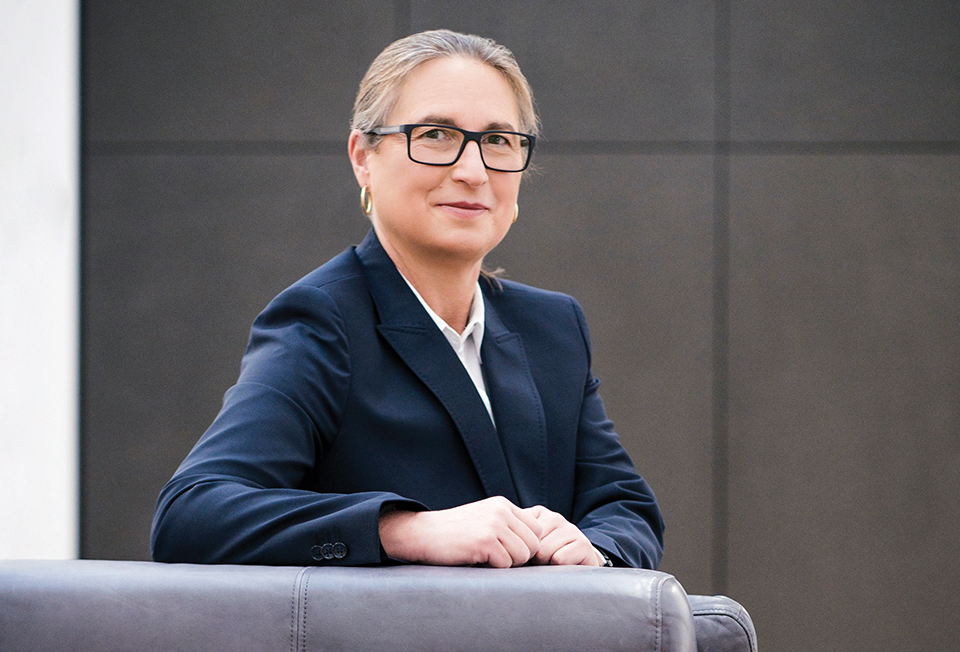
As there is less bureaucracy, it’s easier to do business with us
Marion Höllinger, HVB
Euromoney hears similar questions about technology, including how Orcel’s cuts to consultants might be affecting its digital transformation, although he has always said they were because it was outsourcing jobs it could do better internally.
“From an industrial point of view, you may be leaving your successors a legacy that is less good,” says one rival, discussing the tech platform.
Similar doubts come from Germany – where an efficiency drive has fuelled a dramatic reduction in HVB’s cost-to-income ratio – and on the acquisitions front.
“In the short term, the stock market is very happy if you distribute all your profit, you buy back shares and you don’t make investments, but it does not strengthen the company for the long term,” says a high-profile Milan banking source, who argues that Orcel should already have bought Banco BPM and Mediobanca.
Orcel is quick to reject these claims about short-termism. Other banks that had excess capital three years ago have already distributed all of it, unlike UniCredit.
On acquisitions, one of Orcel’s first actions as chief executive was to signal that UniCredit was removing the ‘no M&A’ mantra of predecessor Jean Pierre Mustier, despite initial market fears this would result in a value-destructive buying spree. He has also sought to partly reverse the asset sales that Mustier oversaw, such those as in asset management.
“In the last three years, we reduced €1.2 billion in costs, but we reinvested €800 million in new front-line hires, product factories and technology, as well as offsetting inflation,” he says. “In the next three years, we’re doing the same.”
Other executive board members tell a similar story of how the bank is investing in technology in areas like capital markets and transaction banking, while the efficiency drive has helped it streamline processes, reducing errors and allowing its staff to spend more time with clients.
“With 155 years of legacy, for sure there are efficiencies to be gained,” says Marion Höllinger, chief executive of HVB. “This has not affected the business negatively but rather positively. As there is less bureaucracy, it’s easier to do business with us.”
Already, most of UniCredit’s business is outside Italy – and that is core to its equity story. It is also a key differentiator with its Italian rival Intesa Sanpaolo, which is much bigger inside Italy.
UniCredit is “firmly pan-European with Italian roots,” as Orcel sees it.
Yet some of the bank’s excess-capital M&A war chest could go on Italy. Would this also most likely be a traditional bank?
Orcel won’t dismiss that possibility, and a bank seems most likely if UniCredit was to do a large deal in Italy, despite rumours two years ago of its interest in Italian insurer Generali. The bank could also do bolt-on deals in Italy in areas adjacent to banking such as payments or consumer finance.
The problem is that many businesses in these adjacent areas are either not for sale or trading at higher valuations than UniCredit. UniCredit’s exit under Mustier from the digital-focused Italian wealth manager Finecobank, for example, was among the moves that most enraged the former chief executive’s critics – along with the sale of a minority stake in Mediobanca, an Italian investment bank with a growing wealth-management business.
Fineco’s price-to-earnings ratio of around 14 times is about twice as high as that of UniCredit. However, UniCredit’s valuation is much closer to Azimut, an asset manager subject to takeover speculation and with which UniCredit already has a product partnership.
Many bankers in Italy still believe state-owned Monte dei Paschi di Sienna (MPS) remains the most likely large mid-tier bank in Italy to be bought in the coming years. Soon after he arrived, Orcel tentatively started and then soon backed out of talks with the Italian government to buy MPS, as he didn’t believe the terms could meet his pre-conditions. Investors have appeared sympathetic to this decision.
The 2020 arrival on UniCredit’s board of Pier Carlo Padoan, the former member of parliament for Siena and finance minister who oversaw MPS’s nationalization, precipitated Mustier’s departure and replacement by Orcel. Padoan secured a second three-year term as chair this year. He was not involved in the discussions on buying MPS, but says he has a strong relationship with his chief executive and was not disappointed by Orcel’s decision to pull out of the MPS talks in 2021.
“UniCredit’s financial results and performance in the stock market since 2021 are the clearest manifestation that the strategy is the right one, and this will continue,” Padoan tells Euromoney.
Orcel is clearly mindful to avoid ending up doing the wrong M&A deal by trying to game the local political environment. Acquisitions supported by the Italian government have not always resulted in stellar results for the acquirer, as UniCredit’s 2007 acquisition of Capitalia showed. Orcel, partly as a result, tends to limit his business trips to Rome.
Having grown up in Rome, he still has a soft spot for the city, yet Orcel spent most of his adult life in London.
“I am Italian,” he says. “I have an Italian passport, I speak the language and I’m from Rome, but I left when I was 21 and only came back when I was 58, so I have an international outlook.”