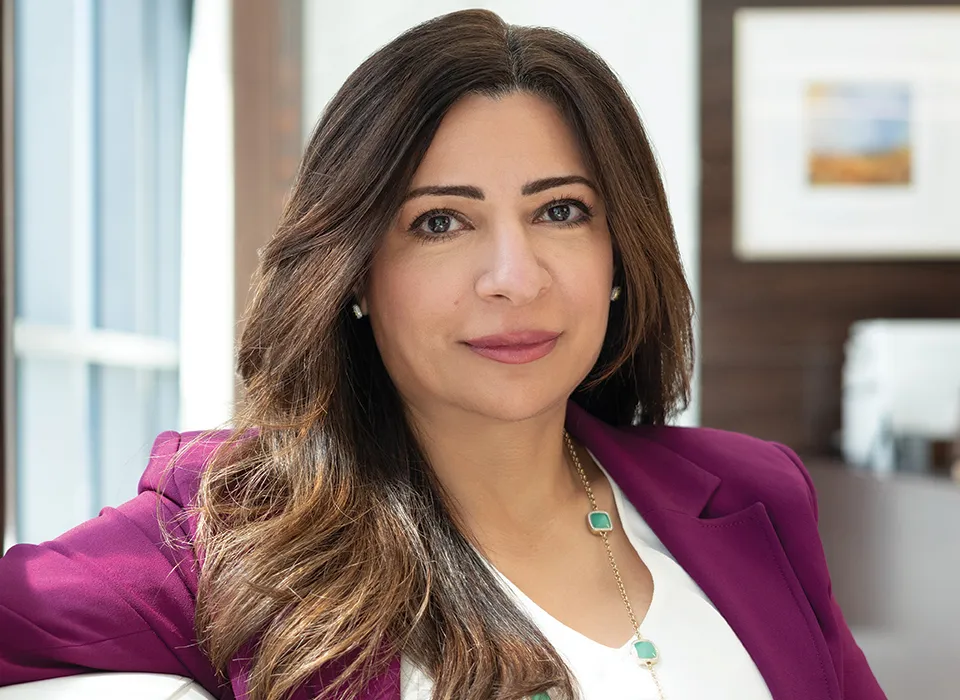

It was another stellar year for First Abu Dhabi Bank (FAB), under the continued leadership of group chief executive Hana Al Rostamani.
FAB posted net profit for the full year 2023 of $4.5 billion, up 56% year on year, on total revenues of $7.5 billion. The bank’s return on assets inched up to 1.4%, with margins also ticking up, and its return on tangible common equity also rising, from 15.7% in 2022 to 17.6% a year later.
FAB’s cost-to-income ratio fell sharply in 2023, coming in at 25.9%, against 31.6% in 2022. Operating income rose across the board, led by investment banking and corporate banking. It ranked number one in equity capital market and initial public offering deal volume in the full year 2023, according to data from Dealogic.
It was a year of firsts for the Abu Dhabi-based lender, the country’s largest lender by assets, and a key finance and trade gateway to the Middle East and North Africa.

In October 2023, it issued the largest ever tier-2 bond by a UAE lender, raising $1 billion and attracting a diversified and high-quality book, with 79% of orders emanating from outside the region. At a little under $3 billion, it was the largest book ever achieved by FAB. In June, the bank also priced a $600 million, five-year green bond that was 2.8 times oversubscribed.
A host of notable tie-ups were signed during the awards period. In January 2023, First Abu Dhabi Bank entered into a strategic joint venture with Abu Dhabi-based digital bank Wio, to offer the latter’s business customers cash and cheque facilities, via FAB’s ATM and cash deposit machine network.
In May, the bank joined forces with Saudi Arabia based fintech Geidea to deliver digital payment services to corporates across the Kingdom. FAB also signed memorandums of understanding with two UAE firms – Abu Dhabi-based renewable energy company Masdar and Dubai-based Blue Carbon – to accelerate the region’s carbon-trading market.
FAB was the first bank in the Gulf region to commit to a net-zero future
FAB is also emerging as a leader in transition finance. It was the first bank in the Gulf region to commit to a net-zero future. In December 2023, it pledged to provide more than $135 billion in green finance by 2030, raising its target by 80% – the single largest sustainable finance commitment made by any Middle East lender to date.
And in November, First Abu Dhabi Bank also expanded its global private banking offering, unveiling five new evergreen liquid private-market funds with the likes of Pimco, New York investment firm Muzinich & Co, and London-based asset manager Fasanara Capital. The funds give FAB’s wealthy clients access to diverse asset classes, including private credit, real-estate debt, corporate debt and private equity.