The decision by SoftBank, confirmed in statements to media at the start of March, to float UK technology company ARM only in the US rather than with a primary or even a dual listing on the London Stock Exchange (LSE) comes as a big disappointment to those desperate to pretend the City is not losing its status as a leading financial centre.
However, it was hardly a surprise.
Even after the great sell off in 2022, US investors still put higher valuations on technology stocks than do their UK and European peers. And ARM, a UK-headquartered semiconductor and software design company founded in Cambridge in 1990, has an unusual business of licensing its technologies to leading manufacturers of popular accessories such as mobile phones, smart TVs and iPads.
“This is an attractive model and it’s easy to see why the market would be excited to see shares in the company listed,” states Sophie Lund-Yates, lead equity analyst at UK retail broker Hargreaves Lansdown. “But for London, this comes as further confirmation that plans to rebrand the LSE as a high-growth tech haven aren’t working.”
… Plans to rebrand the LSE as a high-growth tech haven aren’t working
Sophie Lund-Yates, Hargreaves Lansdown

The sting felt all the sharper because a number of other companies already listed in London also confirmed in March their ambitions to shift trading in their shares away from what was once the capital of global finance but is now a financial centre in marked decline.
CRH, the Dublin-headquartered building materials company with a primary listing in London, revealed that in the coming weeks it will recommend to shareholders that it is in their best interests to pursue a primary listing in the US instead, together with US equity index inclusion, and to do so as soon as possible.
Partly, this reflects how insignificant the UK now looks as a market for goods and services as much as for capital.
CRH has made a series of acquisitions over recent years in the US, which now accounts for 75% of its pre-tax earnings. This will likely grow thanks to substantial increases in US infrastructure spending, a renewed drive for the onshoring of manufacturing and significant levels of under-building of homes.
Perhaps more troubling was sports betting company Flutter Entertainment’s confirmation that it too believes an additional US listing will yield long-term strategic and capital market benefits.
The company is known in the UK as the owner of Paddy Power and Betfair, but it also owns FanDuel in the US, which is now driving its growth. The company sees FanDuel eventually becoming its largest business by revenue and an ever-greater proportion of its overall value.
Flutter began evaluating an additional listing in the US after an investor day there in November 2022. Executives believe this will bring more than just access to a much deeper and sophisticated capital market. They also see it as a way to boost the company’s profile in the US among customers and to gain a currency for acquisitions as well as to recruit and retain US talent.
A dual listing may not be the end of it. The company is exploring the option of then shifting its primary listing to the US so as to be included in US indices and benefit not just from self-directed retail investor flows but also from tracker funds.
There are plenty other companies in the FTSE 100 which do business in the US that could easily follow Ferguson and CRH. That’s not a good look for the London Stock Exchange
Russ Mould, AJ Bell Photo: Matt Williams

That would see it drop out of the FTSE 100 UK index, which is full of mining, energy and financial stocks, many of which derive a majority of earnings outside the UK. The Financial Times even reported in February that Shell, the largest of these, had considered shifting to the US two years ago, hoping to secure a higher valuation.
“So much for making London the go-to place for companies to list their shares,” says Russ Mould, investment director at UK broker AJ Bell. “The London Stock Exchange is having to work overtime just to keep those already listed, let alone attract new ones.”
Mould points out that plumbing, heating and air conditioner group Ferguson took exactly the same decision as CRH, confirming the shift to a US primary listing with shareholder support in 2022, after selling its UK business Wolseley to a private equity group in 2021. Ferguson sees a big boost for its business coming from the US bringing semiconductor manufacturing back onshore.
“There are plenty other companies in the FTSE 100 which do business in the US that could easily follow Ferguson and CRH. That’s not a good look for the London Stock Exchange,” says Mould.
Loss of status
A lot has contributed to the decline of London as a financial centre, but much of it comes back to Brexit.
The UK is a $3 trillion economy. Putting itself outside the European Union’s $17 trillion economy makes it look like a minnow, unaligned either with its largest trading partner or with the even bigger $23 trillion US economy, let alone China’s $18 trillion economy.
This is a country still to find its feet following the decision to leave the EU taken almost seven years ago. Former prime minister Boris Johnson delivered an unworkable deal, with no chance for equivalence agreements over financial services, waving away the advice of City and corporate executives with his famously cheery motto “fuck business”.
… Just knowing that there is a domestic real money investor base that generally supports deals would be helpful
Tiina Lee, Deutsche Bank

The UK now has entrenched inflation, a timid central bank fearful of dealing with it, labour shortages, rolling strikes by public-sector workers and a recent record of political instability. And while London once stood apart from the UK economy as a financial centre for the whole of Europe and far beyond, it is suffering a similar loss of status.
“Overseas investors lost interest in the trading venue as soon as the UK voted in favour of Brexit, and valuations have got even cheaper,” Mould points out. “That’s hardly a good sales pitch to attract more big companies to the UK market.”
This is another reason why the ARM decision resonates. When SoftBank acquired the UK company in 2016, it suited chairman and chief executive Masayoshi Son to portray his deal as the first big bet on the post-Brexit UK. The UK’s ruling party was happy to go along with this story of a leading global technology investor unfazed by the leave vote and the UK still being open for business.
But then regulators got nervous at Son’s attempt to flip the business four years later to California-based Nvidia. The relisting of its shares is, like so many IPOs, the result of a failed trade sale. Son was clearly in no mood to sell it at a lower valuation in London just to appease UK sensitivities. Stories spread that the company and its owners had been seeking exemptions, for example on regulations over related-party deals with companies linked to directors.
If those stories are true, it is hard to see how losing this particular listing damages London. It may be a good one to see go elsewhere.
“I don’t know why ARM has generated so much controversy,” says Frederick Bouverat, a former IPO investment banker at Numis and now head of TPE, a fintech seeking to boost liquidity in private company stock. “It was listed in 1998. It has since been acquired. The shares are now being relisted. So what?
“Of much greater concern is making sure that the UK has a capital market fit to support the next generation of growth companies that are going to power the economy.”
But does it?
Digging into data
In the aftermath of the Truss/Kwarteng UK budget fiasco last September, a rapid sell off in government bonds brought segregated liability-driven investment funds that UK pension funds had invested heavily in to the brink of collapse.
This prompted Michael Tory, former Morgan Stanley banker and managing partner of boutique advisory firm Ondra, to dig into the data.
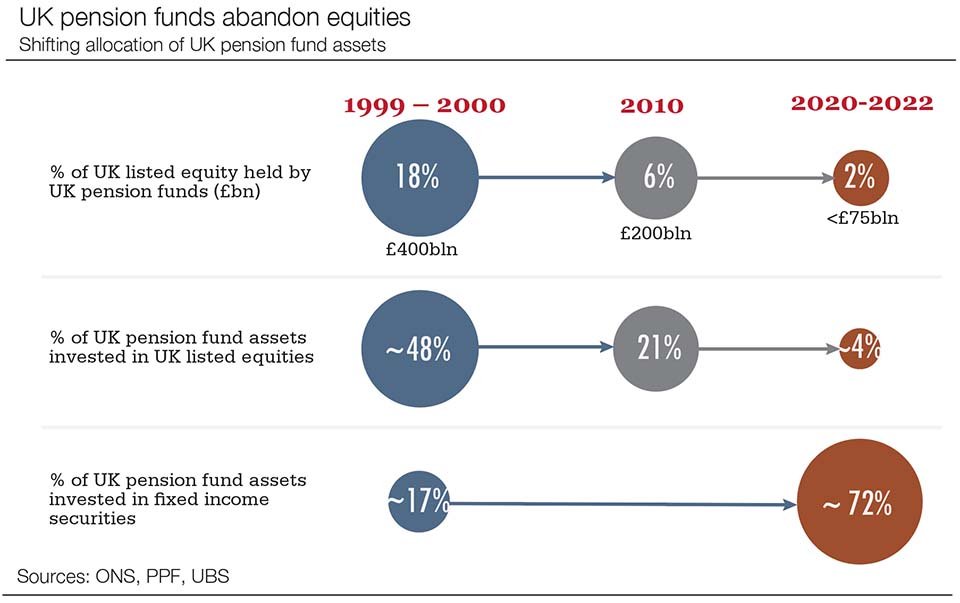
Ondra’s research went back far before Brexit and traces a 20-year liquidation by UK pension funds of their holdings in the domestic equity market.
In 1999 to 2000, just under half of UK pension fund assets, then totalling around £400 billion, were in listed UK equities. By 2010 that had fallen to 21% as pension funds reallocated into bonds. Come 2020 to 2022, a mere 4% of their funds were in UK stocks.
“I think that matters, not because domestic pension fund investors drive any particular IPO or secondary capital raise,” says Tiina Lee, UK chief executive of Deutsche Bank. “But rather just knowing that there is a domestic real money investor base that generally supports deals would be helpful. And this is a point we have made repeatedly to the government.”
The public markets in general need to ensure that they are not being used simply as the buyer of last resort and make being quoted fundamentally desirable once again
Frederick Bouverat, TPE

Another source tells Euromoney that the dark hidden secret is illiquidity in London, where not many stocks in the FTSE 100 see more than $40 million a day in secondary turnover. “A fund manager may like a company and do the work to understand a business, but if they can’t take an appropriately sized position in the stock because their risk management framework around liquidity and transaction cost analysis says ‘no’, then it is useless.”
The prime segment of the London stock exchange is simply the final level in a capital raising game that works up from angel and startup capital, through venture fundraising to scale companies and then late-stage private equity for crossover investors seeking to get in ahead of an IPO.
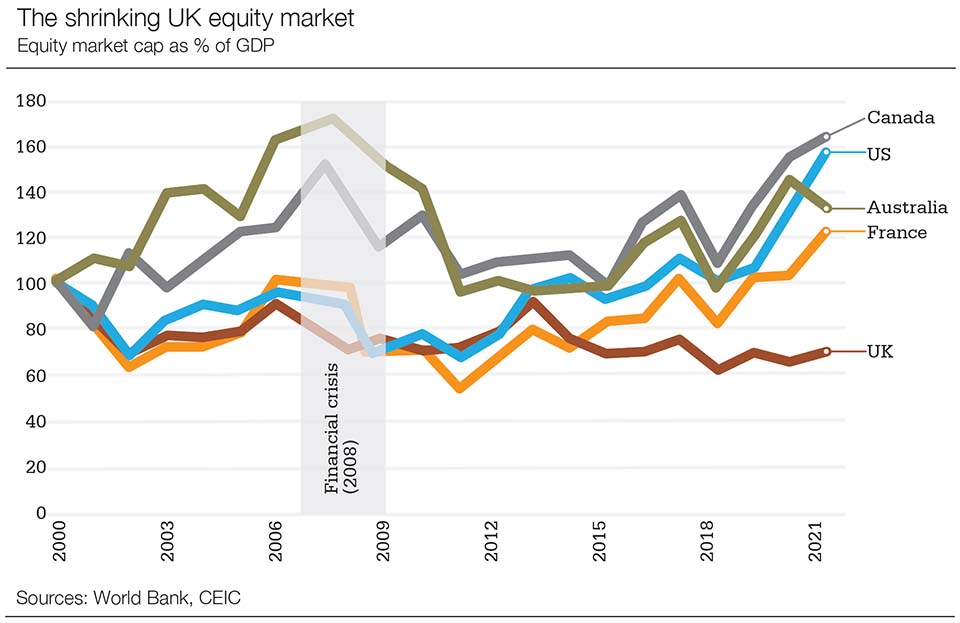
Ondra’s research rebases stock market capitalization as a percentage of GDP to 100 in the year 2000 and runs the data forward. All countries have seen leveraged take-privates over those two decades and large-scale mergers and acquisitions taking out many large listed companies. But in most countries new companies grow up to take their place in the lists.
By 2021 the rebased number for equity market cap as a percentage of GDP had climbed to 158 in the US, an even higher 164 in Canada, 133 in Australia and 121 in France. In the UK it had shrunk to 69.
“I believe that being a listed company has to some extent lost its lustre,” says Bouverat. “Capital availability in the private markets has led to companies remaining private for longer if not indefinitely. The public markets in general need to ensure that they are not being used simply as the buyer of last resort and make being quoted fundamentally desirable once again.”
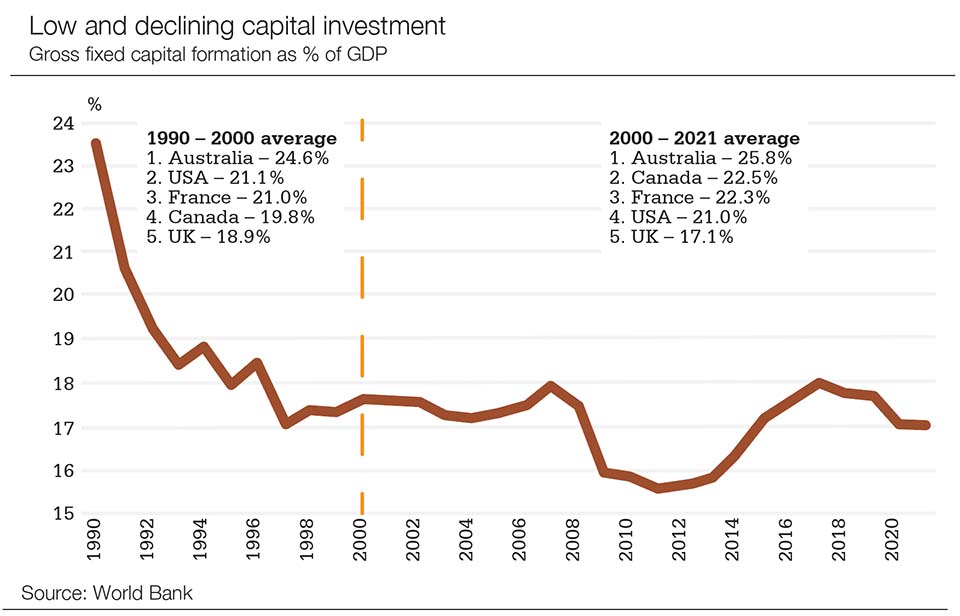
But even if the UK does have a deep private capital market, Ondra’s data shows that the UK also has a persistently low – and declining – level of capital investment compared with other countries over the same period. That entrenches low productivity.
Michael Tory headlined the think piece that went with this data ‘There is no capitalism without capital.’
Uncertainty leaks down from the top. The UK government is desperate to reclaim some bone of consolation from the carcass of its hard Brexit. Throwing off the bureaucracy of supposedly excessive EU financial regulation – most of it in fact written in the UK – was meant to be the easiest one to pick.
The Conservative government has told UK regulators that, as a secondary objective, it is going to require them to boost the competitive standing of the UK as a financial centre. This copies some other jurisdictions but comes with a threat from the UK government that it might overrule regulators.
Regulators have not welcomed this.
“A secondary objective takes the Financial Conduct Authority (FCA) and the Prudential Regulation Authority into new territory,” says Lee. “Their primary objective will remain financial stability, so striking the right balance between that and competitiveness will require care.”
Hoping something sticks
Reviews of the rules, first around primary listings in 2021, led by Lord Jonathan Hill, a former European commissioner for financial services, and then into secondary capital raising in 2022, led by Freshfields lawyer Mark Austin, have suggested all manner of possible reforms. A few that do not require legislation have already swiftly been enacted.
… The UK seems to be throwing a lot of stuff at the wall in the hope that something useful sticks
Jason Paltrowitz, OTC Markets

“Some of the reforms make sense, for example reducing the minimum free float requirement from 25% of a listed company’s market capitalization to 10%, which catches them up with other financial centres,” explains Jason Paltrowitz, executive vice president of corporate services at OTC Markets. “But as an outsider looking in, the UK seems to be throwing a lot of stuff at the wall in the hope that something useful sticks.
“A lot of things, some related to Brexit, have contributed to this malaise. If you are a growth company deciding where to list, where is the best secondary market for investment, for research and development, for innovation and for building a business, there are a lot of choices. The UK has put itself in a difficult position and there is a lot of money elsewhere.”
Mark Austin’s UK Secondary Capital Raising Review was published in July 2022. Some of its less controversial recommendations, for example around allowing larger non-preemptive capital raisings of up to 20% of a company’s market capitalization, are already in effect. This codifies a practice that was first allowed temporarily during the desperate dash for cash in the Covid spring of 2020 when the limit was raised from 10%.
Austin also recommends that companies should seek to preserve a degree of soft preemption and extend this even to retail shareholders by using new technology to make follow-on placements, normally sold only to institutional investors in a couple of days and at a discount to the secondary market price, available to all shareholders that may have stuck with a company through the cycle.
Retail investors don’t deserve to be diluted by hedge funds coming in for a quick flip at a discount to an already low valuation on cyclically low earnings – especially not now that technology exists to notify them of deals quickly, gather up orders and settle allocations. This can be done in days, even hours. It does not have to extend deals over a weekend with all the attendant market risk.
… There should be no, or at most very little, regulatory oversight of the secondary capital raising process by the FCA
Mark Austin, Freshfields

A big theme of the review is reducing regulatory involvement in secondary capital raising, for example by curtailing the requirement for companies to distribute new disclosures that may simply repeat what they have already published.
“As such there should be no, or at most very little, regulatory oversight of the secondary capital raising process by the FCA,” Austin wrote.
The most eye-catching suggestion is to raise the requirement for offering a prospectus to much larger transactions. Austin recommends a prospectus should only be required on a fundraise by a company in relation to admission to trading where the offer size is at least 75% of the existing share capital.
That’s quite a step change from 20% today. In December the European Commission proposed a similar change to prospectus regulation but one that would raise the size limit on deals not requiring a prospectus to 40% of a company’s capital from 20%.
“Punchy” is how one equity capital markets investment banker describes the 75% suggestion to Euromoney.
“Desperate” is another source’s characterization.
“That really looks like playing on the edge. Is that going to attract big companies to list in London ahead of a US market that is built entirely around transparency and disclosure? I don’t think it will. It may even drive some of them away and attract instead more questionable companies that might then hurt investors that buy their shares, so pushing London into a downward spiral.”
This source adds: “It’s not far away from giving in over restrictions against related-party dealing. For what it’s worth, my prediction is that the UK authorities are going to cave in.”
The whole dilemma for the UK government and for regulators is neatly captured in Austin’s review.
On the one hand it recommends that, as a matter of course, companies raising fresh equity capital in the UK should include retail investors. And that seems right, being both a fair way to protect them against dilution and, even if they are not a large source of capital straight away, potentially improving liquidity in some UK stocks that are on the edge of being orphaned.
On the other, it wants to do away with a lot of regulation intended to protect small investors.
PrimaryBid prominence
PrimaryBid has been building a business around easing retail inclusion in new equity offers ever since 2016 when it initially focused on small AIM-listed companies, raising £1 million to £3 million pounds at a time, of which retail buyers might chip in maybe £100,000 here, £300,000 there.
They would sign up for notifications of capital raises on PrimaryBid’s app and fund share purchases with their credit cards, maybe £1,000 at a time.
Bringing in £2.8 million on a £24 million capital raise for Sound Energy was an early highlight.
PrimaryBid rose to new prominence during Covid when companies became nervous about collapsing revenues during shutdowns and potential loan covenant breaches and set out to strengthen balance sheets with new equity in often large accelerated bookbuilds.
This is when the 10% limit on non-preemptive offers was increased to 20%.
PrimaryBid was brought in to run a retail tranche alongside a £2 billion institutional placement by FTSE 100 food group Compass in 2020. Freshfields was legal adviser to Compass and its lead partner on equity capital markets, Mark Austin, put PrimaryBid through the wringer to test its systems before recommending it to the company.
PrimaryBid also raised £37 million of retail demand for a £500 million capital raise by Taylor Wimpey and found itself chafing at the £8 million limit on retail participation in follow-on offers without a prospectus that stems from the European prospectus directive.
… We recognize our role as the first FTSE 250 company to raise capital under this new regime
Sally Lake, Beazley

This may soon be lifted by the UK government’s own prospectus review and in Europe too.
More recently, PrimaryBid has brought retail investors into IPOs and even block trades. As well as using its app, they can now access its service via the big retail brokers, lodging orders through their accounts at AJ Bell, Hargreaves Lansdown, interactive investor, Barclays, Fidelity, Halifax and others in the UK, as well as distribution partners in Europe.
PrimaryBid wants to work with these distributors and with the investment banks arranging deals and not compete with them. Retail investors can’t hold shares they buy through PrimaryBid with accounts at the company. They eventually must transfer them into investment accounts.
“We have always thought of what we do as fair inclusion for existing retail investors in new share offers, but this can also extend beyond existing shareholders to employees and even customers,” Anand Sambasivan, chief executive of PrimaryBid, tells Euromoney. “At the start, including retail was a novelty and some companies worried about potential regulatory liabilities from bringing them into placements. That has now completely changed and the potential regulatory issues today arise from not including retail.”
Following the Austin review, the UK’s preemption group incorporated many of the report’s recommendations into its principles. Last November, insurance company Beazley became the first listed UK company not only to include retail in a £350 million follow on but also to explain the process of how it had done so.
Sally Lake, CFO of Beazley, said at the time: “Delivering retail inclusion is part of Beazley’s ongoing commitment to strong corporate governance and we recognize our role as the first FTSE 250 company to raise capital under this new regime.”
The European head of equity capital markets at one global investment bank tells Euromoney: “We have used PrimaryBid on a number of transactions recently and its systems work well even on accelerated bookbuilds that are completed in hours and even when it is onboarded quite late in the process.”
Some initial caution still springs from companies being unfamiliar with the process.
“Many companies have quite a lot of retail shareholders and retail participation could increase above the current €8 million cap and become a useful new source of capital,” this banker continues. “It’s still early days and we’re not yet seeing a flood of retail demand that could influence the price and size of transactions. But we do see retail demand in excess of the cap on allocations and it could well evolve further.”
There’s no price tension yet between retail and long-only, sector-specialist institutional investors and no company is likely to launch a deal that depends on retail buyers. But retail could be a useful addition. The standard estimate is that some £300 billion in retail money for now sits in UK cash individual savings accounts (ISAs) earning next to nothing, with another £300 billion in stocks and shares ISAs; with more tucked away in very low-rate bank savings and deposit accounts and plenty in self-invested personal pensions.
“That’s quite a big pool of capital to tap into,” Sambasivan points out.
There are two issues here. First, this has been a tough period to buy equity as interest rates soar to contain inflation. Just because you can access a secondary offer or an IPO as a retail investor does not mean that it will work out for you. Retail investors that came through PrimaryBid into the IPO of Deliveroo may harbour regrets that they weren’t happy just to remain as customers.
Second, questions remain over whether regulators can make capital markets more flexible and easier to use, especially for growth companies that might want to raise a lot of equity in a cycle of raises, but still give retail investors the information they need to make an informed decision and the protections they deserve.
As well as increasing the limit for follow-ons without a prospectus to 75% of a company’s capital from 25%, Austin also recommends doing away with the requirement for a sponsor, typically a lead investment bank, to make any formal declaration of an issuer’s financial good health going into and after a capital raise, unless a secondary offer relates to a material transaction such as a large acquisition.
“Those two together are quite punchy,” says one ECM banker. “The market is quite used to sponsor declarations that provide good diligence. If we are moving to accelerated, non-preemptive, non-documented transactions that don’t have prospectuses, we must be thoughtful about investor protections.”
Retail investors could be caught both ways. Institutions will always have access to a corporate investor presentation for any deal and know of course that this is just the company selling its story within certain limits.
But if that counts as advertising to retail buyers and they cannot see even the investor deck, on what basis do they decide whether to buy new shares?
Austin’s report is 266 pages long. Can we boil it down to two words: caveat emptor?
Building the plumbing
“When they raise new equity, company managements must take a more active role now in investor allocations,” says Sambasivan. “The good news is that instead of presenting one big block of demand for retail as a whole, we can now go line by line in a granular way through retail orders, so companies can distinguish between existing retail shareholders, employees, customers and would-be new investors. We have built robust datasets to help companies include the retail stakeholders they want.”
When Membership Collective Group (MCG), owner of Soho House in London, launched its IPO in New York in 2021, PrimaryBid did the first retail offer for a UK company listing outside the UK. The company has since rebranded as Soho House.
“Soho House has a lot of members in the UK and it wanted to allow members to participate in the IPO,” says Sambasivan. “And we were able to run that digitally and in sync with their US IPO process. It is our blueprint for other US listings wanting to include retail investors in the UK.”
Unfortunately for investors that did get in, MCG priced its IPO at $14 and the shares now trade at $6.46.
Still, consumer facing business may be able to do a lot more in future with rapid processing of low-value payments around purchases of goods and services, rewards and sometimes stock ownership.
PrimaryBid continues to build the plumbing to enable all this. In January, it entered into a collaboration with Winterflood, a pioneer of electronic secondary equity trading in the UK, to further expand retail participation in new issues. Together the two firms will offer application programming interface (API) integration to any stockbroker or wealth manager wishing to distribute primary market deals to retail investors, building on a UK trading network that currently pools secondary market retail liquidity.
US gateway
The competition with New York looks unwinnable. But there may be one way for UK and other European companies to gain the advantages of having US investors in their share registers without going through the expense and trouble of listing on large US exchanges, submitting to all the disclosure requirements and exposing senior executives to the strictures of Sarbanes-Oxley.
That way is to get their shares quoted on OTC Markets, a Securities and Exchange Commission and Financial Industry Regulatory Authority-regulated alternative trading system where 90 broker dealers, including leading electronic market makers like Citadel Securities, GTS, Jane Street, StoneX, Susquehanna/G1X and Virtu, display quotes in the ordinary shares and or American depositary receipts of leading non-US companies.
Adidas, BNP Paribas, Heineken, LVMH, Nestlé, Roche and Siemens are all quoted on OTC Markets. So too are easyJet, Marks & Spencer, J Sainsbury and Tate & Lyle.
“I would argue that for the London Stock Exchange, OTC Markets Group is the best defence in town, because for a UK company that sees an undervaluation and wants to diversify its shareholder base to resolve that, being quoted on the OTC Markets is a way to attract US investors without a dual listing that would split liquidity. In fact, it leaves most of the secondary turnover in the home market,” says Paltrowitz.
One thing is clear to me: as and when the IPO market returns, thoughtful data-led inclusion of retail investors is going to be a core part of the proposition
Anand Sambasivan, PrimaryBid

Of course, he is talking his own book and says that the pipeline of foreign companies aiming to be quoted on OTC Markets in the US is strong. The firm has had conversations with the London Stock Exchange about ways to encourage companies with primary listings in the UK and that may be looking elsewhere.
However, he says: “London has traditionally not been particularly receptive. Many non-US exchanges are fearful of their best companies seeking dual listing and may not distinguish what we do from the NYSE and Nasdaq, which really are competing for listings.
“Other foreign exchanges get it though. We are doing a number of events with exchanges across Europe. And some of the corporate advisory firms, for example in France, also get it and see OTC Markets as a valuable next step for their listed corporate clients. Some of the Nordic advisory firms understand it too.”
It sounds like almost everywhere gets this idea except London.
And it could be the same with retail involvement in new issues as a means to open up a wider pool of new capital for companies and improved secondary market liquidity.
In March, Blackstone at the last minute bought PrimaryBid into a block trade in its shares of the London Stock Exchange Group itself, which was handled by Goldman Sachs, Morgan Stanley, Citi and Barclays.
“We’d been talking to Blackstone and other sponsors for some time on the topic of blocks, both about the governance implications of executing deals in an inclusive way and the beneficial effects of retail involvement on liquidity and diversifying the shareholder base,” says Sambasivan. “We were delighted this was the transaction they decided to bring us in.”
It is the first time retail has participated in a block trade sell down in a FTSE 100 stock and yet another signal of the growing importance of retail.
But the UK has no lock on this.
“France has a mandatory retail allocation on IPOs and when we spoke to Euronext about doing the same for follow-ons as well, they got it very quickly,” says Sambasivan. “We have arrangements with leading retail brokers and have done deals for well-followed companies in healthcare and semiconductors, accounting for 10% to 20% of these transactions. On the day the European Commission proposed changes to the regulations that limit retail participation to €8 million of a capital raise, we breached that with retail demand on one French deal. The issuers love it and are approaching us directly.”
Sambasivan has spent a lot of time in the US recently talking to underwriting banks and future issuers. “One thing is clear to me: as and when the IPO market returns, thoughtful data-led inclusion of retail investors is going to be a core part of the proposition. Companies want better ways to include their stakeholders at IPO and beyond.”
Deal arrangers just want to raise capital for corporate clients wherever is best. Advisers want to put their investors into good investments so they come back for more.
This looks like a race where London is falling further back into the pack it once led.
Peel Hunt collaborates on retail liquidity platform RetailBook
PrimaryBid is not alone.
In February, Peel Hunt, a UK investment bank that covers mid-cap and small-cap companies, announced that it will move its retail liquidity platform, known as REX, into a standalone independent business called RetailBook, which will pursue much the same business as PrimaryBid.
RetailBook will benefit from collaboration agreements with wealth manager Hargreaves Lansdown, investment banks Jefferies and Numis and equity capital markets advisory company Rothschild & Co to enable retail investors to participate in follow-on equity offerings and IPOs.

The group said at the time that it had worked on nine such follow-on deals since August 2022 led by investment banks such as Jefferies, Citi and Stifel, raising £450 million of retail demand though just £7.5 million of allocations.
Rather than running its own API, RetailBook will work exclusively with other brokers. It comes with a secondary retail liquidity platform that has grown share in a business once dominated by Winterflood, expanding from 600 instruments covered in 2015 to 2,000 equities in the UK alone and 11,000 across all markets.
“We assess that the pool of retail capital in the UK is over £1 trillion and that is going in one direction only,” Aaqib Mirza, chief technology officer at Peel Hunt, tells Euromoney. “If you examine companies’ share registers there is often a high level of retail ownership, we’ve seen anything up to 50%, especially for smaller AIM companies, which are some of the reasons why the government-commissioned Secondary Capital Raising Review last year recommended that companies give due consideration to the inclusion of retail in all fundraisings.”
Collaboration
This was not a business the firm decided it could build on its own, hence the decision to collaborate with Hargreaves Lansdown and the other firms. The burden of going direct to consumer, onboarding retail investors and managing their funds is considerable.
“We first took the idea of including retail in IPOs and follow-ons to other investment banks back in 2015,” he recalls. “But it wasn’t even on their radar. They didn’t see the evolution of retail coming in the same way we saw it and felt dealing with retail was too cumbersome and too high risk.”
Mirza adds: “The €8 million cap was also good reason not to give retail due regard. But that will hopefully be removed or increased in the not-too-distant future and that could be very significant in a country like the UK where retail investors account for 12% of UK PLC.”
There was also resistance at some smaller investment banks to giving Peel Hunt access to their corporate clients: hence the creation of an independent business. One day, this may look like an industry utility to investment banks wanting to include retail and that don’t want to go to the expense of building their own retail coverage.
Change is now coming fast. The familiar language of institutional equity capital markets is being applied to retail.
“We want to make it look and feel as much like an institutional order as possible. For issuers, while you cannot wall-cross one million retail accounts to gauge the scale and price sensitivity of demand, we can work with issuers to analyze their share registers and wall cross the most relevant retail intermediaries,” says Mirza.
Following launch, the retail investors that are customers of participating intermediaries then get a notification that there’s a new share offer by a company they are already a shareholder of. “From then, we are collating orders from intermediaries and building the retail book,” says Mirza.
How big could retail demand become? “If the ARM IPO goes ahead in New York only, there is a still a way to include a UK retail offer, which in our view would easily generate retail demand in the hundreds of millions of pounds,” says Mirza.
Sadly, for UK prime minister Rishi Sunak, the IPO isn’t going to be in the company’s home market and retail demand will always be much stronger in the US. Not a single person Euromoney talked to for this story, including the many who asked not to be quoted, see any prospect of a meme stock craze in the UK.
Could getting it right on retail give the UK any kind of advantage as a capital market? “It could be a huge opportunity for the UK to distinguish itself from Europe,” Mirza suggests.