Even as a low-level legal war breaks out between US regulators and crypto companies – with the SEC alleging much of crypto constitutes unregistered securities while some big crypto exchanges countersue and threaten to quit the US – regulated financial institutions continue to invest in blockchain.
On May 9, BNP Paribas and Goldman Sachs emerged as partners in Canton Network, a new consortium also including the Cboe, Deutsche Börse, an array of blockchain companies, such as Digital Asset, leading technology companies, including Microsoft, as well as venture capital investors.
The aim is to address the familiar problem of interoperability. Innovators have built, somewhat haphazardly, a whole series of potentially useful pieces of blockchain kit. But unless they all connect, they achieve next to nothing.
The Canton Network says it will provide a decentralized infrastructure that connects independent applications built with Daml, Digital Asset’s smart-contract language, to create a ‘network of networks’, allowing previously siloed systems to interoperate with the appropriate governance, privacy, permissioning and other controls required for highly regulated industries.
Trade-off
There is a trade off in all efforts to put conventional finance on blockchain between the drive for scale on open public blockchains and the need to maintain control inside banks’ own private permissioned blockchains that comply with real-world regulation.
This tension has tripped up the enthusiasts who seven or more years ago claimed blockchain as the new rails for wholesale finance.
The idea that Canton Network is somehow creating demand for adoption isn’t especially compelling
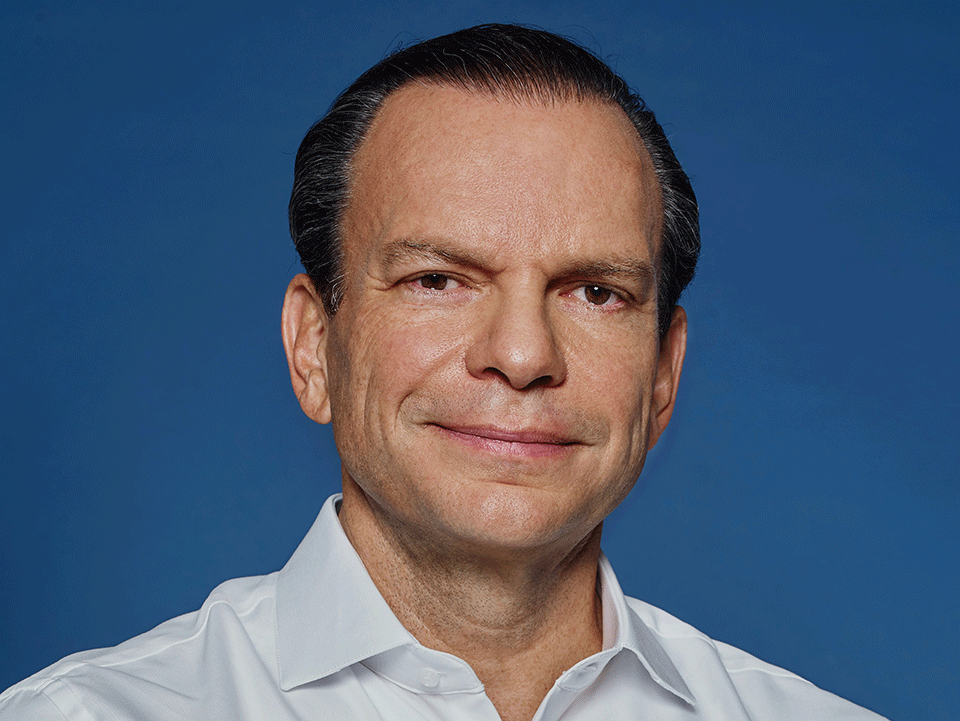
Philipp Pieper, Swarm Markets

One source at a bank not in the Canton Network tells Euromoney: “Back in the days of the ICO [initial coin offering] boom, it looked to some banks as if everything would soon go on blockchain. But tech firms are internally focused. If they don’t like code; they change it. Banks face an external framework set by regulators.”
And there is little point innovating inside walled gardens if hardly anyone visits them.
This source continues: “It’s not that the outcome with blockchain has been poor, more that it hasn’t met expectations.”
Some still hope it might.
The founders point out that, for example, asset registers and cash payment systems are distinct and siloed. With the Canton Network, in theory, a digital bond and a digital payment might be composed across two separate applications into a single atomic transaction, guaranteeing simultaneous exchange without operational risk.
Likewise, a digital asset could be used in a collateralized financial transaction via connection to a repo or leveraged-loan application.
“At Cboe, we believe the tokenization of real-world assets may offer an unprecedented opportunity to create new market infrastructure and drive efficiency in the trading of products across the globe,” states Cathy Clay, executive vice-president, global digital and data solutions, at Cboe Global Markets. “Efforts like the Canton Network will help our industry further explore this frontier.”
Time will tell. But those outside the network are not rushing to embrace it.
“With a venerable list of participants, it might be easy to conclude it is one to mark as a winner,” says Philipp Pieper, co-founder of Swarm Markets.
No guarantees
But broader adoption beyond the founding members is not guaranteed.
Pieper points out: “Major networks are already meeting scale and adoption requirements, but these big institutions seem keen on providing something proprietary instead of subscribing to what is already available. Protocols like Swarm prove that permissionless networks employed with access control built into smart contracts can satisfy compliance requirements.”
He adds that blockchains such as Ethereum or Polygon work because they’re open access and already host myriad use cases. “So, the idea that Canton Network is somehow creating demand for adoption isn’t especially compelling.”
It is lack of regulation that is holding back crypto adoption in mainstream finance.
One theory is that the regulatory crackdown in the US is designed to drive out the crypto natives to leave behind only the regulated incumbents and that only when that is done will regulators offer a framework that encourages tokenization of conventional finance.