Few nations have had a more eventful 15 years economically than Greece. More or less consistently since 2007 it has suffered both international crises with profound impacts on the country’s finances and debt crises all of its own.
Growthfund, a sovereign wealth vehicle established as Hellenic Corporation of Assets and Participations (HCAP), is in some sense a mirror and response to these times, having been formed in 2016 during the third economic adjustment programme of the Greek debt crisis.
In the eight years before its launch, Greek GDP had dropped by a quarter while unemployment had risen by the same amount, bad debts were up by half and Greece’s sustainability as a eurozone nation had been in doubt throughout.
Listen to Chris Wright interview Gregory Dimitriadis here

Growthfund, as it became officially known this year, was set up to encourage state-owned enterprise (SOE) reform, but it also has a broader overall ambition: to bring financial stability, good governance and professionalism to the whole institutional idea of Greece. A big job.
But it is an interesting time to be talking to the fund because all of a sudden – and if only in a contrarian investment sense – Greece is sexy. The sovereign vehicles of Saudi Arabia and the UAE can be found bouncing around Athens looking for investments. The invasion of Ukraine has given the country a chance to redefine its positioning in geopolitics, with the shift towards liquefied natural gas particularly advantageous for its Alexandroupolis port.
“Greece is trying to use the opportunity offered by the Ukrainian conflict to enhance its position in the regional security architecture in the making, to secure its interests,” noted Fondation Méditerranéenne d’Études Stratégiques, an independent research institute.
Against this backdrop, Growthfund announced a new strategic plan for 2022 to 2024 at the end of June that is important in two respects. One is a statement of targets that speak of growth rather than just keeping a ship afloat: a net asset value increase of 15% accompanied by a 15% reduction in carbon emissions.
The other is a pivot away from simply reforming existing enterprises to a commitment to become an active investor in the Greek economy.
There is also another target, which tells its own story: a commitment to “increase citizens’ trust by 40% compared to the 2021 baseline values” based on an annual research study. Trust in Greek institutions has long been in short supply and must be earned.
Reaching potential
Gregory Dimitriadis has a diverse CV, which embraces everything from US telco Level 3 Communications to a stint in the army, but the bulk of his career has been in Greek institutions.
He spent three years as a special adviser to the minister for development and competitiveness in the aftermath of the global financial crisis. He was chief executive of the Athens Urban Transport Organization, an SOE that serves greater Athens, chairman of Enterprise Greece, another SOE, secretary general at the ministry of foreign affairs and, since 2021, chief executive of Growthfund (then HCAP).
“We want to be active shareholders,” he tells Euromoney. “The state-owned enterprises that we have in our portfolio are companies that, until very recently, belonged directly to the state.
“So they had all the bureaucracy and the rules that apparently didn’t make them reach their potential, to say the least. Some were operating OK, but overall they didn’t have the impact that we would expect them to have. That is something that we have to help them to change.”

The portfolio covers a wide range of sectors: energy and utilities, transportation and infrastructure, real estate, food and supply, technology and postal services. Within those divisions are some very large entities, including: Eydap, the water utility for metropolitan Athens; Transport for Athens; and Elta, or Hellenic Post, one of the oldest postal services in the world.
One gets a sense of the task at hand from the fact that the airport segment – just one of several elements of the transportation and infrastructure segment – constitutes 23 regional airports. There are salt works, canal operators, railway rolling stock, food logistics; everything, in fact, except banks, which are covered by the Hellenic Financial Stability Fund (HFSF).
(Technically, HFSF, which contributes to the stability of the Greek banking system for the sake of the public interest, is a subsidiary of Growthfund, but in practice the decisions about it are made elsewhere.)
“Each one of them are in different industries, different parts of the Greek market; some are B2C, others B2B,” says Dimitriadis. “But they are important in the whole Greek economy. If we modernize, then we will have a very positive impact and also be able to engage with the private sector in a better way.”
There are some needs in common: the fund wants all of its underlying SOE holdings to adhere to OECD-standard corporate governance codes. Then there are key performance indicators for each of the holdings, with monitoring against those indicators.
“There are six different industries and 18 enterprises,” Dimitraidis says. “It sounds a lot, but at the same time there is a growth opportunity for each one of the companies.”
As a wealth fund, we are not looking for the next quarter… we’re looking for the next generation
Gregory Dimitriadis, Growthfund
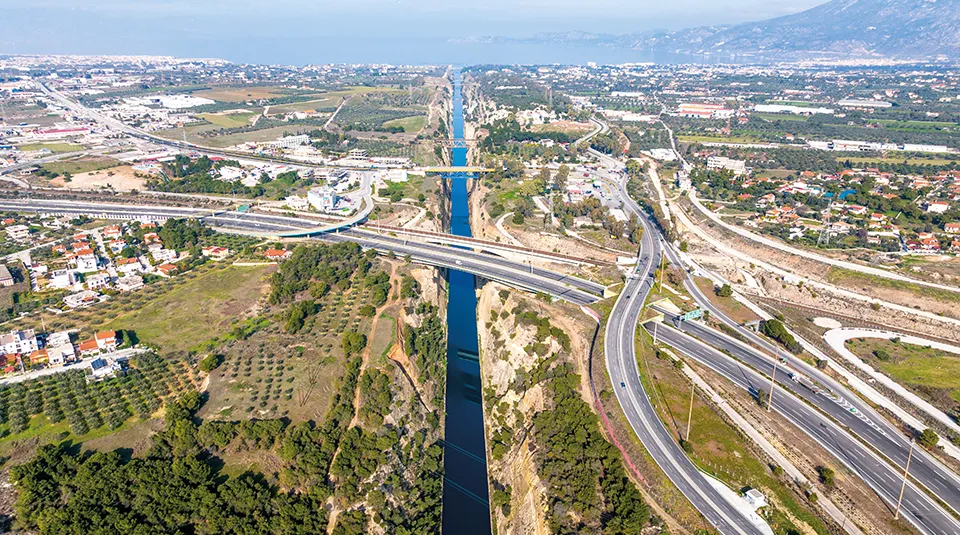
Asked for an example of what the fund is trying to do, Dimitriadis turns to an icon: the Corinth Canal, the 130-year-old artificial waterway that connects the Ionian and Aegean Seas, separating the Peloponnese peninsula from the Greek mainland. Photogenic and famous, it is actually little-used in commerce because it isn’t wide enough and is used chiefly for tourism, and even then only for small recreational craft. Worse, it has a tendency to crumble.
The canal is managed by a state-owned company called AEDIK, which falls under Growthfund’s purview. The canal was closed in 2021 following a landslide, meaning the company’s largest source of income was gone.
“The only thing this company was doing was to collect tolls,” says Dimitriadis.
It conducted very basic maintenance on the canal as part of its mandate.
“Now, the idea here is to change it completely as a business model because the company does not just have the canal, but it also has the real estate on both banks.”
Growthfund has invested in the business in cooperation with the private sector to maintain the canal and improve safety. It plans to develop real estate linked to it, including marinas at the ends, so that “it makes it more than just a crossing, but a destination you want to go and visit.”
At the same time the fund has brought digital technology to ticketing, nothing particularly revolutionary, “but it is basic steps that allow all these companies to improve,” says Dimitriadis. “For some companies, they will stay in the business line they do, but we have to improve how they do it. And some others will have to change their business model completely.”
Some, he thinks, can be left alone, like Athens Airport; others will need considerable surgery.
In this respect the fund most closely resembles Malaysia’s Khazanah: a steward entrusted with improving the companies under its purview for the greater good. But if Khazanah has learned anything from this mandate, it is that it takes patience and that every company is different. There might be a few principles in common between rebuilding a telco and an airline but not that many.
Real estate
One highly distinctive aspect of the Growthfund portfolio is just how much real estate is in it, accounting for about 31% of the asset base and covering 77,000 individual property titles.
Around the world, sovereign wealth funds are striving to find real estate, a reliable yield-generating tangible asset at an uncertain time. Growthfund has it in abundance, most of it through a public properties company called ETAD, but its quality varies dramatically.
Even getting a handle on all of this is a challenge, so the fund began a pilot programme this year to evaluate 1,000 of the properties, in two batches of 500, and map them out, “to update their value, see if they have any legal or technical issues in order to improve them, and then be able to present it to the market in order to be utilized,” says Dimitriadis.
The idea is to partner with the private sector here and gradually assess all 70,000 properties, “identifying what you have, making a segmentation and then making good use of it.”
A request for proposal is in progress for the first 500 real estate assets.
There is likely some great stuff in the portfolio, whether through ETAD or the real estate holdings of other state-owned enterprises.
“Some of it has great locations in Greece,” says Dimitriadis. “It can be great opportunities for touristic development, industrial development and so on. The important thing for us is to have a good idea of the opportunity potential.”
The next step is for Growthfund also to become an investor. Under its latest strategic plan it will make €50 million of direct investment a year into the Greek economy until 2024, then reevaluate its progress.
“This is something we are mobilizing now,” says Dimitriadis. “We are building the capacity internally to be able to manage investments.”
A chief risk officer, Michael Oratis, whose previous positions include risk and treasury roles at the National Bank of Greece and ABN Amro, was hired in February. An investment officer will follow and an international consultant – Berg Capital Management – has been appointed to build processes and structures.
Dimitriadis presents this as part of a journey to becoming a public wealth fund.
Also, the idea is that by co-investing with others, “the Growthfund can be an enabler for investments as well.”
This is an increasingly commonplace mandate for sovereign vehicles today: to be a reliable and trusted investor around which international investors can gather.
The idea is “not just to manage but to enable and bring what is I think a unique advantage for an investor,” Dimitriadis says. That is, co-investors can look at Growthfund and find “a state part, which gives you some stability and security, but since the management and the whole team is professional and non-political, it gives investors someone they can talk to and at the same time have continuity beyond political cycles.”
Next generation
Growthfund is independent from the government insofar as it is a distinct legal entity, but it has a sole shareholder and that is the Greek state represented by the ministry of finance. Nevertheless, Dimitriadis says the fund is independent in its decision-making process and has a supervisory board that is there to ensure that corporate governance is followed.
“It is not there to ask if we take the right decision or not but to monitor that we follow due process,” Dimitriadis says.
The board is made up of three Greeks and two non-Greeks.
The ministry of finance gives strategic guidelines, and from them Growthfund builds its own strategic plan, generally in four-year chunks, which in turn must be approved by the Greek state. “Which is a good thing,” Dimitriadis says, because it shows “the government is backing the reforms and the targets that we are setting.
“We are not something out of touch with reality, but we preserve our decision-making process beyond everyday political situations that might arise.”
In any event, foreign capital appears to be interested, in particular that originating from the Gulf. Saudi Arabia’s Public Investment Fund (PIF) and the UAE’s ADQ have both been looking around and, when we speak, the rumour is that PIF is going to take a stake in National Bank of Greece – PIF declined to comment.
Saudi Arabia’s crown prince, Mohammed bin Salman, started his first European trip in four years in Greece in July, signing a number of bilateral agreements and discussing making Greece a bridge of sorts for electricity transmission from the Middle East to Europe.
We are not something out of touch with reality, but we preserve our decision-making process beyond everyday political situations that might arise
Gregory Dimitriadis, Growthfund
One interesting ambition for the fund is around sustainability. It is in a powerful position to make a change – which is another way of saying it holds a lot of big emitters.
“All together in our portfolio, we’re responsible for 25% of total emissions in Greece,” says Dimitriadis. “This is a big responsibility for us that we’ll have to manage.
“As a wealth fund, we are not looking for the next quarter, we’re looking for the next generation. So it is very important that we build something that is sustainable, that serves the citizens and the people not just now but for many years.”
But how? How do you grow the portfolio value by 15% while cutting emissions by 15%?
There was a time when this would have been impossible, but Dimitriadis argues things have changed: “It used to be a perception that if you want to become green and sustainable, you’ll just lose money because it’s easy to pollute and make money.”
Now, he argues, the very act of improving the value of assets under management ought to involve a reduction in emissions by changing the nature of the businesses themselves. The public power company, in which Growthfund has a 34% stake, has, Dimitriadis says, the most ambitious decarbonization plan in Europe.
This is partly what it should do as a good citizen, but it is also a matter of long-term survival if it wants to attract international investors.
A group of international advisers, led by environmental, social and governance specialists Earth Active, was appointed to Growthfund in August.
Looking up
All of Growthfund’s ambitions are playing out against a backdrop of global economic turmoil.
“I think that everybody has learned that we have to adapt to extreme circumstances,” Dimitriadis says. The energy crisis affects earnings and expenses across the portfolio, and so does inflation. “At the same time, these cannot act as an excuse that we will slow down our reforms.”
And then there’s the matter of what this means for Greece, a country that has been through so much economically in a debt crisis that dates back more than a decade and has arguably never quite ceased.
Things are looking up compared with the dark days of 2012 and 2015. In August, the EU ended its so-called enhanced surveillance of Greek economic and fiscal policies, supervision that lasted 12 years. Greece repaid its IMF credits two years ahead of deadline in April. The IMF’s latest full report on Greece, announced in June, speaks of progress in reforms in digitalization, privatization, fiscal policy mix and bank balance-sheet repair; it predicted 3.5% growth in 2022 and applauded the downward trajectory in public debt.
But disruption is never far away and the global environment really doesn’t help a country finding its feet. OECD expects recovery to slow through the remainder of 2022, even if domestic progress will partly offset global pressures.
How important is it to have an instrument of financial stability and reform in Greece today?
“It is essential. It is one of the main reasons we were created,” says Dimitriadis, who argues that the mandate of stewardship “is what contributes to the financial stability of Greece. And that’s why we want to establish ourselves as an institution which is like the Bank of Greece: a pillar of stability for the overall system.
“Greece had a very difficult time over the previous decade,” he says. “I think that we have gone beyond that in the last few years. Greece has not just much better growth results but growth potential.”
And this brings us to local trust: that the fund must also earn the confidence of the Greek population that it is going to be a well-run fund for the nation.
“I think this is what was missing from Greece,” says Dimitriadis.