DBS plans to launch its own digital exchange, thought to be the first to be built and owned by a leading bank.
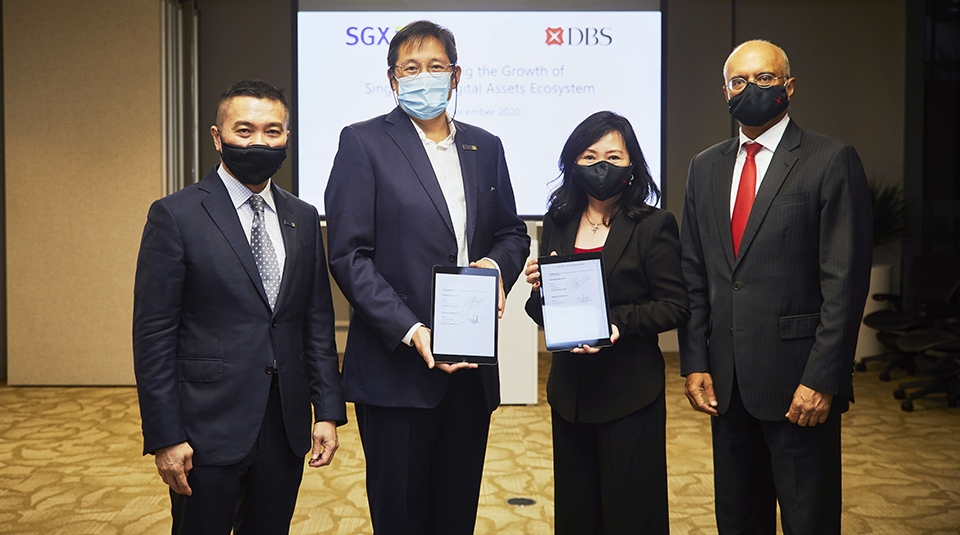
Singapore Exchange (SGX), which runs the country’s stock exchange, will hold a 10% stake in the venture and will work with it on developing its liquidity and scale.
“We are, to the best of my knowledge, the first bank in the world to put together an integrated offering in the tokenized asset space,” said Piyush Gupta, chief executive of DBS, at the launch.
The new venture, called DBS Digital Exchange, will have three components to it. One is a regulated platform for the issuance and trading of digital tokens backed by financial assets that are not already found on public markets, such as shares in unlisted companies, bonds and private equity funds.
The second is a cryptocurrency trading exchange that will allow for spot exchanges from fiat currencies to cryptocurrencies and vice versa. The exchange will start out with four cryptocurrencies (Bitcoin, Bitcoin Cash, Ether and Ripple’s XRP) and four fiat currencies (Singapore dollar, US dollar, Hong Kong dollar and yen).
Everybody knows the private capital markets are growing exponentially
Piyush Gupta, DBS
The third is a digital custody solution housed within DBS Bank itself, designed to bring security to one of the more problematic areas of the cryptocurrency world to date, namely the safe storage of cryptoassets beyond the reach of hackers.
The Monetary Authority of Singapore has given in-principle approval for DBS Digital Exchange to be a Recognized Market Operator, which means that it can operate organized markets for assets such as shares, bonds and private equity funds.
The three components: “Round out the complete set of infrastructure you need to be a meaningful player in the space,” said Gupta. “While there have been a lot of players and exchanges around for some years, they all tend to lack the possibility that being part of a banking group can bring to this activity.”
Specifically, he said banks’ experience in origination from their capital markets businesses and distribution from their wealth and institutional arms, plus their long-standing expertise in custody, can contribute in a way “which other bespoke exchanges find difficult to do.”
Private capital
While DBS’s willingness to embrace any kind of digital or technological disruption is well known, the new venture has been partly prompted by a change in the way companies raise capital in southeast Asia and beyond. “Everybody knows the private capital markets are growing exponentially, and more and more companies would rather stay private,” said Gupta.
Asia has provided some very clear illustrations of this theme. Grab, the ride-hailing service, which has recently been licensed to form a digital bank in Singapore, has raised significant amounts in private funding rounds without ever having to go to public markets, for example.
“The growth in private equity and the private capital space in Asia is much faster than in other parts of the world,” said Gupta. That “lends itself to a need for creating liquidity in private capital.”
This is where the possibilities of digital assets and the modern preferences in capital raising coincide. If an unlisted company, or private debt or equity, can be tokenized, then an exit exists for investors who otherwise are required to hang in for the long term and wait for either an IPO or a takeover. There is also a sense that regulators are finally beginning to gain comfort with the idea of digital assets and to create structures within which they can operate.
“The time is right for this industry to try partnership with and sponsorship from the formal banking sector,” Gupta noted. “This marks a pivotal moment.”
For the foreseeable future the exchange will be members-only – for accredited and institutional investors, not retail. However, existing clients of DBS Private Bank and the DBS Vickers brokerage business will be able to invest, said Gupta.
The role of SGX
The venture raises a number of questions. Banks do not normally own exchanges and especially not one part-owned by the stock exchange on which it is itself listed. As a listed company, DBS is supervised by SGX, which is now its partner in a commercial venture.
Asked about conflicts, Gupta said that the exchange would be governed by an independent committee chaired by someone separate from DBS. The chief executive of the new exchange will be Lim Meng Wee, a former DBS Vickers executive director who spent 13 years at SGX, including time as senior vice president for operations, before joining UOB and then Delta Consulting.
There are also questions about how easily existing models of origination might be applied to tokenized offerings; whether the liquidity it brings will cannibalize offers that might otherwise have gone to public markets; and whether there are any fees in it for banks.
Gupta was honest about the uncertainty around the path to revenues and profits from the exchange – “the short answer is, I wish I knew” – but said the pipeline of business ready for the exchange suggested it should break even within a year of launch. “I’m confident this will be material over time, but as a dollar and cents number, it’s hard to put a finger on.”
Eng-Kwok Seat Moey, group head of capital markets at DBS, said it was too early to talk about an impact on public market volumes. “The public market is very different and for companies to access them they need to be at a certain stage of growth with a certain track record,” she said.
Companies that might use the tokenizing functions of the digital exchange are more likely to be those that were in the private capital raising stage, she said. The initial pipeline will start with DBS’s corporate customer base, she added.
DBS will also have to make sure that it does better than some other exchanges on the security of its custody offering. Many of the biggest scandals in the crypto world, from Mt Gox and Bitfinex to Coincheck, have involved the theft of cryptocurrencies from exchanges or other institutions that were supposed to be safeguarding them.
“We believe our solution with custody, not in an exchange but held in the bank, should… be more secure,” said Gupta, calling the custody offering “institution-grade”.
The launch follows the appearance of Sygnum, the new digital asset bank profiled by Euromoney, which is based and regulated in Switzerland and Singapore and which offers similar services around custody, cryptocurrency exchange and tokenization.
The presence of a former DBS executive, David Gledhill, on the Sygnum advisory council, has prompted speculation that the two enterprises are linked, although Sygnum said last month that this was not the case. DBS did not take a question on Sygnum at the launch of DBS Digital Exchange.