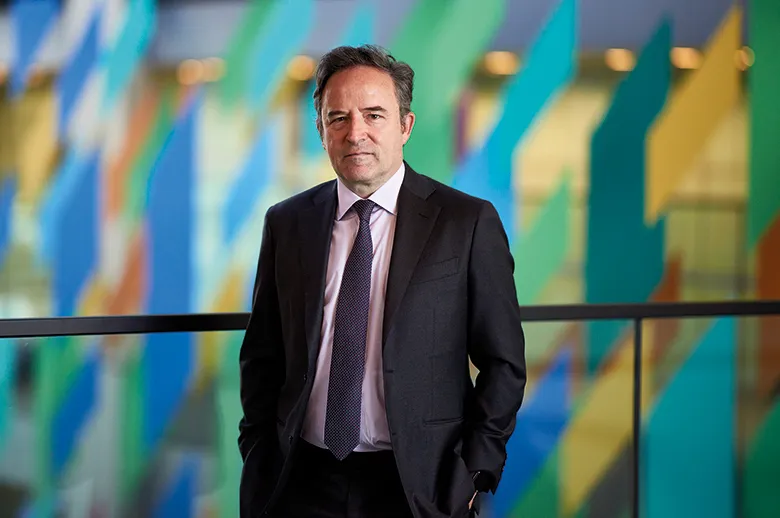

While credit costs and reserves for expected loan losses at Citi dragged net income for the first nine months of 2020 down by 51% compared with the same period in 2019, the institutional clients group (ICG), its investment bank, provided a bright spot.
Fixed income sales and trading revenues were 42% higher year on year over the first three quarters of 2020, equities revenues were up 18% and investment banking revenues rose by 16%.
Paco Ybarra, chief executive of ICG, does not beat his chest when Euromoney asks for his highlights of the year. Rather, he talks about surviving well.
“There was massive price volatility in markets in March, when we still did not know how governments would respond, that also impacted counterparty credit exposure. We had to manage both price and counterparty risk through a dramatic increase in activity levels, processing a record number of transactions with the front and back office now working from home,” he says.
“We came through in pretty good shape and were making good money in sales and trading, and then in April and May our loan footings increased substantially, as clients drew lines and asked for new facilities, which we were able to accommodate in a very complex credit situation.
“We were now using a lot of capital, as the very significant increase in volatility also drove up RWA [risk-weighted assets].”
Capital markets deals
As central banks and governments supported markets, Citi was also able to price and execute a burst of debt and equity capital market transactions.
“There was an explosion of capital markets deals in a credit situation that was still not improving,” says Ybarra. “That we were able to evaluate and execute all those and respond well to all the other challenges shows our resilience and the whole system’s resilience. We have had a good year despite the increases in reserves.
“It is almost miraculous.”
But another setback was coming. Chief executive Michael Corbat had already announced his retirement a month before regulators hit the bank in October with consent orders and $400 million in penalties over Citi’s failure to adequately remediate long-standing enterprise-wide risk management and control deficiencies.
According to the Federal Reserve, these deficiencies extend across various areas of risk management and internal controls, including for data quality management and regulatory reporting, compliance-risk management, capital planning and liquidity-risk management.
It’s not just the low level of rates, it’s the shape of the curve
Paco Ybarra, ICG
“We don’t disagree,” says Ybarra. “Given how many markets we operate in, we are the most global institution they supervise, and regulators are saying: ‘If you want your model to work, you need to up your game.’
“Data is incredibly important. This is about basic hygiene and getting our data into very well organized and governed systems where it is immediately available at your fingertips and you can answer questions as soon as they are asked. We are going to the core of our systems infrastructure and fixing it.”
The bank had been making investments in digital infrastructure. Corbat told analysts on the third quarter call: “In hindsight, we should have done them faster and prevented it from coming to this.”
The pandemic has seen its clients more eager to adopt digital technology.
“This is not about geniuses sitting in a corner inventing new technology,” says Ybarra. “The technology has been available for quite some time, but it has not been so impactful because adoption has been slow. Clients are now adopting much faster. This is all about automating fairly simple processes as a matter of routine and also associated communications, so clients can ask: ‘Where is my payment, how fast will it get here, what data will be attached?’
“We are now glimpsing what the future will look like – perhaps five years from now – when the financial world operates fully digitally.”
Outlook
And what of the outlook for his business in the quarters ahead?
Low interest rates will hurt parts of the ICG such as treasury and trade solutions (TTS), arguably the business that defines Citi.
“It’s not just the low level of rates, it’s the shape of the curve,” Ybarra points out. “We can do OK at low short-term rates if the curve is steep. However, I think that the worst outcome for banks is if rates continue to hover around zero as they are now. If rates went negative, clients – especially large clients – will understand that you will have to reprice them to hold their deposits.”
After a banner year for revenues in sales and trading and capital markets a slowdown looks inevitable. Balancing that, Citi may not have to take further large credit provisions and could even enjoy some releases.
However, that remains to be seen.
“We initially modelled expected losses on conservative assumptions that did not include so much government support,” says Ybarra. “That support helped enormously, but likely cannot continue indefinitely. The credit situation and the true extent of the damage remains uncertain.”
Maybe 2022 will be a better, or at least more normal, year than 2021.
“The trick is to be prepared to survive a pretty dire outcome for credit, activity levels and rates without damaging your franchise,” Ybarra says, “but also be ready for the opportunities if recovery is quick and robust.”


