Awards for Excellence 2018
|
|
|
Also shortlisted |
Citi |
ING |
| View full 2018 results |

The backbone of any business is the strength of the relationships within the senior management team. Diane Reyes, group general manager, global head of liquidity and cash management, and Natalie Blyth, group general manager, global head of trade and receivables finance, both bring a dedication and deep understanding of their own business to HSBC’s transaction banking franchise, and that has been instrumental in its selection as the world’s best bank for transaction services this year.
Because of its strong presence among small and medium-sized businesses, HSBC is embedded far more deeply into the supply chain than many of its competitors. With transaction banking at an inflection point as a result of technological disruption, the bank has shown leadership in digital simplification; evolving its own business model and delivering innovative solutions to clients drawn from breakthroughs in artificial intelligence, big data, distributed-ledger technology and mobile solutions. The bank is also co-creating transaction banking products with key technology partners such as R3, Kyriba, Tradeshift and Symphony.
Trade finance customers can now follow the progress of a specific transaction on their mobile using the HSBCnet app.
“Over the last year alone, HSBCnet Mobile has grown by 38% by volume, with a comparable growth in value” says Reyes. “Recently we saw $2.6 billion of transactions in a single week and one transaction from a single client exceeded $1 billion in size.”
HSBC has led the pack in developing distributed ledger technology for trade. In addition to Cargill’s recent soybean transaction with ING – the first live trade finance transaction using blockchain – HSBC is also part of the we.trade consortium that is developing a distributed ledger-based trade finance platform to make open-account cross-border commerce easier. “This [Cargill] ground-breaking transaction is a significant and much anticipated inflection point for how trade is conducted,” says Blyth. “It underscores HSBC’s leadership of the trade finance industry and demonstrates our ability to harness the power of innovation to make trade easier for our clients, by making it cheaper, faster and more secure.” The bank is also one of a consortium of financial institutions that have successfully developed software prototypes as part of Project Ubin, an initiative sponsored by the Monetary Authority of Singapore to develop a payment system prototype on blockchain.
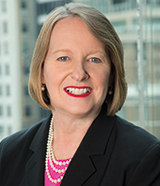 |
| Diane Reyes |
Managing FX has also become easier. By using the GetRate for Trade feature, clients can book live FX rates at the time of authorizing export-import transactions. Security levels have been improved by using built-in mobile biometrics: users of HSBCnet mobile can use Face ID to log in on an iPhone X. HSBC has also created the Liquidity Management Portal, which allows clients to manage their own liquidity flows. The dashboard enables personalized reporting across international positions and automated cash investment sweeps.
The result has been a nimbler range of solutions that will help clients to grow. For example, HSBC has provided seamless on-boarding of new stores for the Ikea group, together with real-time views of account balances across all accounts, as well as automated cash delivery and collection for local stores.
“The range of solutions that HSBC offers simplifies processes,” says Robert Page, business process manager at Ikea. “HSBC provides us with cash collections and payments – including large payment files – as well as our accounts and even a short-term facility. Having all of these services coming through the same institution just makes it a lot easier for us to manage. There is also much less need to transfer cash, which saves us on fees.”
HSBC’s global footprint is at the heart of its transaction banking franchise. It was appointed by specialty chemicals producer AkzoNobel as the firm’s primary banking partner across eight countries in Asia Pacific, six countries in the Middle East and two countries in Latin America, delivering a single, centralized electronic banking platform.
“Our relationship with HSBC has grown significantly since 2012, and the team demonstrates good collaboration and delivers commitments on time,” says Eva Pang, Asia head of treasury at AkzoNobel. “Trust is one of the core components that has helped us to build our strong and enduring business relationships.”
The global capabilities of the bank were also crucial for Flight Centre Travel Group (FCTG), which tasked the bank with simplifying global payments and minimizing cross-border banking fees.
“Managing local requirements in different jurisdictions within a global framework is always challenging,” says Scott Reid, assistant treasurer at FCTG. “That’s where HSBC’s local relationships and knowledge come into play. We know we can enter new markets with confidence.”
HSBC has made some big improvements to its key digital channels over the awards period and delivered a flexible and convergent architecture for its clients. It understands that technology is the catalyst transforming the industry, creating new connections and breaking down traditional silos. Digital simplification is a standard expectation for clients, but as many smaller correspondent banks and corporates themselves remain unsure about what technology to adopt, the bank aims to lead the way to create an industry standard. The goal is for this to be replicated along the entire correspondent banking chain, keeping existing relationships close and drawing in new clients over time.


