The recent G8 meeting confirmed that OECD governments are in denial. They are trying to stave off the impact of private sector deleveraging by adding to their own debt. This won’t work and is merely creating new problems that will emerge farther down the road.
Government debt will weigh heavily on sustained economic growth because of wasted expenditure and rising tax burdens to pay for it.
The servicing of government debt will mean higher government bond yields and a lower dollar, along with lower-than-average returns on productive assets. And that means the same for most financial assets.
One of my key themes in past columns has been that the huge rise in asset prices since 2002 had been made possible by a massive increase in debt, particularly in new forms of money beyond traditional areas of credit such as bank lending. These new forms (securitized debt and the derivatives based on it) must now shrink. And bank credit must shrink and bank leverage be reduced permanently before sustained economic growth can be resumed in a world based more on thrift than credit.
If that is the measure of when we can expect the global economy to start to recover, then we are not there yet. In fact, we are not even standing in the antechamber.
Deleveraging is in its infancy. Take the US. In previous economic recessions, debt to GDP has tended to fall 5% to 10% below trend. If that happens in this recession, then we should expect US debt to contract by $3 trillion to $5 trillion from here.
US net borrowing by sector |
Percentage of GDP |
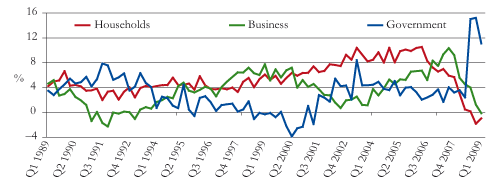 |
Source: Datastream, Independent Strategy |
US household debt has fallen in the first decline since records began in 1952. Household debt to disposable income is now down to a ratio of 1.31 compared with 1.39 at the start of the credit crunch. This reflects mainly mortgage defaults as homeowners walk away from their assets but is also partly a result of a paying down of mortgage and consumer debt. But the debt-to-net-worth ratio is still rising – indeed it is at its highest level ever – because household wealth in the form of homes and stocks has dropped by more than 20%. So substantial reductions in household debt have only just started on the long road down. The debt-to-net-worth ratio for businesses also reached a new high in the first quarter of 2009, even though business debt fell in that quarter, the first fall since 1993. So the business sector has yet to deleverage significantly.
While households and businesses have begun the painful process of deleveraging, the total debt of the domestic non-financial sector grew 4.1% year on year in the first quarter of 2009. What is happening is that the US government has stepped in to sustain leverage as the private sector contracts. While total borrowing by firms and households fell from more than 15% of GDP in late 2007 to a negative 1% of GDP, government borrowing jumped from 3% of GDP to a staggering 15%. As a result, overall debt is still up nearly 6% since the credit crunch began.
The US government is trying to avoid a collapse in wealth and incomes that will deepen the economic recession. It’s the same story in the UK and other OECD countries.
Can the US government avoid economy-wide deleveraging by boosting government borrowing and thus revive the US economy using the easy credit model of the past? The quick answer is no. IMF research has shown that, beyond a certain level of leverage, government stimulus is ineffective. Taxpayers know that government can only spend their money, so they cut back on their own spending as government takes a bigger slice of the cake.
The main funders of US government debt issuance remain foreigners. Government debt has increased by $1.7 trillion since the end of 2007. Households and retail mutual funds have financed $790 billion, while foreign buyers have accounted for $900 billion. Foreign holdings constitute nearly half of all outstanding debt.
The US government cannot expect rising household savings to provide the exit strategy for its increased leveraging. The government will either have to pay down debt by raising taxation and slashing discretionary spending or it will have to rely on foreigners to buy more treasuries.
If foreigners are to do this they will want higher yields as the dollar is now in play as a trusted reserve currency (let alone as the global reserve currency). Foreigners will only be willing buyers as higher yields are matched by a weaker currency, so reducing their investment risk and increasing potential returns from a recovering dollar farther down the road.
David Roche is president of Independent Strategy Ltd, a London-based research firm. www.instrategy.com


