
 |
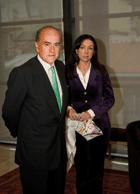
Baldomero Falcones with Esther Koplowitz, principal shareholder of FCC: confident of the future |
FOMENTO DE CONSTRUCCIONES y Contratas (FCC) has its origins in one of Spain’s oldest companies, listed since 1900. A constituent of the Ibex35 index, FCC’s business composition – which has increasingly diversified from its heritage in construction and most recently embraced renewable energy – makes it an archetype of the rapid development of the Spanish economy in recent decades. Despite energetic efforts to broaden its revenue base, FCC has suffered as the global financial and economic crisis has gathered pace. In the nine months to September 2008, the company’s net profit fell 51.6% to €297 million; net profit excluding extraordinary items from the sale of part of real estate firm Realia in the first half of 2007 fell 22.3%. Sales increased 6% over the same period.
The task of ensuring FCC’s resilience in a challenging environment – and retooling the company for the future – rests with Baldomero Falcones, who has been chief executive and executive vice-chairman since December 2007. Falcones has broad experience in three areas crucial to FCC’s success – utilities, power and finance. In addition to being a founding partner of private equity firm Magnum Industrial Partners, chairman of MasterCard International and of Santander Seguros and a former general manager and member of the executive committee at Banco Santander Central Hispano, Falcones has been a director of Unión Fenosa and director for Spain at RWE.


We are not reviewing our strategic plan. It was widely perceived as extremely conservative and that was deliberate on our part: we were worried about the scale of the economic crisis. The plan focused on four themes. The first is the consolidation of our markets and margins in Europe. The second is that we will take opportunities that make sense for us in central Europe, the UK, the US and the Iberian peninsula – the strategy is buy and build to enable us to rapidly create synergies. The third objective is an improvement in efficiency through a reduction in costs and improvements in productivity. And the fourth goal is to move into renewable energy. We remain fully committed to those four objectives.
This year we will grow turnover by more than 6% and we expect around 7% growth next year – clearly that is less than the 10% target. But we expect that growth will accelerate in 2010 and will be better again than in 2009. There are some activities that the group is involved in – most obviously cement and real estate – that are seriously affected by the current situation. But our infrastructure operations and services group should show strong ebitda growth. Overall, as the plan stands, ebitda probably will be lower than originally expected – that is what we are currently working on: how the plan can be refined to try to achieve the original targets in a different way.
Everyone realizes that the situation is much more complicated now than 10 months ago when the plan was put together. We were expecting – and worked into the plan – a serious downturn in the economy. But I don’t think many people were expecting the crisis to result in the effective bankruptcy of much of the international financial system. The market recognizes that the nature and scale of the crisis has changed – and it also recognizes that compared with our competitors we have proved resistant in terms of our cashflow, ebitda and net profit.
Normally we don’t issue bonds. Our financing comes from banks and project finance facilities. At the beginning of 2008 we recognized that liquidity was seriously constrained and could become more so and we came to market in March for all the funds we needed for 2008 and 2009. Markets conditions were favourable for our €1.225 billion three-year syndicated loan, which can be extended by two years – our total costs were 75 basis points: much better than is now available or than any of our competitors achieved in 2008. Our budgets for 2008 have been exceeded, so based on our current predictions that fundraising will not last for the full year 2009.
We are signing the financing for the Babcock Wind portfolio in January and the club deal is already signed. It was a tough experience – we signed the agreement for the acquisition in August 2008 when market conditions were already unsettled. But trying to close the deal was extremely difficult and the cost of funding was relatively expensive due to turbulent market conditions. Consequently, we have inserted a condition into the deal that allows us to swap to a fixed interest rate from floating during the first six months of 2009 – we expect Euribor to come down significantly over that period while the European Central Bank is also likely to cut rates steeply – making it a good time to close the swap.
In addition, the deal can be renegotiated at any point over its 16-year life. In this deal, the financing is 25% capital and 75% debt. Traditionally, a deal of this nature would be 85% to 90% debt. Our hope is that the market recovers sufficiently to allow us to increase leverage at some point.
The deal was tough because of the terms we wanted included but it was also tough simply to get banks involved. Liquidity in the system has been severely squeezed – certainly during the early stages of the club deal we had to lean heavily on some of the banks to get them involved, although during the later stages, as it became clear to banks that we are considerably less indebted than many of our peers, it was easier to achieve the terms we wanted and the deal was oversubscribed.
In 2008, there were two significant impacts on FCC in terms of FX that we are seeking to avoid in 2009. The first was related to sterling: we had no permanent hedging for our UK cashflow. In the past three months we have moved to hedge not only our sterling investment but also our cashflow and we will continue that strategy in 2009. The second was related to Polish zloty and was a similar problem. The impact of not having hedges on our cashflow in those currencies may be 1% or 2% of ebitda in 2008.
The large part of our business is in euros and generally our policy now is to have hedging for investment, financing and cashflow where possible. We aim for hedging as close to 100% as possible, although sometimes it is not possible because of the depth of a particular currency market or the changeable nature of the cashflows of a particular subsidiary. We never speculate on currencies.
The current crisis resulted from too much liquidity in the financial system, partly as a result of a huge fiscal and current account deficit in the world’s largest economy – the US. At the same time, there was significant financial deregulation and a massive increase in leverage among financial institutions. Now the economy needs to be deleveraged and financial activity needs to be regulated more thoroughly.
I am optimistic in relation to the current environment. I believe that we are over the worst in the financial sector and liquidity appears to be returning. The challenge, of course, is to ensure that liquidity reaches companies and consumers so that the recovery of the real economy can begin. There is clearly a major adjustment taking place and this is the worst crisis of my life – but I think the reaction from various governments around the world has been positive.
It is essential that liquidity reaches corporates and consumers. I’m not sure that the government should intervene or legislate to achieve this. I believe that if confidence is restored in the various institutions of the financial sector then the market itself will begin to direct funds to where they can be most beneficial to the economy.
Fair competition is an important principle to remember during the current period when governments are getting involved in helping various sectors. It’s not fair to help just one company or sector – it will affect the normal evolution of the market. It’s not just the way in which the financial sector has been prioritized over other sectors – given that this is a financial crisis it makes sense to tackle its problems first. But it is important that the direction of the economy is not distorted by the way in which governments react to the problems.
Similarly, governments must resist the urge to over-regulate. There were clearly regulatory mistakes and under-regulation in some areas in the past and it has caused huge problems. However, to have an over-regulated system would prove equally problematic in the future. Finally, governments must be ready to act quickly once the crisis is over to recover liquidity from the system. If they don’t get the excess liquidity out of the system extremely quickly once recovery begins there could be an inflationary spiral that could have catastrophic consequences.
It is correct that growth may slow but the character of the growth will improve: it should be more consistent and less speculative. Growth should come from gains in productivity and innovations in technology rather than financial engineering.
Infrastructure has been a very strong area for 2008 and will be so in 2009. In Spain, the government has a plan to invest in infrastructure in order to create jobs and improve the economy. But in central and eastern Europe there is also significant continuing infrastructure investment, often making use of EU funds or driven by other investors such as the European Investment Bank.
More generally, contracts for environmental and other services are long-term in nature and consequently offer high visibility of earnings making them attractive – especially in current market conditions.
The decision to enter waste-to-energy was a simple one: FCC is the largest waste manager in Spain and the UK. And the decision to enter the wind and solar sectors was also a logical next step for FCC. There is a strong synergy for FCC in the renewables sector because we have an existing construction company and electrical engineering company – entry is a natural vertical integration. The 20MW photovoltaic farms [which convert sunlight directly to energy] we bought in Córdoba were designed and built by FCC. There was a natural progression from providing the knowledge and skills required to construct these facilities to owning and operating them.
I met the Spanish prime minister [José Luis Rodríguez Zapatero] recently, and he said that the Spanish commitment to renewable energy is solid. Similarly, the new US administration appears to be an enthusiastic supporter of renewable energy. Renewable energy is still dependent on public subsidies and political support but every year it is becoming more competitive [with traditional energy generation] because the technology is advancing and the investment cost is lowering. Waste-to-energy is already competitive based on our experience of operating plants in Spain.Wind energy will probably be the next to become competitive followed by photovoltaic and thermal solar [which uses solar energy to generate heat].


