 |
|
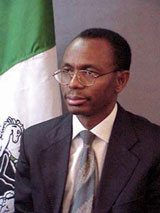
Mallam Nasir El-Rufai, minister, Federal Capital Territory, Abuja |
“It is the fastest growing city in the world, and the most successful planned capital city,” claims Abuja’s supremo, Mallam Nasir Ahmad El-Rufai, minister of the Federal Capital Territory (FCT), head of the Federal Capital Development Authority (FCDA), and a key member of the economic management team driving reform. The city and its surrounding satellites are now home to an estimated eight million people growing at 15% a year. However, the speed of its growth has exceeded the control of its planners and given rise to a series of other problems: too many people have come too quickly, and in the process, many of the rules of the original master plan were ignored.
El-Rufai has pledged to return to the original plan, and there is evidence throughout the city that he has stuck to it. Bulldozers are knocking down illegally constructed buildings on land reserved for sewers and water; in one central market, the government has just evicted 70% of the shops; across the city, commercial properties are being forced to revert back to the residences they were originally supposed to be.
Clearly these moves are not popular with everyone, from powerful vested interests in the National Assembly to newcomers trying to earn a pittance. “We are one of the few planned cities in Nigeria, and I accept that we are causing a lot of pain,” says El-Rufai. “But we are paying compensation and cleaning up the city from 15 to 20 years of a bad legacy.”
Abuja is a work in progress. It is still being built. Julius Berger, the country’s largest construction company, employs 4,000 people in the city that has main landmarks and infrastructure, says Hartmut Tolle project manager and public relations executive at Julius Berger Nigeria in Abuja.
Even its trees are in the process of being planted. “The president likes trees,” says El-Rufai, and he has set a target of one million in four years; already the FCT government has planted half a million in 18 months. The city is a late developer in many ways, because its early years were not so auspicious. The plan for Abuja, launched in 1976, was to create a capital over a 25-year period. “It was the vision of the head of state Murtala Mohammed that in 25 years we would have built the first four phases of the city and moved the seat of government from Lagos to Abuja,” says El-Rufai. “But in 1976 oil prices were high and the plan was based on public sector development – that is to say, the government would do everything – but then oil prices crashed. Now we have only done stages one and parts of two, with three and four to go, even after 29 years.”
“Abuja has not developed as expected but it has been far more successful than expected,” says El-Rufia. What was meant to have been a city of three million people after 25 years has already attracted eight million at least (based on satellite estimates). Growing at the rate of 15% a year, that makes it the fastest growing city in the world.
The FCT is also a sprawling metropolis that includes half a dozen or so satellite towns or suburbs situated miles from the town centre. A victim of its own success, the territory faces challenges in coping with infrastructure and support services.
“The city works fairly well, but with the outskirts we are facing challenges, as the urban sprawl creates unplanned settlements,” El-Rufai explains. “The success of the city and the challenges on the outskirts say a lot about the country: the city is the new face of Nigeria, things work, there are no beggars, it is clean and there is good infrastructure.”
On arrival at the airport, Abuja presents a stunning contrast to Lagos. The atmosphere is calm and it is easy to get a hassle-free – though expensive – taxi. Then follows a 20-minute drive down avenues lined with trees, including the stunning red ‘flame of the forest’ trees being planted all over the city.
Abujans, and there are precious few who actually come from Abuja, like the city. One government employee who has relocated from Lagos calls it: “an oasis of calm in a country of chaos”. A business visitor takes a different tack: “It’s a pain having to come here, and it’s pretty boring, but you just have to do it if you want to get things done.”
It is not perfect; you can’t escape the short power cuts and even five-star hotels are subject to air conditioning failures. But these are small inconveniences compared to the grandness of the original vision and the possibility that Abuja could become the epitome of a world-class city in Africa.
“It was the vision of the founding fathers that Abuja would not be dominated by any ethnic group,” says El-Rufai. “It was sparsely populated at the time with less than 100,000 people in 1976; now it has become something of a melting pot. Indeed, some of the success of Abuja is due to the failures of other areas. Here people feel safe.”
In other words, Abuja is not like anywhere else in Nigeria. It is different: Abuja is not Lagos, the Yoruba-dominated commercial centre in the southwest that previously struggled with two roles as a state and a federal capital; nor is it the northern Middle Belt, which periodically erupts into ethnic and religious tension between Muslims and Christians; nor is it the troubled Niger Delta oil region where violence and kidnappings are rife.
In the middle of the country, it is also easy for everyone to get to. However, there have been criticisms that rail links between Abuja and other cities were not enshrined in the infrastructure-building programme. Building railways in Nigeria is costly and they are hard to run, says Julius Berger’s Tolle: “Lagos to Kano, for example, has a train maybe once a week, and you can’t rely on that.”
The latest news is that an Indian firm has won a contract to build a line from Abuja to Lagos. More and more foreign firms are joining in with the Abuja party. The city is also home to Chinese companies planning to assemble GSM sets, and another Chinese firm is already manufacturing batteries.
“It is the seat of government and, since colonization, Nigerians have looked to government,” says El-Rufai. “But it is not just a centre of administration, it has also become an active commercial hub.”
He adds: “People are moving because there is so much commercial activity rather than because of the conception of the city – and that has added to its melting pot characteristics.”
Politicians, though, still dominate Abuja. Even the private sector primarily comes to visit the politicians, civil servants and perhaps the embassies. The grandiose roads reflect this. Named after heads of state and other public sector luminaries, they present a curious tone. The current President Obasanjo has a modest crescent named after him, presumably from his previous stint in charge in the 1970s; it is just off Ibrahim Badamasi Babangida (IBB) Way, one of the biggest thoroughfares named after the country’s military dictator from 1986 to 1993, who is hoping to stand for election in 2007. It was some surprise to find that the legendary kleptocrat Sani Abachar still has an avenue to his name. Bill Clinton and George Bush are honoured with prominent roads too.
The legacy of past regimes is everywhere in Abuja, notably in some of the white elephants, such as the National Stadium that is your first sight of the city on the way in from the airport. No one can bear to talk about how much it cost – but it is in the millions of dollars – it has found few uses, aside from the occasional international football match or religious meeting.
Julius Berger Nigeria constructed the stadium at what it says was a very competitive cost compared to stadia that hold 60,000 people elsewhere in the world. “We finished it punctually and opened for the 2003 All Africa Games, as the President wanted,” says Tolle. Debts, however, have spiralled for the government, and it still owes Julius Berger and other local contractors billions of Naira for this and other projects.
“Nine times out of 10 Julius Berger delivers – whether it is a building or furniture, it won’t fall apart – but it is extremely expensive,” says Amina Ibrahim, senior special assistant to the president on Millenium Development Goals.
To which Tolle replies: “For good quality you have to pay the price. And if you don’t you won’t make any important contributions to infrastructure.” He points to the ports and bridges the company has built in Lagos that have lasted since the 1960s.
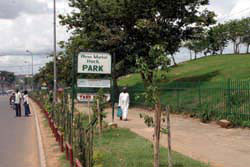 |
| Wuse Market Rock Park, Abuja |
In the past, the FCT may have had a “fat cat” image to Nigerians: it was seen as the place where all the oil money was blown on a corrupt government elite. But that is changing, says El-Rufai, especially with publication of all oil revenues each month and which regional governments they go to. “People now know that the Delta region gets nine times more than FCT, Rivers State eight times more – in all, 30 states get more than Abuja, which is the third largest city after Lagos and Kano.” “We just use the proceeds more effectively and they can now see how it is done; they now see it is not quite like they thought,” he continues. “People are now asking their own governors and local governments – ‘where is our money’? The only thing missing is publishing where the states use their tax revenues, but we cannot force them to do this under the federal system.”
The success of Abuja has created problems. “It was not a successful move by the government from Lagos in 1991, and by 1999 there had been a huge influx that meant we soon ran out of land with sufficient infrastructure,” says El-Rufai. “Predators located plots that were reserved for sewers and water, and the buildings could have cut the city’s water supply.”
Something had to be done and, since arriving in office as a presidential trouble shooter, the FCT minister has presided over the destruction of 500 buildings, paid nearly $2 million in compensation and is not finished yet. The next step is to make commercial buildings revert back to their original purpose as residential dwellings. El-Rufai points to Victoria Island in Lagos, which was once purely residential but has grown into a business/entertaintment zone, as an example to avoid.
Tolle at Julius Berger agrees: “In Lagos the chaos was self-made. It grew and grew and no one did anything about building roads. If you don’t foresee the difficulties when everywhere people are building a house here and a hut there, then soon you will have nowhere to build a road.”
Another high-profile example of insisting on building in accordance with the standards of the masterplan was the clearing of Wuse Market in January. Originally designed for 2,000 shops amidst boulevards and parking space, Wuse was bulging at the seams with 15,000 shops, of which 10,000 were illegal. “It was a fire disaster waiting to happen – we estimated 50,000 to 100,000 people could have died – but we cleared it in two weeks and everybody said we were heartless. But now the shopkeepers say it is nice and they like the order.”
This is a theme that is dear to the hearts of most of the ‘young turks’ at the heart of the reform process. “It is a challenge in Nigeria to restore order in a society that, under years of military rule, allowed people to do what they wanted with impunity,” says El-Rufai.
There are two circles of growth in Abuja: the city and the suburbs, and they are separated by a buffer zone that includes a forest reserve. Property in the city is very expensive, which forces most people to live in the suburbs. But out on the fringe there have been armed robberies, a persistent lack of electricity for days and fuel costs to get into work are expensive. The suburbs range from 30 minutes (near the airport) to more than an hour away.
Housing is an issue, because demand greatly outweighs supply, concedes El-Rufai. He is trying to get the private sector involved and to develop an active market for mortgages. Meanwhile, the federal government is selling thousands of houses in Abuja, as well as building low cost housing in the suburbs.
 |
|
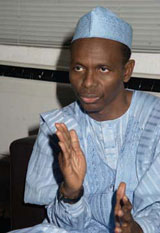
Mallam Nasir El-Rufai, minister, Federal Capital Territory, Abuja |
“The government is trying make a better FCT, but you can’t make a city that doesn’t reflect a country; you can’t just hide the poverty,” says Ibrahim. “Abuja, I think, will work. It certainly needs to. But perhaps more important is to make the state capitals work.” El Rufai’s demolition programme and his attempts to impose order is proving unpopular with some. Powerful people have had their land-grabbing plans stymied. But Abujans generally agree that it has to be done. And it has to be done by someone who will not baulk at sacred cows and is scared of no-one. As a successful head of the privatisation programme in the early part of the Obasanjo administration, El-Rufai has many of the credentials.
However, he could sometimes be more diplomatic. On one occasion, the National Assembly reacted furiously when they thought he had called them fools. The president had to enter the fray to apologise on his behalf.
“The whole episode was greatly exaggerated,” he smiles ruefully. “I have had a long and interesting relationship with the National Assembly and am a constant target. One of the members was conducting a smear campaign against me and I didn’t reply. Someone asked me why I wasn’t answering the charges and I said: ‘I’m not talking to a fool’.”
“The National Assembly likes to interpret any attack on its members as an attack on all of them,” he says. It’s only media spin usually, but he does add: “In the Senate, I have some university friends but there are also some people there with serious character flaws.”
Supported by: The Federal Ministry of Finance, Nigeria


