
Brazil: The banks party through the crisis
Duhalde was quick to make it clear that he did not intend Argentina to default on its debt obligations. But Brazil’s devaluation in January is still fresh in the minds of investors and after two years of wondering where the next emerging-markets shock will come from, the markets remain jittery. Unfortunately, elections loom in three of Latin America’s biggest economies, Argentina, Peru and Chile. Traditionally, in Latin America, elections mean three things: politicians make populist statements, governments loosen the purse strings and capital flees.
In many ways Latin America – or at least South America – is suffering an economic crisis as bad as that in Asia. Although the region has endured repeated financial shocks in recent years, this is the first time for 15 years that the continent as a whole has suffered recession. Brazil’s devaluation has brought Ecuador and Colombia to the brink of economic collapse, has put untold strain on Argentina’s economy and has even pushed Chile’s previously robust economy into sharp recession.
In contrast to Asia’s economic crisis, which forced itself onto the world’s attention in 1997 in a sudden clattering of falling dominoes – and unlike Russia’s, which exploded into life with the announcement of a domestic debt default in August 1998 – Latin America’s is a slow-drip crisis. Each piece of bad news has provoked pessimism, followed by relief that things haven’t turned out as badly as feared. But as the world begins to cheer Asia’s rapid recovery, it doesn’t seem to have noticed how bad things have become in Latin America.
Not since the dark days of the debt crisis in 1982 have the majority of Latin American countries simultaneously suffered negative growth. Argentina’s economy shrank at an annualized rate of 3% in the first quarter of 1999 and is now moving into much deeper recession. Chile’s GDP was 2.9% lower in the first half of 1999 than in the same period last year. Meanwhile Colombia, Venezuela and Ecuador will all suffer negative growth of 5% or more this year. The only two large Latin American economies growing this year are Peru, where growth has slowed sharply to 2.6% in the first half of 1999, and Mexico, buoyed by strong links with the US and a rising oil price, which achieved growth of 2.5% in the first half of the year compared with the same period in 1998. Brazil’s GDP growth rate is hovering around zero.
This is an economic crisis on a par with Asia’s recent troubles. The rate of GDP contraction in Thailand, Malaysia, Hong Kong and South Korea reached between 5% and 7% in 1998 before a sharp bounce back. The low point for the Philippines was just below 0%. Only Indonesia experienced a contraction of more than 10%. Singapore, Taiwan and China have continued to grow through Asia’s crisis.
The big difference is that with the exception of Ecuador, banking systems in Latin America have not collapsed. But Latin America has been shut off from international credit to at least as great an extent as Asia. Whereas the better Asian credits can tap pockets of demand in Europe and can count on some support from Japan, appetite for Latin American risk has vanished in the market which matters most to the continent, the United States. When US investors have felt bullish this year they have continued to pile into domestic equities. When they have felt bearish, any emerging-market security has been marked for sale, if a bid could be found.
Latin American governments can borrow in the international markets only at spreads several percentage points higher than one or two years ago. Instead, they are increasingly tapping local sources of finance. That is crowding non-sovereign borrowers out of domestic markets and starving industry of credit. Brazil, the world’s eighth largest economy, cannot get maturities of more than three years in any market. Company defaults have risen alarmingly. Raising equity or corporate bonds is nigh impossible for Latin American companies.
If the latest bout of uncertainty was caused by comments made by a possible future president of Argentina, the crisis was prompted by the cavalier pronouncements of a former South American head of state. Itamar Franco, who was president of Brazil for a short while in the early 1990s, became governor of the state of Minas Gerais in January and almost immediately announced that the state would not be paying back its debt to the central government. This was enough to shatter the fragile confidence in Brazil’s currency, the real. After months of holding the line, the central bank abandoned its peg and let the currency float. Share prices fell, bond yields increased and the value of Brazil’s mostly dollar-denominated debt soared.
Ecuador, one of the continent’s smaller economies, was the next to be hit in late February. It too was forced to devalue its currency. There was a run on the banks and 10, including some of the country’s biggest, have since collapsed.
Then, in the second quarter of 1999 things became a little better. In Brazil the currency stabilized and, with economic activity subdued, there was no quick return to inflation. Argentina’s authorities squarely rejected the suggestion that its currency could go the same way as Brazil’s: its constitutional commitment to parity with the dollar seems safe. Latin American borrowers began to come back into the market. Argentina issued a 10-year $1 billion bond in late March and this was quickly followed by a rush of issues from smaller sovereign borrowers. In late April, the Brazilian authorities were able to attract $3 billion in the international capital markets by issuing $2 billion of new five-year bonds and exchanging $1 billion-worth of Brady bonds.
But within a couple of months events had started to worsen again. Colombia was forced into an effective devaluation of its currency in June. And as economic data became available for the first months of the year it was becoming clear that most of the continent was moving into deep recession.
And once again, Latin American politicians are unnerving the markets. Ecuador has made several unsuccessful efforts to sign a letter of intent with the IMF. That would release a $400 million loan from the fund and unblock further funding from multilateral lenders. The stumbling block is that the country’s parliament is unable to agree on reforms. As the date for a $95 million payment on its Brady bonds drew near last month, Ecuador’s president, Jamil Mahuad, announced that the country would not meet this payment and intends to restructure its $6 billion of Brady debt. There is real concern that Ecuador will become the first country to default on its Brady bonds, the securities consisting of repackaged bad loans from the 1970s and 1980s which did so much to put Latin America’s finances back on track in the 1990s.
Ecuador is a small and relatively poor Latin American country. A default there would send a shudder through the markets but the knock-on effects should be containable. Much more worrying is the situation in Venezuela, a country which, because of its oil exports, has one of Latin America’s highest per capita incomes.
In December the Venezuelan electorate roundly rejected its traditional ruling parties and chose as president a former paratrooper and attempted coup-leader, Hugo Chávez. The new president has moved quickly to rewrite the constitution and make good his populist electoral promises of higher incomes and lower interest rates. The new government has arm-twisted the country’s banks into lowering interest rates, undermining the independence of the central bank in the process.
The new president’s initiatives are beginning to follow a pattern. First, measures are promised which scare the life out of the markets, such as a proposal to write spending promises into the new constitution and a requirement forcing banks to make cheap loans to the agricultural sector. But then the measures are watered down after haggling between the government and the interested parties. However, though the new president’s bark may be worse than his bite, Venezuela is becoming markedly less capital-friendly and the government’s unpredictability is making investors very suspicious of the country. For now, a strong oil price continues to prop up government finances but Venezuela needs to borrow some $4 billion in the rest of this year. Its economy is contracting dramatically and its currency could be its Achilles heel.
“Venezuela is in a lot of trouble,” says Felipe García, analyst with economic consultancy Idea. “They haven’t had to devalue the currency because oil prices have remained high. But the Venezuelan currency is over-valued by 40%. That’s more than Ecuador’s was before it devalued and more than the Brazilian real was overvalued before its devaluation.”
Brazil, the country which triggered all this, has come off better than most, at least in terms of income growth. Inflation has remained subdued, confounding fears that the devaluation would lead to a resumption of Brazil’s tradition of entrenched inflation. And the recession has turned out to be shallower than many predicted. GDP was less than 0.5% lower in the first half of 1999 than in the second half of 1998 and there was growth of almost 1% in the second quarter. Most economists expect growth for 1999 as a whole to be around 0% based on current performance.
In many senses the country that has suffered worst from Brazil’s devaluation is Argentina. That has much to do with the country’s self-discipline in sticking to its fixed exchange rate to the dollar. All candidates in the forthcoming Argentinian presidential elections have stated their commitment to keeping the currency-board system which is known locally as convertibility and which for the past seven years has kept the country free from inflation.
But the devaluation of the real had a dramatic knock-on effect on Argentina by making Brazilian exports suddenly much more competitive. The two countries, along with smaller Uruguay and Paraguay are linked by the Mercosur trade agreement. Mercosur has brought low tariffs and higher trade between South America’s two big manufacturing economies. Some 30% of Argentina’s exports go to Brazil.
The devaluation has put unprecedented strain on the agreement. Argentina complains it is being flooded with Brazilian goods made suddenly cheap by the weakening of the real. Disputes between the two countries over manufactured goods such as shoes have become increasingly bitter, leading some to doubt that Mercosur can survive the strain. In mid-August the industry minister of Paraguay, whose economy is linked closely to that of Brazil, suggested that Paraguay could leave Mercosur as a result of a dispute with Argentina.
After stabilizing in the months following the devaluation, the Brazilian currency felt new strain in July and August. The Brazilian central bank has attempted to ease interest rates gradually during the year, but has found that as soon as rates touch around 20% the real starts to fall dramatically. In mid-August, the Brazilian central bank was forced to go into the market to defend the currency. The uncertainty pushed up spreads on bonds from both Brazil and Argentina and prompted talk that the southern cone of South America was being penalized for “Mercosur risk”. Last month Moody’s placed Argentina’s rating on review citing concern about its fiscal deficit.
Meanwhile, in the rest of South America things were going from bad to worse. Last month, Moody’s stripped Colombia of its investment-grade rating – the country was already rated below investment grade by Standard & Poor’s – demoting it two notches from Baa3 to Ba2. But at the same time Moody’s upgraded Mexico to Ba1, just below investment grade.
Moody’s move on Mexico’s rating reflects the large gap that is opening up between perceptions of Mexico’s risk and that of the rest of Latin America. “Mexico has done a remarkable job in handling the effects of the recent crises,” says Carlos Novís Guimarães, managing director responsible for Latin American investment banking at Lehman Brothers. “It is becoming the safe haven for the region.” A recent Moody’s report praises Mexico for having “effectively decoupled its real economy from the rest of Latin America”. And many observers believe that it is only the prospect of elections next year which is preventing the rating agencies from giving Mexico an investment-grade rating.
But how solid is the argument that Mexico is different from the rest of Latin America? Much of the rationale for Moody’s upgrade of Mexico rests on the country’s continuing ability to attract capital flows which are themselves based on investor confidence in the country. Yet investors are overlooking some deep-seated problems. The country’s banking system is still on its knees after its collapse in 1995; Mexican banks rarely bother to make loans because the country’s bankruptcy laws are so generous. Inflation remains in double figures and the entire system of government is based on shakier political foundations than is the case for almost any other Latin American country.
What Mexico does have in its favour are close economic links with the US, and growth – driven largely by the continued health of the US economy. After GDP growth of near 5% in 1998, the Mexican economy has continued to grow in the first half of 1999. Its central bank also commands the confidence of foreign investors. Analysts have been impressed by the central bank’s resolve in tackling inflation and predict that the bank will soon adopt a policy of targeting inflation rather than the monetary base which should give the country greater monetary stability over the long term.
Mexico has become the great convergence play of the western hemisphere, with investors betting that its interest rates will move ever closer to those of the US. The country’s cost of borrowing has come down, especially following the Moody’s upgrade, just as that of the rest of Latin America has been moving steadily upwards.
Mexico’s 10-year bonds were trading at spreads of 0bp last month just before its Moody’s upgrade, which is less than the spread at which it issued its six-year bond in March. Meanwhile, spreads on Colombia’s 10-year sovereign paper have increased from around 500bp when it issued in April to 675bp to 700bp in mid August. Argentina’s spreads have also moved out from near 600bp to some 780bp in the past four months.
Latin America’s governments may be paying more to borrow internationally this year but they have been among the few emerging-markets borrowers who are able to tap the international bond markets at all. Those governments with smaller borrowing requirements have the luxury of being able to choose the best moment to do their deals. And this year there have been several issues from the region’s less frequent sovereign borrowers, most of them taking advantage of the improvement in sentiment in the second quarter of the year.
The longest-dated Latin American bond issue of 1999 was the $500 million 30-year offering from the Republic of Panama in March. Panama is able to borrow at such maturities because of its entirely dollarized economy and it was able to borrow at a spread of 405bp.
The following month, Colombia issued $500 million of 10-year paper at a spread of 495bp. That spread has subsequently widened considerably, but it was much wider than the 215bp paid by Uruguay for its $250 million 10-year deal later in April. At the time Uruguay had the same credit ratings as Colombia: Baa3 from Moody’s and BBB- from Standard & Poor’s.
Costa Rica, rated BB, came to the market on the same day as Uruguay with a $300 million 10-year deal on which it paid 412bp. That deal was criticized as being expensive for the borrower at the time, but with hindsight proved timely given the subsequent deterioration in sentiment towards Latin American borrowers. The deal for Costa Rica also demonstrates that international issuance, even at these prices, can have tangible benefits for smaller Latin American countries with underdeveloped domestic markets. The deal has freed capacity for companies to borrow locally and made it possible for the central bank to reduce interest rates significantly.
El Salvador, which has been waiting for the right time to issue its debut Eurobond for more than a year, timed its deal less well. The seven-year deal from the Baa3/BB+ rated sovereign came to market in early August and paid a spread of 500bp over treasuries. The issue, which at $150 million was for less than the borrower had originally hoped to raise, was led by Salomon Smith Barney.
Central American countries, several of which have close political links with Taiwan, may do better to emulate the borrowing strategy of another smaller Latin country which recognizes the sovereignty of Taiwan. Paraguay, which is in deep financial trouble, managed to raise $400 million in July by placing a bond with two Taiwanese banks. The credit was made available in recognition of Paraguay’s support for Taiwan.
April saw a rare international bond from a Latin American sovereign with a much better credit standing. The Republic of Chile issued a 10-year deal for $500 million which was eight times oversubscribed. Pricing tightened during bookbuilding from over 200bp to less than 180bp. Chile, with its flourishing pension fund industry and strong fiscal record, does not need to borrow internationally. It did so with the deliberate aim of paving the way to the market for non-sovereign issuers.
While issuers such as Chile or Uruguay have been able to choose when to do their rare deals, life has been much harder this year for Latin America’s larger sovereign borrowers. They have had to cope not only with a volatile and largely hostile borrowing climate, but also with the fear that Y2K concerns will close the market to them in the last months of the year. Those which issued in volume in the relatively benign second quarter of the year now look to have made the right move. Mexico issued several large bonds early in the year and has now covered its borrowing requirement for the year.
Argentina, widely praised as Latin America’s most savvy borrower, issued frequently in the first half of 1999 and has also come within hailing distance of meeting its 1999 funding needs. By early August it needed only $1.8 billion more for the remainder of the year and expected to raise that in the local market.
Argentina became the first Latin American sovereign this year to issue in euros and it has issued frequently in the new currency throughout the year, bringing, for the most part, smaller retail offerings with relatively short maturities.
Brazil and Mexico also issued in euros when, towards the middle of the year, the dollar market became increasingly difficult for Latin American borrowers to access. Mexico issued an €400 million seven-year deal in June and two weeks later the Federative Republic of Brazil issued €800 million of three-year paper through bookrunners Credit Suisse First Boston and Dresdner Kleinwort Benson. Brazil’s deal, which was priced at 600bp over the French government yield curve, gained a good reception.
Non-sovereign borrowers have also come to the market in euros. The Province of Buenos Aires issued e150 million at seven years in June, for example. And the Brazilian development bank, BNDES, followed in the sovereigns footsteps by launching a e200 million three-year deal in mid-August.
“Latin American sovereigns tend to be strategic and forward-thinking,” says Susan Dingilian, head of Latin American debt capital markets at Paribas in New York. “They established benchmarks in euros in 1997 and 1998 and having done so they have tapped the market more opportunistically in 1999. The euro has become a very viable source of funding for them. In Europe there is a well developed institutional investor base which has traditionally bought emerging-market sovereigns – they were active buyers of Brady bonds for example – and several Latin American borrowers have also cultivated retail investors.”
The volume of Latin American bond issuance began slowly in 1999 amid Brazil’s default. It picked up gradually through February and March and reached a peak during the last two weeks in April when some $4.5 billion-worth of international bonds were issued by Latin American borrowers. Issuance slowed in May as the US bond and equity markets turned bearish in expectation of an increase in interest rates.
Latin American issuance remained depressed during June, July and August with only a handful of deals completed in each of those months. However, Dingilian at Paribas believes the volume of issuance last month was quite encouraging. “There is a pause now,” she says. “But that is quite normal for the time of year. In fact you are seeing more issuance than you might in other years as some borrowers seek to take advantage of borrowing opportunities now in anticipation of any problems they may face coming to the market towards the end of the year as a result of concerns over Y2K.”
Borrowers line up
It is clear that there is a large volume of bond deals in the pipeline which Latin American borrowers hope to get done before the closing months of the year. Market participants expect a rush of issuance in September and October. “Everyone wants to come back to the market,” says one head of emerging-market debt in New York. “We are talking to people all the time. But two things are putting people off. First, the limited tenor; it is hard to get Brazil out beyond two years for example. And second, the price they are having to pay. Corporates are finding that spreads have moved out considerably because sovereigns are crowding out the market.”
The biggest single shadow hanging over the bond market for Latin American issuers is the prospect of Venezuela attempting to raise a large amount of money. The Venezuelan authorities hope to raise between $3 billion and $4 billion in September. However, most bankers believe it will be very difficult for the country to achieve that level of funding and that the government will have to raise much of it in the domestic market.
For the most part Latin American governments and companies can borrow only at very short maturities in their domestic debt markets. Argentina, however, has succeeded in meeting part of its funding needs locally and has developed a liquid market for medium-term instruments. Borrowing locally can, however, prove much more expensive than international bond issuance and it has the effect of crowding non-sovereign borrowers out of the market. In one domestic issue of three-year bontes early last month, for example, the Argentine treasury had to pay the equivalent of some 900bp over treasuries to raise $350 million.
In recent years, a number of Latin American countries have embarked on reforms to their pension systems which have given much greater depth to their domestic capital markets. Chile was the trailblazer in this area and much of its population now owns pensions which are managed by one of a number of domestic pension funds.
Where Latin Americans have been given the choice to switch out of poorly managed state systems into private pension funds they have jumped at the chance. In 1998, for example, workers in El Salvador were allowed to move their pensions out of the state system and into privately managed funds. Within a year more than 600,000 people, out of a total population of only six million, had signed up with the new pension funds and more than $900 million of assets had been accumulated.
Governments of those countries with well developed private pension systems, notably Chile and Peru, have significantly greater access to funding than those which do not. Although these domestic asset managers are, for the most part, limited to investing in local securities, the proportion of funds which can be invested cross-border is growing, creating a small pool of domestic Latin American liquidity which can be tapped by borrowers throughout the region. Chilean pension funds, for example, own $11 billion-worth of Argentine assets and have some $4 billion invested in Brazil.
If Latin America’s sovereigns are finding life hard this year, its non-sovereign borrowers, particularly municipalities and corporates, have found it even more difficult to raise money on the international markets. With demand for Latin American paper of any kind thin, the volume of sovereign issuance is crowding corporates out of the market almost completely.
Rising default rates
A rise in the number of defaults, as the region’s economy contracts, has also cast a shadow over corporate issuance. In the second quarter of 1999 there were nine defaults by Latin American corporate borrowers; the outstandings involved totalled $2 billion. Nevertheless, a recent report by JP Morgan concludes that this level of default is within the expected range for Ba3, the average Latin corporate rating.
There were only around 20 bond issues by Latin American corporates this year between January and August. Mexican companies account for almost half of all issuance in the first half of the year. The largest issue was from Telmex, which came to market in June with a $1 billion five-year convertible bond, Latin America’s largest convertible to date, underwritten by JP Morgan and Salomon Smith Barney. Other Mexican issuers to have accessed the bond market include Pemex, Cemex and Alestra.
Argentine companies have also had some presence in the market this year. Because of its highly dollarized economy, some of Argentina’s best companies can achieve credit ratings above the sovereign ceiling and attract financing on better terms than the government. Pérez Companc, for example, is rated BBB- by Standard & Poor’s while the sovereign rating is BB. The company was able to issue a $200 million five-year bond through Merrill Lynch in April at a spread of only 375bp.
The only other corporate bond issuers in the first six months of this year were from Chile and Brazil. Brazilian corporate issuance amounted to less than $500 million, much of it at very short maturities.
The relative success of Chilean companies in accessing the market is partly a result of the country’s much stronger economic fundamentals than the rest of Latin America in spite of its current deep recession. This is reflected in the single-A investment grade rating for the sovereign. It is also a consequence of the Chilean authorities’ deliberate efforts to give their companies access to the international bond markets.
The Republic of Chile’s bond issue in late April was carried out with the purpose of paving the way for other Chilean issuers. “They felt it was the right time to establish a benchmark for their corporates,” says Keith Horn, head of Latin American debt capital markets at Merrill Lynch.
Nine days after the Chilean sovereign issue, state-owned copper company, Corporación Nacional del Cobre de Chile (Codelco), took advantage of the government’s groundwork by bringing a $300 million issue of the same 10-year maturity as the Republic of Chile’s $500 million offering. Rated on a par with the sovereign at Baa1 by Moody’s and A- by Standard & Poor’s, Codelco was able to achieve a spread of 217bp.
Few Latin American corporates can access the international bond markets in these difficult times without having a powerful shareholder. Codelco, Pemex and Petrobrás are among several of this year’s corporate borrowers which are state owned. European and North American companies own large stakes in many of the other Latin American companies which were able to tap the international capital markets this year.
Mexico’s Alestra, for example, is 49% owned by AT&T. Its $750 million high-yield issue in May was the first by a single-B rated Latin American borrower since January 1998. Alestra’s success also reflects the extent to which Mexican borrowers are able to differentiate themselves from the rest of Latin America. In addition, telecoms companies have generally found it easier to tap the markets this year than other corporate borrowers since US investors, high-yield buyers in particular, are more familiar with this industry.
Telecom Argentina, in which Telecom Italia and France Télécom have significant stakes, became the first Latin American corporate to issue in euros when it brought a €200 million five-year deal in March. The borrower was able to tap a particularly strong source of demand for its paper among Italian retail investors who were drawn by the company’s links with Telecom Italia. Telecom Argentina’s issue was followed in subsequent weeks by other telecoms-related Argentine issues from unrated Multicanal and Cablevisión.
Telecom Argentina returned to the market in June with a €250 million three-year issue and also brought a $100 million bond. In the same month, its rival Telefónica de Argentina, in which Spain’s Telefónica owns a controlling stake, tapped the dollar sector with a $100 million deal over three years.
With deals few and far between and spreads seemingly heading ever upwards, many of those investors who have bought Latin corporate bonds this year have become disenchanted with the sector. “A lot of investors were dissatisfied with the lack of liquidity in the Latin corporate sector over the last 18 months,” says Cindy Powell, a managing director in international fixed-income syndication at Chase Manhattan in New York. “A lot of the banks have pulled out of the market, not wanting to commit capital, and that has clogged the arteries of the system with unsold positions. We’ve often felt that we’re one of only three or four market-makers left. In the future investors will demand more realism in the Latin corporate market, which essentially means not just greater liquidity, but also a wider spread over sovereign issues.”
With demand for Latin corporate paper so thin, those issuers who can do so are increasingly using securitization to increase the creditworthiness of their issues. Pemex, for example, has been able to get spreads of 100bp below the sovereign with triple-B bonds backed by oil receivables.
In late March, Petróleos de Venezuela became the only Venezuelan issuer this year other than the Caracas-based Corporación Andina de Fomento, when it raised around $1.2 billion through a securitization rated A3 by Moody’s and BBB by Standard & Poor’s. Goldman Sachs led the issue which was secured by payments for offshore oil sales.
One of the more innovative deals this year was a small deal for Brazilian media giant Globo. The €50 million deal launched in May securitized the income Globo will earn from the sale of soap operas and other TV programmes to Portugal. The deal, which paid 300bp over Euribor, was arranged by Finantia and BES.
Closure of the loan market
If the bond markets have been difficult for Latin American borrowers, the syndicated loan market has been all but closed. According to Ron Percival, director and head of Latin American loan syndication at Credit Suisse First Boston, the value of syndicated loans for Latin American borrowers in the first half of this year was $15 billion, a decrease of 40% on the same period last year. However, the amount of new money lent is considerably less than that. Many loans were extended in 1998 as bridges to the capital markets, particularly to fund purchases of privatized companies. Those loans have not been taken out in the bond markets and the banks involved have for the most part had to roll over their loans.
The existence of these large outstanding credits, particularly to Brazilian borrowers, has reduced liquidity for other loans by bringing many banks to the top of their Latin American country lending limits. At the same time, consolidation in the banking industry has reduced capacity. Several banks which have in the past lent extensively to Latin America, including Bankers Trust and Nationsbank, have undergone mergers, which tend to bring a decline in net lending capacity.
Those loans to Latin American borrowers which have been completed have had to offer generous terms and structures to lenders. “Banks are relative-value investors now,” says Percival. “If a borrower has a bond outstanding they will look at where that is trading and look for a comparable price. Syndicated loan deals are being done, but only when they are priced and structured flexibly. And we are also not seeing total underwritings being widely used as they were previously.”
Tenors have also come down. Where a couple of years ago many corporates could get syndicated loans for between five and seven years, few can now get five-year money in the loan markets. Mexican corporates are getting somewhat better terms than corporate borrowers in other Latin American countries. Companies such as the cement producer Cemex, drinks company Panamco and media concern TV Azteca have been able to access the syndicated loans market this year.
In most other countries the market is dominated by project financings and by the refinancing of bridge loans. Large projects which have been financed this year include several energy projects in Argentina. The finance for the Mega liquefied natural gas project launched in May attracted some $500 million of financing.
The Mega project was unusual in that it was completed without political risk insurance. But for the most part project financings in Latin America now require either political risk insurance or some kind of dollar earning capacity. Other large project-finance deals completed this year have included the $640 million financing package for Peru’s Antamina Copper & Zinc project and the $880 million Madero Refinery upgrade project in Mexico.
The number of countries for which syndicated lending of any kind is available has been falling throughout the year. While Colombian borrowers such as telephone company Empresa de Telecomunicaciones de Bogotá and Empresas Públicas de Medellín were able to attract financing in the syndicated loan market, Percival believes the Colombian market has now been put on hold in the wake of the country’s rating downgrade by Moody’s. Venezuela is also attracting little non-oil related financing as a result of its political uncertainties. Few syndicated loans are being extended to Brazil either, with the exception of the refinancing of bridge loans.
The equity alternative
Equity issuance, like debt raising of all kinds, has ground almost to a halt in Brazil. “Raising equity in Brazil is very difficult,” says Danny Rappaport, an economist with Banco Santander Central Hispano in São Paulo. “On the open market it is almost impossible. So instead you are starting to see the development bank, BNDES, taking equity stakes in some companies.”
And in the rest of Latin America too public equity issues have become a rarity. “There have been some equity deals but the availability of new financing is limited,” says Geoffrey Dennis, chief Latin American equity strategist at Salomon Smith Barney. “Typically, deals have been small and they have been in the better economies, Mexico for example.” In July telecoms operator Iusacell became the first Mexican corporate to launch an international equity deal since 1997. It raised $131.25 million in an offering led by JP Morgan. However, another Mexican issuer, the grain company Gruma, shelved its issue of $105 million of preferred shares the following month. Opinions are divided over what caused the cancellation. Some believe that the issuer simply baulked at the price it was being asked to pay.
While the offering from Iusacell, a cellular telephone company, may have appealed to some US investors, Dennis at Salomon Smith Barney believes that most money going into Latin American equity is from dedicated Latin American funds. “The poor performance of Latin American countries, not just in the past few months but in recent years, has been such that there are not many US-type investors buying into these deals.”
One of the very few international equity deals this year from Latin American companies outside Mexico was for Telefónica del Perú, the Peruvian fixed-line telephone operator which is controlled by Spain’s Telefónica. The company raised $88 million through an international share issue in July which was led by JP Morgan.
The other traditional source of Latin American equity issuance is privatization. But in recent months and years governments in the region have shunned public offerings in favour of trade sales. While indirect investors are unwilling to pick up Latin American securities at any price, foreign companies, particularly in the telecoms sector, remain eager to gain a presence in the market. “Financial investors and strategic investors have different perspectives,” points out Guimarães at Lehman Brothers. “Strategic investors are looking at the potential for future growth of businesses, whereas financial investors have a more immediate outlook. They are driven by liquidity, volatility and perception.”
And yet in spite of the continued demand for assets from strategic investors, the pace of privatization in Latin America has slowed this year. The Brazilian government’s agreement with the IMF assumes privatization revenues in 1999 of R30 billion. But proceeds in the first half of this year were well short of half that figure. In late July, Duke Energy of the US paid R1.2 billion to buy Paranapanema, an electricity generating company, from the state of Sao Paulo. But the sale of other electricity generating facilities have hit problems.
Those countries which have pressed ahead with privatization have generally been those with relatively few assets left to sell. In late July, for example, El Salvador raised nearly $400 million through the sale of the government’s 49% stake in the country’s main telephone company; the remaining 51% is owned by Spain’s Telefónica. And last month Chile sold off its three biggest sea ports through a trade sale raising $294 million.
Dennis at Salomon Smith Barney sees little prospect for immediate improvement in the Latin American equities market. But he believes good news from the region could start to stimulate investors’ appetite. “If you get an extended period of outperformance, things could start to improve,” he says. “There are many good companies in Latin America and they are available at the moment at very good valuations.”
Resisting temptation
What is putting off investors more than anything is Latin America’s sudden economic downturn. Equity and bond investors alike worry that prolonged recession and continued volatility, possibly leading to further currency devaluations, will depress company earnings and make it difficult for governments to raise sufficient revenue to meet their obligations.
But some economists believe the extent of Latin America’s recession is not a cause for concern. “Latin America has suffered a shock, and its governments are taking the inevitable recession,” says Liliana Suárez Rojas, chief economist for Latin America at Deutsche Bank in New York. “They are resisting the temptation to spend their way out of recession and end up with both inflation and recession.”
Many believe the key to a turnaround in investor sentiment lies in the continent’s biggest economy, Brazil. Guimarães notes that if Brazil’s politicians pass the law on fiscal responsibility which is currently being debated by parliament, that would send a strong signal that the country is at last ready to get its fiscal affairs in order. It should encourage increased lending to Brazil, help to stimulate its recovery and bring about an improvement in attitudes to the whole region.
But if the fate of Latin America is in the hands of a small group of Brazilian politicians, history suggests few grounds for optimism. The country’s constitution, which includes lavish promises on spending and gives the country’s states considerable autonomy on spending, lies at the root of Brazil’s chronic dependence first on inflation and then on foreign short-term foreign borrowing. Progress on amending the constitution has been painfully slow in recent years.
Following the devaluation of the real, the popularity of Brazil’s president, Fernando Henrique Cardoso, once an inflation-fighting hero, has plummeted. Brazilians claim his 12% standing in the opinion polls makes him the least popular elected president of any country on record.
His allies have quickly abandoned Cardoso and are jostling for position in the next presidential elections. The problem for Brazil and the rest of Latin America is that those elections are not imminent. They aren’t scheduled to take place until 2002. Those Latin American companies and governments waiting for the best time to issue debt or raise equity may be in for a long wait.
Bond issuance by Latin borrowers
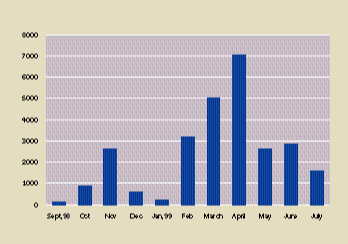
Source: Capital Data Bondware
Performance of main Latin American stock market indices – year to August 1999
Source: Primark Datastream


