
 |
"A marketplace like this will bring to us what may very well be once-in-a-career opportunities" Brett White, CB Richard Ellis |
A conversation with Brett White, chief executive of CB Richard Ellis, brings to mind the Mercer/Arlen lyrics: "Accentuate the positive/eliminate the negative, latch on to the affirmative". For in the face of second-quarter earnings numbers that would cause any chief executive to blench, White sees the proverbial silver lining. He and his team have lived through tough markets, he says. He’s confident the company he leads will come out of the current horror show of a market to be bigger, better and further ahead of the competition. "We believe, as we have in prior downturns, we will likely emerge from this one having captured market share and having put the company in a position where we ought to derive outsized benefits from the recovery we know is coming," he says.
Before CBRE reaps these predicted benefits, it, like its competitors, remains under pressure thanks to the global credit crunch and the economic downturn. Next to investment banking, nowhere has the pinch been felt more profoundly than in real estate. CBRE’s second-quarter numbers are a good illustration of how hard this market has been hit.
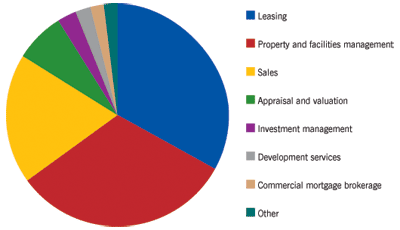
At the end of the second quarter of 2008, the Los Angeles company’s net income was down 88% on the same period in 2007 at $124.6 million. Its biggest business areas have been savaged. In the six months ended June 30, sales are down 38% and revenues from investment management have plummeted 52%. Leasing, which contributes 33% of revenues, is up 5% for the first half but discouragingly down 6% for the second quarter. This key part of CBRE’s business is set to soften further as market conditions and the global economy deteriorate.
In the market as a whole, investment sales are down roughly 50% globally and 60% in the US, in large part because of the disappearance of securitized debt and the standoff in buyer and seller expectations, manifested in the wide bid-offer spreads in property. What had been largely a US and UK problem is spreading to other markets, even Asia-Pacific, where optimism about real estate had remained high. Now that market is showing signs of a slowdown, illustrated by a 23% decline on 2007 in CBRE’s second-quarter 2008 sales figures in that region.
| The difference a year makes | ||
| Change in revenue over a year in $mln | ||
| 2008 | 2007 | |
| Leasing | 436.2 | 465.7 |
| Property and facilities management | 419.7 | 324.4 |
| Sales | 250.2 | 432.1 |
| Appraisal and valuation | 92.4 | 101.2 |
| Investment management | 43.3 | 86.3 |
| Development services | 30.1 | 16.4 |
| Commercial mortgage brokerage | 24.7 | 44.4 |
| Other | 18.3 | 19.9 |
| Source: CB Richard Ellis | ||
White, however, points out that not all the numbers bode ill. "Our revenue has held up pretty well considering the market conditions," he says. "We’re up 6% for the first half of the year and we’ve maintained profitability, albeit at lower levels than the prior 12 months, but profitable nonetheless. We’re particularly proud of our ability to convert revenue in a tough revenue environment to profitability in all of our jurisdictions around the world." Deals such as the $2.9 billion sale of New York’s landmark General Motors building are keeping CBRE on top. Billed as the largest single-building sale of all time, the deal was brokered by CBRE for a group led by Boston Properties. The firm’s capital markets team was behind a few big European deals, too. In January this year it completed the sale and leaseback of Banco Santander’s vast property portfolio with the sale of its Madrid headquarters for $2.8 billion. CBRE also acted for HSBC in the sale and leaseback of its global headquarters in Canary Wharf in London. That deal was worth £1.1 billion ($2.09 billion) and set a record for a single property sale in the UK.
Although CBRE’s investment management business suffers from a dearth of deal flow and a steep drop-off in incentive fees earned, there is some positive news. This year, according to White, CBRE expects to raise $7 billion in equity. Right now it has $44 billion under management, up 17% on the end of 2007. This increase in assets under management enables CBRE to continue to generate revenue, despite the lack of activity.
"While no-one likes to be in a market cycle that’s moving down, we in our management team here have been through these before," says White. "This is the fourth serious market downturn I’ve been through as an employee of CBRE. I don’t like it but my team and I certainly understand it. We know the levers to use to increase efficiency and we know the strategies to employ to increase share and to emerge from the downturn a stronger and better firm, and that’s exactly what we intend to do."
Some of these strategies are already bearing fruit. In the first half, CBRE’s market share of US property sales was 17%. That’s more than double the shares of the number two and three firms combined. "The distance between where we sit at the moment in the US on the capital markets side and our competitors is fairly significant," says White. "And that is a shift from last year. So again this speaks to the fact that in difficult times we tend to accrete share fairly quickly, and that’s absolutely happening."
The company has also shored up its market share in the key global markets of London, Paris and New York. For example, in the first half of 2008 CBRE was responsible for seven of the top 10 largest leasings in New York, the world’s biggest commercial real estate market.
Outsourcing uplift
The number White really likes to talk up, however, is the 29% increase in revenue from CBRE’s outsourcing business. This part of the company now accounts for one-third of revenue. CBRE added 16 new outsourcing clients in the first six months of 2008 and expanded its services with a further 16 corporate accounts.
"When we see economies go into more difficult times, we tend to see the pace of outsourcing increase and, frankly, the pace of outsourcing growth in the past, say, 12 months, has been at record levels," says White. "It’s one part of our full-service platform that allows us to perform fairly well through difficult economic times and it’s one of the strengths of the company."
New outsourcing clients include Dr Pepper Snapple Group, Citi, Zurich, Visa, Nestlé, Oracle, Software AG and Hertz. CBRE has expanded its services to Bank of America, General Electric and BP America. The reason for the boom in outsourcing mandates is that when economic environments become difficult, companies look to increase efficiencies. One way to do that is to outsource non-core activities to third-party providers. Real estate activities, it turns out, are at the top of the list when it comes to outsourcing.
These new mandates mean a lot to CBRE. Nestlé chose CBRE to provide facilities management services to four of its key markets, accounting for almost 7 million square feet. The company is Oracle’s preferred commercial real estate services provider for its 3.8 million square foot EMEA portfolio. And Hertz turned to CBRE to be its global real estate outsourcing provider for all its self-controlled locations in North America and Europe. Winning Citi as a client is another coup. CBRE will act as one of three preferred real estate services advisers for the bank group’s transaction management services in EMEA.
| Range of services keeps CBRE competitive |
| Revenue breakdown for the second quarter of 2008 |
 |
| Source: CB Richard Ellis |
These new outsourcing mandates as well as the renewal and expansion of existing relationships have gone some way to keeping CBRE profitable in these tough times, but to a much lesser extent. Outsourcing alone has not been enough to keep CBRE’s profits at the levels enjoyed last year. White points to CBRE’s platform, which is able to deliver the full complement of real estate services to its international client base, as making the difference in the downturn. To be competitive requires this global platform, a concept that did not exist 15 years ago, when the real estate services industry still retained a local flavour. "The industry has completely changed," says White. "What we now see is that this is a very serious business that requires lots of resources, lots of smart thinking. To compete at the level we’re competing requires, we believe, a wholly owned global platform of hundreds and hundreds of offices around the world and tens of thousands of people all marching to the same play-book, all believing in our way of doing business, our way of providing services, carrying the same card, participating in the same corporate culture."
Early on, CBRE identified the way the real estate services sector was going and set its course. The idea was to move away from the fragmented local real estate services model – thousands of small companies, servicing clients in each market – to the global model White describes.
Jim Didion, former chief executive of what was then CB Commercial, is responsible for the thinking that has put CBRE in the position it is in today. When Didion assembled his senior managers, in 1992, CB Commercial was a big player but nowhere near the size CBRE is today. Didion and his colleagues were interested in setting out a strategy for the company’s growth and direction. The conclusion they reached in 1992 was that the ownership and occupation of commercial real estate would be increasingly driven by multinational owners and multinational occupiers. The decision was made to grow CB Commercial into the kind of real estate services company that reflected their vision of the future of the sector. When Didion announced the senior management’s strategy, it was seen as quite radical.
"As obvious as his ideas sound, I was at the meeting where Jim Didion talked about this, and I remember thinking to myself ‘I’m not sure’," says White. "In the 1990s there was an active and aggressive debate in this industry as to whether there would ever be global capital flows in commercial real estate. And the thing about that today, it sounds absurd, but it was just a few years ago where people were debating: Will you ever see a day where there’s really global capital flows in commercial real estate?"
| "In difficult times we tend to accrete share fairly quickly" Brett White, CB Richard Ellis |
Didion’s strategy has more than simply paid off; it put CBRE firmly at the top of its industry. Today, it boasts in excess of 2 billion square feet under management and more than 400 offices worldwide. It is a Fortune 500 company, the only real estate company on the list. This year it ranked 11th on Business Week’s 50 best-in-class companies from all industries – again, the only real estate company to do so. That CBRE appears on these lists is a sign of its success and an indication of how real estate has grown in importance as an asset class and industry. "Being a member of the Fortune 500 is something we’re very proud of," says White. "It speaks to the seriousness of the industry, it speaks to the fact that companies in this business can be viewed in a global sense, as serious, sustainable, long-term businesses with terrific growth potential. This industry has grown up. It’s matured into something pretty terrific, and we’re extremely proud to be a leader in that industry."
Being the biggest player with a vast global reach makes CBRE attractive to some of the world’s largest corporations seeking real estate services. In CBRE, companies such as Microsoft and AIG can access a one-stop shop for real estate.
"Microsoft is a great example of a global corporate account for us," says White. "Multinational corporations tend to now go to just a couple of firms for provision of services, because the people like those at Microsoft involved in real estate decisions don’t want to have to work through different companies to provide these services to them. They can use a single firm – ours – to provide these services and get done for them what they need to get done."
This year CBRE did the largest lease in Seattle, which was a 650,000 square foot office deal for Microsoft. Then, about 5,000 miles away, it advised Microsoft on the relocation of its primary Netherlands office near Schiphol. CBRE is also overseeing as project manager the build-out in the Schiphol location of 160,000 square feet of office space.
AIG is another example of a client that uses CBRE on a global basis. This year the company negotiated the largest office lease in New York City – 800,000 square feet – for AIG. In Paris, it represented AIG in a 120,000 square feet office requirement at La Défense. Most recently, the insurer has retained CBRE to procure a space for its subsidiaries in Russia.
"Anecdotally these mandates speak to the ability now that multinational corporations have to hire a firm to do work around the world, and to know that firm, CBRE, can provide them the best-in-class people into the markets where they want to work," says White.
Another part of Didion’s legacy is the acquisitions and organic growth that have put CBRE on the ground in what have become key markets, such as China, India and the Middle East. Since 2005, CBRE has acquired 52 businesses worldwide, most recently adding to its presence in Romania, Canada and Australia. Today the company’s Ebitda spread breaks down to 51% from the Americas, 37% in EMEA and 12% in Asia-Pacific. That’s a significant change for CBRE, which as little as five years ago was still generating most of its profits from the US.
"We are in all the geographies that we believe we need to be in and, frankly, have been in those geographies for a while," says White. "We’re not a firm that is trying to figure out where we need to be, we’re already there. We’re a firm that is making decisions around where we think the highest growth opportunities are in the near and mid term and making investments around those opportunities."
| "Being a member of the Fortune 500 is something we’re very proud of. It speaks to the seriousness of the industry" Brett White, CB Richard Ellis |
Those opportunities are in such markets as India and China. The company now has 15 offices in greater China and 1,500 employees there. This June it signed up to a joint venture with Vanke, for residential property management. On the subcontinent, CBRE has a presence in 50 Indian cities, of which seven are full-service offices. The most recent addition is an office in Kolkata. CBRE has the largest property management portfolio in India, covering 55 million square feet. It represents some of the largest multinationals in India, including Cisco, Hewlett-Packard, Barclays and Mercer Consulting. "We see real opportunity, significant growth opportunity, in those areas at the moment, and we’re investing against those opportunities as we speak," says White. "We make those investments in good markets and bad. Our strategy of growing the business is not impaired by the current market, and that’s one of the benefits of being the size we are."
Environmental credentials
Much in the same way that CBRE is maintaining its commitment to growing the business, despite adverse economic conditions, it is keeping its word on environmental matters. In 2007, the company took the decision to reduce its carbon footprint by 2010, which it plans to achieve through reductions and offsets. It has hired London firm ICF International, which is measuring CBRE’s global carbon footprint, a process due to finish in September.
In the meantime, in all of its big facilities worldwide CBRE is working on reducing its carbon footprint by making changes where possible and doing the simple things such as increasing recycling and looking at energy use that can make a big difference. In its new facilities under construction, it is making a concerted effort to be as environmentally sensitive as possible.
"It would be easy to forestall those efforts," says White. "We made a strategic decision last year that we did not want to be a company that talked about sustainability or provided marketing materials around the idea. If we were going to talk about it, we were going to hold ourselves and allow the public and the marketplace to hold us accountable to real targets."
White is cautious when it comes to predicting when the global real estate market will experience a revival. In its second-quarter results presentation, CBRE states that it expects the market to improve in mid-to-late 2009. CBRE expects its outsourcing business to thrive. White points out that in the past four years of booming markets it hasn’t been too difficult to look good. The coming 12 or 18 months are going to be a big test for CBRE and its competitors. White is positive CBRE will not only pass this test but that it will also ultimately strengthen the company.
"A marketplace like this will bring to us what may very well be once-in-a-career opportunities. There’ll be terrific businesses that are under pressure that may make that once-in-a-business-lifecycle decision to sell. There will be clients who, for whatever reason, decide to look at the provision of services differently or new services they want provided to them that they haven’t before. And our job right now is to provide that real differentiated service to our clients."